





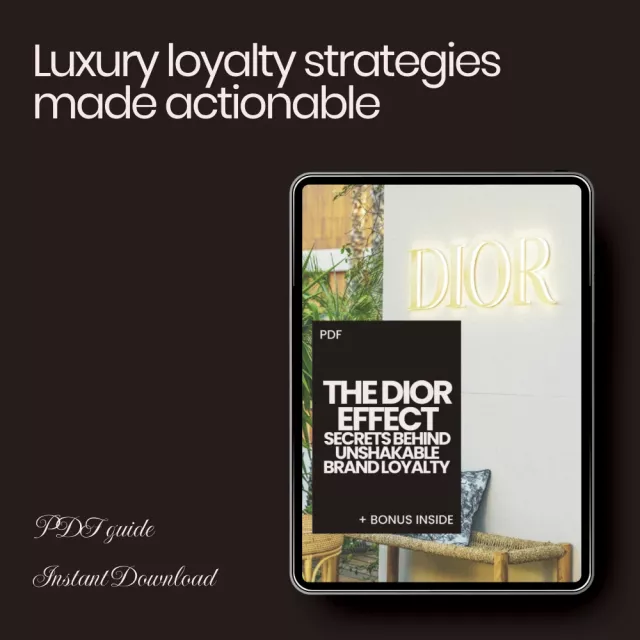
Unlock the Strategy Behind One of the World’s Most Devoted Luxury Followings
What makes customers line up for every launch, defend a brand passionately, and return again and again without hesitation? The Dior Effect: Secrets Behind Unshakable Brand Loyalty reveals exactly how one of the most iconic luxury houses has mastered emotional connection, exclusivity, and modern innovation to create lifelong brand devotion. If you’ve ever wondered how dior builds loyalty and how you can apply those same principles to your own brand, this actionable digital guide gives you the blueprint.
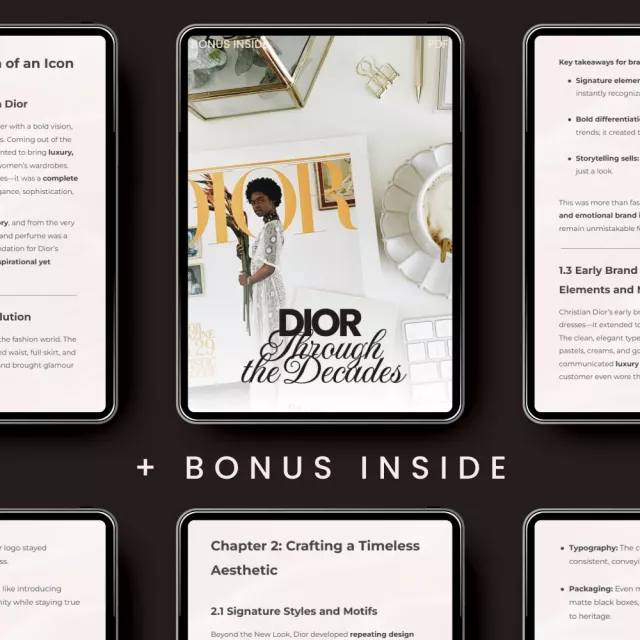
What’s Inside This Digital Guide
- Chapter 1: The Magic of Dior – Understanding Brand Loyalty
- Why Dior Inspires Devotion
- Emotional Connection: Beyond Products
- The Role of Heritage and Storytelling
- Chapter 2: Crafting the Exclusive Experience
- Personalized Service in the Digital Age
- Limited Editions and Scarcity Strategy
- Case Study: Dior’s VIP Customer Programs
- Chapter 3: Modern Tools for Timeless Loyalty
- Leveraging AI for Personalization
- Social Media and Community Building
- Common Mistakes Brands Make with Loyalty
- Chapter 4: Taking Action – Building Your Own Loyalty Blueprint
- Step-by-Step Dior-Inspired Strategy
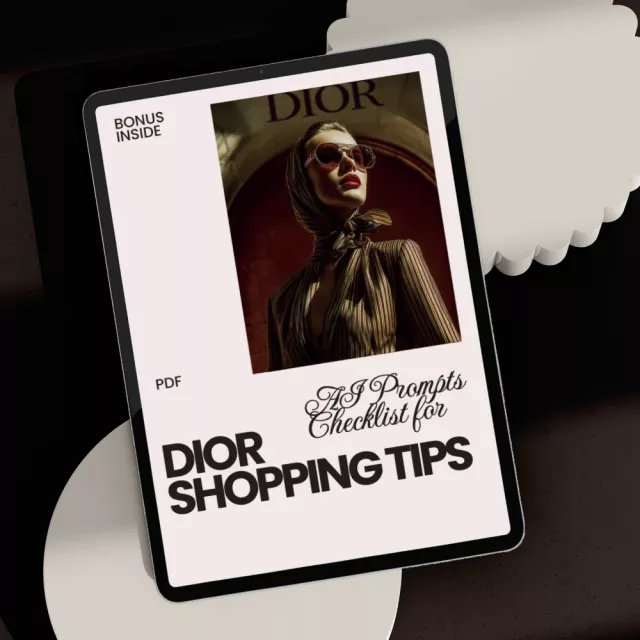
- Practical Prompts for AI Tools
- Next Steps for Small & Emerging Brands
Who Is This For?
This guide is designed for entrepreneurs, boutique owners, personal brands, marketers, content creators, and small or emerging luxury businesses who want to build strong emotional loyalty instead of chasing one-time sales. Whether you run an online store, service-based brand, or creative studio, you’ll learn how dior builds loyalty and how to adapt those principles at any budget level.
Why This Guide Is Different
Unlike generic branding eBooks, this guide goes beyond theory. It breaks down real-world strategies used by a global luxury powerhouse and translates them into clear, practical steps you can apply immediately. You’ll not only understand how dior builds loyalty, but you’ll also receive structured prompts, AI integration ideas, and an actionable blueprint tailored for modern digital brands.
Practical Benefits You’ll Gain
- Build deeper emotional connections with your audience
- Create premium positioning without massive budgets
- Design irresistible limited offers and scarcity strategies
- Implement AI-driven personalization effectively
- Avoid common loyalty mistakes that damage trust
- Develop a clear, repeatable loyalty strategy for long-term growth
Start Building Devotion, Not Just Sales
If you’re ready to transform casual buyers into lifelong brand advocates, The Dior Effect: Secrets Behind Unshakable Brand Loyalty is your next strategic move. Download your digital copy today and discover how dior builds loyalty — then start crafting your own unforgettable brand experience.
SHIPPING
We are proud to offer international shipping services that currently operate in over 200 countries and islands world wide. Nothing means more to us than bringing our customers great value and service. We will continue to grow to meet the needs of all our customers, delivering a service beyond all expectation anywhere in the world.
Do you ship worldwide?
Yes. We provide free shipping to over 200 countries around the world. However, there are some locations we are unable to ship to. If you happen to be located in one of those countries we will contact you.
What about customs?
We are not responsible for any custom fees once the items have been shipped. By purchasing our products, you consent that one or more packages may be shipped to you and may get custom fees when they arrive to your country.
How long does shipping take?
Shipping time varies by location. These are our estimates:| Location | *Estimated Shipping Time |
|---|---|
| United States | 5-20 Business days |
| Canada, Europe | 5-20 Business days |
| Australia, New Zealand | 5-20 Business days |
| Central & South America | 5-25 Business days |
| Asia | 5-20 Business days |
| Africa | 5-25 Business days |
Do you provide tracking information?
Yes, you will receive an email once your order ships that contains your tracking information. If you haven’t received tracking info within 5 days, please contact us.
My tracking says “no information available at the moment”.
For some shipping companies, it takes 2-5 business days for the tracking information to update on the system. If your order was placed more than 5 business days ago and there is still no information on your tracking number, please contact us.
Will my items be sent in one package?
For logistical reasons, items in the same purchase will sometimes be sent in separate packages, even if you've specified combined shipping.
If you have any other questions, please contact us and we will do our best to help you out.
RETURNS
Order cancellation
All orders can be cancelled until they are shipped. If your order has been paid and you need to make a change or cancel an order, you must contact us within 12 hours. Once the packaging and shipping process has started, it can no longer be cancelled.
Refunds
Your satisfaction is our #1 priority. Therefore, you can request a refund or reshipment for ordered products if:
- If you did not receive the product within the guaranteed time (45 days not including 1-3 day processing) you can request a refund or a reshipment.
- If you received the wrong item you can request a refund or a reshipment.
- If you do not want the product you’ve received you may request a refund but you must return the item at your expense and the item must be unused.
We do not issue the refund if:
- Your order did not arrive due to factors within your control (i.e. providing the wrong shipping address)
- Your order did not arrive due to exceptional circumstances outside the control of cyclonica.com (i.e. not cleared by customs, delayed by a natural disaster).
- Other exceptional circumstances outside the control of cyclonica.com.
*You can submit refund requests within 15 days after the guaranteed period for delivery (45 days) has expired. You can do it by sending a message on Contact Us page
If you are approved for a refund, then your refund will be processed, and a credit will automatically be applied to your credit card or original method of payment, within 14 days.
Exchanges
If for any reason you would like to exchange your product, perhaps for a different size in clothing, you must contact us first and we will guide you through the steps.
Please do not send your purchase back to us unless we authorise you to do so.
Order cancellation
All orders can be cancelled until they are shipped. If your order has been paid and you need to make a change or cancel an order, you must contact us within 12 hours. Once the packaging and shipping process has started, it can no longer be cancelled.
Refunds
Your satisfaction is our #1 priority. Therefore, you can request a refund or reshipment for ordered products if:
- If you did not receive the product within the guaranteed time( 45 days not including 2-5 day processing) you can request a refund or a reshipment.
- If you received the wrong item you can request a refund or a reshipment.
- If you do not want the product you’ve received you may request a refund but you must return the item at your expense and the item must be unused.
We do not issue the refund if:
- Your order did not arrive due to factors within your control (i.e. providing the wrong shipping address)
- Your order did not arrive due to exceptional circumstances outside the control of cyclonica.com (i.e. not cleared by customs, delayed by a natural disaster).
- Other exceptional circumstances outside the control of
*You can submit refund requests within 15 days after the guaranteed period for delivery (45 days) has expired. You can do it by sending a message on Contact Us page
If you are approved for a refund, then your refund will be processed, and a credit will automatically be applied to your credit card or original method of payment, within 14 days.
Exchanges
If for any reason you would like to exchange your product, perhaps for a different size in clothing. You must contact us first and we will guide you through the steps.
Please do not send your purchase back to us unless we authorise you to do so.
Customer Reviews
Write a Review
We Think You’ll Love
Top picks just for you













The framing that loyalty starts with emotion, not admiration, hit differently.
I run a small accessories brand and Chapter 2.3 on Dior's VIP program was eye-opening. The idea that early collection access and atelier invitations create deeper loyalty than any discount completely changed how I think about rewarding my top customers. Already planning a pre-order window exclusively for my regulars.
🌹💛✨
Six months ago I was struggling to understand why my boutique had good sales but terrible repeat business — customers would buy once and disappear. I downloaded this guide expecting generic advice but the section on emotional touchpoints in Chapter 1.2 made me realize I had zero post-purchase connection. Dior sends personalized notes and craftsmanship stories with orders; I was sending a plain receipt. I started writing a short story card for each product explaining how and why it was made, and within two months my repeat purchase rate climbed noticeably. The section in Chapter 3.3 on neglecting post-purchase engagement felt like it was written about me specifically. This guide didn't just explain Dior's strategy — it gave me a diagnosis.
Chapter 2.2 explained why limited-edition drops create urgency without cheapening the brand.
The five-step loyalty blueprint in Chapter 4.1 is deceptively simple and genuinely actionable. 'Build communities, not just customer lists' sounds obvious until you realize most brands, including mine, do exactly the opposite 🎯 The AI prompts in Section 4.2 are a practical bonus — I used the sentiment analysis one last week.
The Dior Insider campaign example made community-building feel achievable, not just aspirational.
The breakdown of Dior's scarcity strategy in Section 2.2 is something every brand should study before launching a limited edition. The distinction between a strategic capsule drop and just calling something 'limited' is subtle but the guide captures it clearly. Applying the same logic to exclusive colorways for high-tier clients is a tactic I hadn't seriously considered before.
The section on AI personalization in Chapter 3.1 is genuinely strong — the breakdown of predictive recommendations, virtual stylists, and sentiment analysis gives a clear framework for what's possible even without a large budget. I particularly liked how the guide positions AI as a loyalty accelerator rather than a replacement for human connection, which is a nuanced and important distinction. The practical tip about small fashion brands using recommendation engines to create Dior-level experiences was encouraging. My one gripe is that the AI prompt examples in Section 4.2 felt surface-level — three prompts is a good start, but I wanted a wider range across different customer lifecycle stages. Still, one of the more grounded guides on luxury loyalty I've come across.
Over-reliance on discounts destroying luxury brand perception — finally someone said it plainly.
The craftsmanship storytelling element in Chapter 1.2 opened my eyes to how much narrative work goes into sustaining a brand like Dior. Telling the story behind each product — not just what it is but how and why it was made — is a loyalty strategy disguised as marketing ✨ Chapter 4's advice to celebrate milestones with your community extends this beautifully.
Blending archival designs with modern collections as a heritage loyalty tool — genuinely insightful.
I want to give this the review it deserves because it genuinely changed the direction of my brand. I've been building a premium skincare line for three years, and my biggest frustration was that customers loved our products but showed no loyalty — they'd switch to competitors the moment anyone ran a promotion. I had assumed the problem was pricing, but this guide reframed it entirely. The section in Chapter 1.1 about people not just buying a product but buying into a story and a sense of belonging made me audit everything we were doing. We had no story. Our social media was product-focused, our emails were transactional, and our so-called loyalty program was just a points system. Chapter 2.3 on Dior's VIP program showed me what real loyalty architecture looks like: early access, behind-the-scenes invitations, hyper-personalized recommendations. We can't do atelier visits, but we started sending handwritten cards to top customers with early access codes, and the response was immediate and surprisingly emotional. The section on AI in Chapter 3.1 helped me identify affordable tools that let us segment customers by purchase behavior and send genuinely tailored product suggestions. Chapter 3.3's warning about one-size-fits-all personalization felt like a direct callout of exactly what we had been doing. I also appreciated that Chapter 4.3 specifically addresses emerging brands — so many guides like this assume you're already operating at scale. The final thought that Dior loyalty is built from emotion, exclusivity, storytelling, and smart technology is now pinned above my desk.
Strong on strategy, though more depth on digital-to-physical loyalty bridges would help.
Heritage treated as an active loyalty mechanism — not just brand backstory — is the guide's sharpest insight. The idea that Dior weaves Christian Dior's founder story into modern campaigns makes the case that any brand's history is an asset waiting to be activated. Chapter 4.1's opening step, 'Know Your Story,' now feels like the foundation everything else rests on.
The chatbot and virtual stylist section bridges convenience and in-store luxury service elegantly.
Chapter 3.2 on social media and community building is the section I've revisited most. The framing of loyalty as belonging rather than purchases reorients your entire content strategy 💡 The note about influencer collaborations needing to feel authentic rather than transactional is one of those reminders you need to hear every few months.
👑🔒❤️
The loyalty mistakes section in Chapter 3.3 is worth the download on its own — the warning about over-relying on discounts is one that many DTC fashion brands ignore at their peril. The point about post-purchase engagement being where most brands fall apart is accurate and under-discussed. Dropping a star only because the guide could go deeper on how to practically recover customer relationships once you've already fallen into those traps.
Treating celebrity endorsements as loyalty instruments, not just awareness tools — a real distinction.
I've worked in luxury retail for eight years and read more brand strategy guides than I can count. What makes this one stand out is how it connects Dior's mechanisms — VIP programs, scarcity strategy, heritage storytelling — to a framework any brand can actually apply, rather than simply celebrating Dior as an untouchable case study. The section on AI-driven sentiment analysis in Chapter 3.1, framed as a tool for responding proactively to customer emotions, was something I hadn't encountered described that way before. The AI prompt examples in Section 4.2 are basic but serve as solid starting points for teams who haven't integrated AI into their CRM workflows yet. I've since shared this guide with three colleagues building their own labels, and all three found the Chapter 4 blueprint immediately applicable to where they are right now.
The scarcity section goes beyond 'create demand' and explains the emotional logic — exclusive colorways for high-tier clients rewards loyalty rather than just manufacturing hype. That distinction matters a lot 🔑 Chapter 2's whole approach to crafting the exclusive experience is the strongest part of the guide.
Exclusive event invitations as a loyalty currency — Chapter 2 reframes access beautifully.
There's genuinely useful material here — the emotional connection framework in Chapter 1.2 and the VIP program case study in 2.3 are both well-explained and applicable. Chapter 4's five-step blueprint is a solid starting point. That said, for anyone already familiar with luxury brand strategy, most of this covers familiar ground without going deep enough to surface new insights, and the AI sections stay conceptual when practical worked examples would make them substantially more valuable.
Chapter 1 made it clear — brands aren't selling products, they're selling belonging.
The warning against one-size-fits-all personalization is something every CRM manager needs to revisit regularly. Generic personalization is arguably worse than none — it signals you're going through the motions 📌 The pro tip about using AI to predict churn and optimize communication timing makes the whole chapter feel practical rather than aspirational.
Useful framework, but the social media section needed more depth beyond Instagram and TikTok.
I picked this guide up during a rough patch with my clothing brand — we had just lost a significant chunk of repeat customers after a pricing change and I was trying to understand what had broken. The framing in Chapter 1.1 that loyalty starts with emotion and a sense of belonging, not just products, helped me understand why the pricing change had felt like a betrayal to some customers rather than just a business decision. We had never invested in making customers feel part of something, so when we changed the terms, there was nothing holding them. Chapter 2.1 on personalized service in the digital age was an eye-opener — dedicated stylists and digital consultations sound like Dior-level luxury, but the guide makes a convincing case that even small brands can simulate this with smart AI tools and thoughtful email automation. Section 3.1's breakdown of predictive recommendations, virtual stylists, and sentiment analysis gave me a concrete toolbox I didn't know was accessible at smaller budgets. The warning in Chapter 3.3 about neglecting post-purchase engagement was the most personally confronting section — we had genuinely treated the sale as the end of the relationship. We've since rebuilt our post-purchase email sequence with craftsmanship storytelling and personalized follow-ups inspired by Section 1.2, and our reactivation rate has improved meaningfully. Chapter 4.3's advice for small and emerging brands is exactly what I needed — specific, grounded, and realistic about scale without being dismissive of ambition. The final thought about emotion, exclusivity, storytelling, and technology as the four pillars of lasting loyalty is something I return to whenever I'm making a brand decision.
The 'build communities not customer lists' line in Chapter 4 is the whole point.
What this guide does better than most is show loyalty as a system, not a program. The five-step blueprint in Chapter 4.1 links story, emotional touchpoints, exclusivity, data, and continuous engagement into something coherent rather than a checklist. Reading chapters 1 and 4 back to back gives you a clear picture of what a loyalty-oriented brand looks like versus one that's just collecting email addresses.
Never thought of sentiment analysis as a loyalty tool until Chapter 3.1 reframed it.
Chapters 1 and 2 are the strongest sections here — the emotional connection framework and the scarcity strategy are both well-explained and directly applicable to building a premium brand. The case study on Dior's VIP programs in Section 2.3 is particularly good. Chapter 3 loses some momentum; the social media section covers familiar ground for most brand builders, and the mistakes in 3.3, while accurate, are fairly standard advice. A stronger guide than most in this space, just not a complete one.
The distinction this guide draws between loyalty through exclusivity and loyalty through discounting is something brands at every level need to internalize. Chapter 3.3 is direct about it: luxury customers value experience over price cuts, and chasing retention through promotions is a long-term brand erosion strategy. I've seen this play out firsthand with a client whose constant sale events trained customers to wait for discounts and never buy at full price. The section on Dior's VIP access model in Chapter 2.3 — early collections, behind-the-scenes invitations, atelier visits — shows what the alternative looks like when executed well 🏆 Chapter 4.2's AI prompt examples are simple but sparked several more that I've built into our client engagement playbook.
The post-purchase engagement warning in Chapter 3.3 is the reminder every brand owner needs.
Chapter 2.3 reads like a masterclass in what loyalty architecture actually looks like in practice. Early access to new collections, atelier visits, AI-predicted preferences — each element reinforces the others rather than existing in isolation. The insight that even small brands can simulate VIP experiences through smart email automation and AI tools is the most practically useful line in the guide.
The core argument — that loyalty is built on emotion, exclusivity, and storytelling rather than discounts — is sound and clearly explained. The first two chapters are well-structured and the Dior Insider campaign example is a good one. But the guide thins out considerably in chapters 3 and 4, where the AI sections stay surface-level and the advice for small brands feels rushed given how much setup the earlier chapters provide. Worth reading, but you'll likely want a deeper resource alongside it.
⭐⭐⭐⭐⭐🙌