





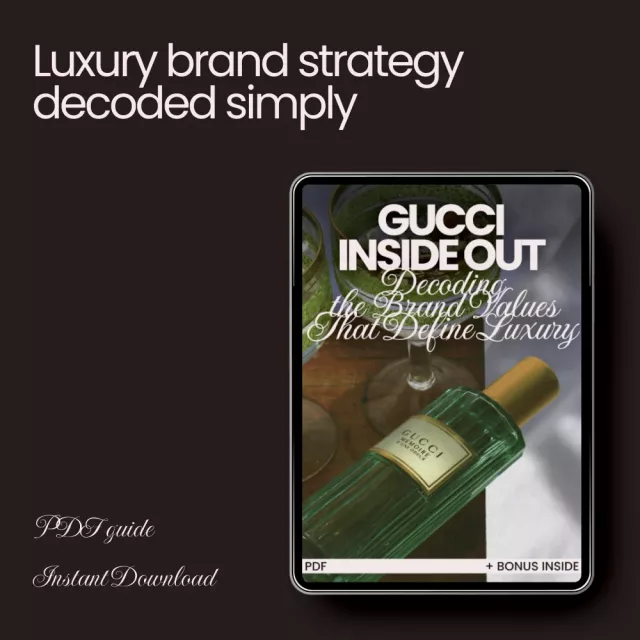
Discover What Truly Defines Modern Luxury
What makes Gucci more than just a fashion house? Why does the brand continue to dominate conversations around creativity, culture, and luxury? Gucci Inside Out: Decoding the Brand Values That Define Luxury is your deep dive into the philosophy, strategy, and creative power behind one of the world’s most iconic brands. This digital guide goes beyond surface-level analysis and delivers gucci brand values explained in a way that is practical, inspiring, and easy to apply to your own projects.
What’s Inside This Digital Guide
This professionally structured guide breaks down Gucci’s brand framework into clear, actionable insights:
- Chapter 1: The Heart of Gucci – Understanding Its Core Values
- Heritage and Craftsmanship: The DNA of Luxury
- Innovation Meets Tradition: How Gucci Balances Old and New
- Sustainability and Responsibility: Modern Luxury with a Conscience
- Chapter 2: Gucci in Action – How Values Shape Design and Marketing
- Bold Creativity: The Signature Gucci Style
- Brand Storytelling: From Runways to Social Media
- Case Study: Gucci’s “Off The Grid” Collection
- Chapter 3: Common Brand Missteps and How to Avoid Them
- Diluting the Brand: Overextension and Misalignment
- Misreading the Market: The Risks of Trend-Chasing
- How AI Can Help: Trend Analysis and Consumer Insights
- Chapter 4: Bringing Gucci Values into Your Own Projects
- Translating Values into Design and Messaging
- AI-Powered Inspiration: Tools for Fashion Innovation
- Next Steps: Learning from Gucci without Copying
Who This Guide Is For
This guide is perfect for fashion entrepreneurs, branding students, content creators, designers, marketers, and luxury enthusiasts who want gucci brand values explained in a clear, strategic format. Whether you’re building your own label, refining your brand identity, or studying high-end marketing, this resource helps you understand how strong values translate into long-term brand power.
Why This Guide Is Different
Unlike generic fashion summaries, this guide connects theory with real-world application. You won’t just learn what Gucci stands for—you’ll understand how those values influence product design, campaigns, sustainability initiatives, and digital storytelling. It also explores how AI tools can support creative research and consumer insight, making this guide modern, relevant, and forward-thinking.
- Clear breakdown of luxury branding principles
- Real case study analysis
- Practical exercises and strategic insights
- Actionable steps you can apply immediately
- Instant digital download for immediate access
What You’ll Gain
- Clarity on what truly builds a luxury brand
- Confidence in translating brand values into design and messaging
- Insight into avoiding common branding mistakes
- Strategic inspiration without copying competitors
If you’ve ever wanted gucci brand values explained in a way that actually helps you create, strategize, and innovate, this guide is your shortcut.
SHIPPING
We are proud to offer international shipping services that currently operate in over 200 countries and islands world wide. Nothing means more to us than bringing our customers great value and service. We will continue to grow to meet the needs of all our customers, delivering a service beyond all expectation anywhere in the world.
Do you ship worldwide?
Yes. We provide free shipping to over 200 countries around the world. However, there are some locations we are unable to ship to. If you happen to be located in one of those countries we will contact you.
What about customs?
We are not responsible for any custom fees once the items have been shipped. By purchasing our products, you consent that one or more packages may be shipped to you and may get custom fees when they arrive to your country.
How long does shipping take?
Shipping time varies by location. These are our estimates:| Location | *Estimated Shipping Time |
|---|---|
| United States | 5-20 Business days |
| Canada, Europe | 5-20 Business days |
| Australia, New Zealand | 5-20 Business days |
| Central & South America | 5-25 Business days |
| Asia | 5-20 Business days |
| Africa | 5-25 Business days |
Do you provide tracking information?
Yes, you will receive an email once your order ships that contains your tracking information. If you haven’t received tracking info within 5 days, please contact us.
My tracking says “no information available at the moment”.
For some shipping companies, it takes 2-5 business days for the tracking information to update on the system. If your order was placed more than 5 business days ago and there is still no information on your tracking number, please contact us.
Will my items be sent in one package?
For logistical reasons, items in the same purchase will sometimes be sent in separate packages, even if you've specified combined shipping.
If you have any other questions, please contact us and we will do our best to help you out.
RETURNS
Order cancellation
All orders can be cancelled until they are shipped. If your order has been paid and you need to make a change or cancel an order, you must contact us within 12 hours. Once the packaging and shipping process has started, it can no longer be cancelled.
Refunds
Your satisfaction is our #1 priority. Therefore, you can request a refund or reshipment for ordered products if:
- If you did not receive the product within the guaranteed time (45 days not including 1-3 day processing) you can request a refund or a reshipment.
- If you received the wrong item you can request a refund or a reshipment.
- If you do not want the product you’ve received you may request a refund but you must return the item at your expense and the item must be unused.
We do not issue the refund if:
- Your order did not arrive due to factors within your control (i.e. providing the wrong shipping address)
- Your order did not arrive due to exceptional circumstances outside the control of cyclonica.com (i.e. not cleared by customs, delayed by a natural disaster).
- Other exceptional circumstances outside the control of cyclonica.com.
*You can submit refund requests within 15 days after the guaranteed period for delivery (45 days) has expired. You can do it by sending a message on Contact Us page
If you are approved for a refund, then your refund will be processed, and a credit will automatically be applied to your credit card or original method of payment, within 14 days.
Exchanges
If for any reason you would like to exchange your product, perhaps for a different size in clothing, you must contact us first and we will guide you through the steps.
Please do not send your purchase back to us unless we authorise you to do so.
Order cancellation
All orders can be cancelled until they are shipped. If your order has been paid and you need to make a change or cancel an order, you must contact us within 12 hours. Once the packaging and shipping process has started, it can no longer be cancelled.
Refunds
Your satisfaction is our #1 priority. Therefore, you can request a refund or reshipment for ordered products if:
- If you did not receive the product within the guaranteed time( 45 days not including 2-5 day processing) you can request a refund or a reshipment.
- If you received the wrong item you can request a refund or a reshipment.
- If you do not want the product you’ve received you may request a refund but you must return the item at your expense and the item must be unused.
We do not issue the refund if:
- Your order did not arrive due to factors within your control (i.e. providing the wrong shipping address)
- Your order did not arrive due to exceptional circumstances outside the control of cyclonica.com (i.e. not cleared by customs, delayed by a natural disaster).
- Other exceptional circumstances outside the control of
*You can submit refund requests within 15 days after the guaranteed period for delivery (45 days) has expired. You can do it by sending a message on Contact Us page
If you are approved for a refund, then your refund will be processed, and a credit will automatically be applied to your credit card or original method of payment, within 14 days.
Exchanges
If for any reason you would like to exchange your product, perhaps for a different size in clothing. You must contact us first and we will guide you through the steps.
Please do not send your purchase back to us unless we authorise you to do so.
Customer Reviews
Write a Review
We Think You’ll Love
Top picks just for you











The way this breaks down heritage versus innovation changed everything. I thought maintaining tradition meant resisting new ideas, but it shows how Gucci does both—now I see the framework everywhere.
Finally understand why the green-red-green stripe isn't just pretty—it's their DNA.
The case study on how Gucci avoids diluting the brand through overextension is required reading. Shows why their Disney and North Face collaborations work when so many partnerships fail.
Best explanation of brand values I've found.
Thought I knew luxury before this. The section on perceived exclusivity—how Gucci maintains it without gatekeeping—was genuinely eye-opening.
The framework for translating values into design decisions is practical without being preachy. Gives you an actual checklist instead of abstract advice.
The Epilogue collection breakdown as theatrical fashion stuck with me. Makes you see how boldness comes from conviction, not accident.
Loved the storytelling section but wished for more social media examples.
The Off The Grid collection analysis made sustainability feel achievable instead of preachy.
Spent years not understanding why some luxury brands resonate and others feel hollow. This nailed it—hollow brands skip the values part entirely. After reading about Alessandro Michele's eclectic style stemming from actual creative conviction, I redesigned my entire brand identity. Every product decision now references core values instead of chasing trends. Customer response has been remarkable.
Shows exactly why diluting a brand kills loyalty.
Excellent breakdown of trend-setting versus trend-chasing, though wished for deeper examples of brands that failed.
Finally someone explaining brand values without buzzwords.
Before this, thought my brand was failing because I wasn't chasing trends fast enough. Turns out I was chasing the wrong ones. Gucci doesn't follow trends—it filters them through heritage and creativity. Applied that lens and suddenly everything clicked. Social media engagement doubled, and I'm now attracting customers who value my philosophy, not just the aesthetic.
GG monogram explained in a way that actually clicked 🔥
Love how this gives actionable frameworks instead of just describing Gucci. The part about using AI to analyze historical collections while staying true to brand DNA is something I'm implementing immediately.
The sustainability section is strong, but wished it expanded more on the challenges Gucci faced implementing carbon neutrality.
Alessandro Michele section is pure gold.
Stuck between wanting to innovate and being afraid to lose heritage. This showed me those aren't opposing forces. The breakdown of balancing old and new gave me permission to experiment within brand DNA. Tested bolder colors and unexpected materials while keeping signature details. Customers responded better than to the 'safe' collections I was making before.
Carbon neutrality and bold design can coexist—finally explained.
The AI angle isn't gimmicky—it's actually strategic about using predictive analytics before investing in full production.
The concept of emotional versus transactional connections in storytelling resonated deeply. Gucci's campaigns feel like short films for a reason—building relationship, not just moving inventory.
Good foundation but oversimplifies how brands navigate sustainability pressure.
The practical brand value checklist at the end made me actually use this instead of just reading it. Created a poster for my design team—referenced it before every project launch. Reduced scope creep and finally feels like building a brand instead of collecting cool-looking things.
Explains perceived exclusivity perfectly.
Run a small sustainable fashion brand and kept trying to compete on price and speed—guaranteeing failure. Reading how Gucci positions sustainability as core identity, not a 'green line,' rewired my strategy entirely. Repositioned everything around supply chain story: small batch, slow, traceable materials. Within six months, loyalty increased, margins improved, and I felt proud instead of constantly stressed.
The framework for applying Gucci values to your own work without copying them is strongest. It's not 'do what Gucci does' but 'apply their thinking to your DNA.'
Maximalism section hits different.
Strong content though some case studies feel dated.
The brand storytelling section connects every touchpoint—runways, social media, craftsmanship narrative. Gucci doesn't sell products; it sells narrative. Stopped treating channels separately and started thinking as one coherent story.
Makes me look at collaborations completely differently now.
I'm a brand strategist and every time I recommend brand identity work, clients ask for proof. This guide is my new resource. Breaking down real Gucci decisions and connecting them to core values gives my recommendations actual weight. Already recommended to five brands—all fundamentally changed how they approach business.
Supply chain transparency angle actually useful 💚
Read dozens of brand strategy books—most oversimplify heritage versus innovation. This untangles it with real examples. The actionable checklist at the end changed things most. Used it to evaluate three product lines: killed one, repositioned two. Internal clarity alone is valuable.
✨💚❤️💎
Every designer should read this immediately.
Clear breakdown of overextension and misalignment.
The section on how Gucci filters trends through heritage and creativity instead of following blindly shows why other brands fail at this balance. Applied that framework and everything clicked.
🎨👑✨🔥
Was stuck between wanting innovation and fearing heritage loss. Shows those aren't opposing. The detailed breakdown gave permission to experiment within brand DNA. Tested bolder approaches while keeping signature elements—customers loved it more than safe collections.
💫👗💚