





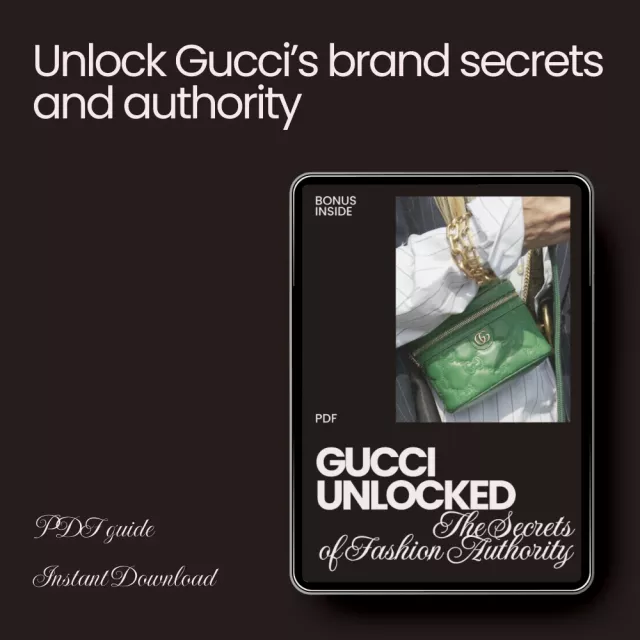
Discover the Secrets Behind Gucci’s Unmatched Fashion Authority
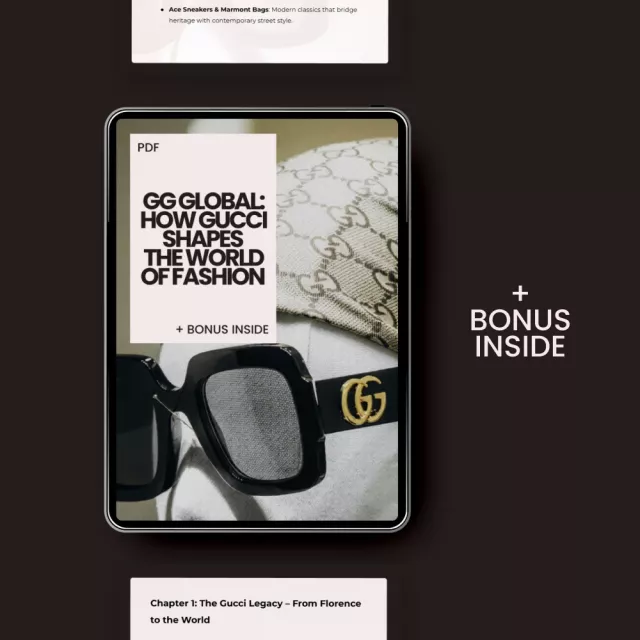
Step into the world of one of the most renowned luxury brands in fashion with Gucci Unlocked: The Secrets of Fashion Authority. This comprehensive guide unpacks the essence of what makes the Gucci brand synonymous with high-end fashion, uncovering the strategies, marketing genius, and brand authority that have established Gucci as a global icon. Whether you’re an aspiring designer, a fashion enthusiast, or simply someone looking to understand the mechanics of luxury branding, this guide offers invaluable insights that you can apply to your own journey.
What’s Inside This Exclusive Guide?
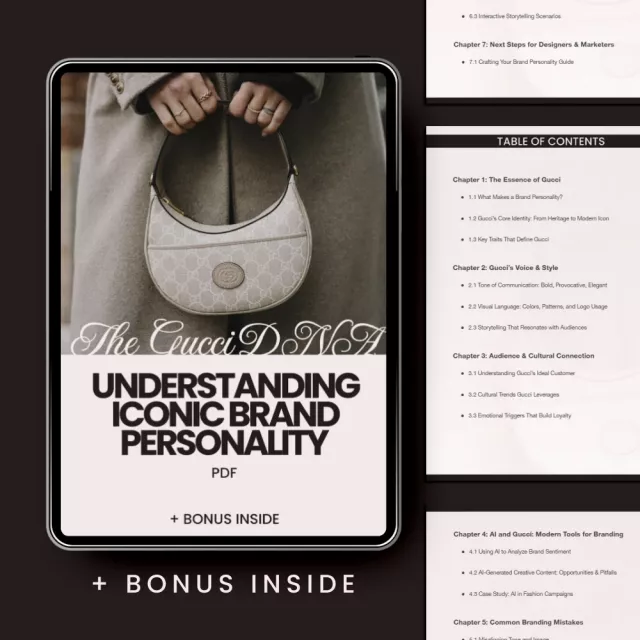
- Chapter 1: The Power of the Gucci Name – Learn about Gucci’s rich legacy, its signature style, and the key factors that make Gucci an elite luxury brand.
- Chapter 2: Gucci in Action – Marketing and Influence – Dive into iconic Gucci campaigns, celebrity endorsements, and the cutting-edge role of AI in fashion marketing.
- Chapter 3: Common Pitfalls in Building Brand Authority – Avoid common mistakes that luxury brands make, and understand the difference between original authority and copycat branding.
- Chapter 4: Building Your Own Brand Authority (Gucci-Inspired) – Get actionable steps for building your own fashion brand, using AI to craft your brand voice, and creating a brand that stands out.
Practical Benefits of Downloading This Guide
- Unlock the secrets of the Gucci brand authority explained – Gain a deeper understanding of the principles that drive Gucci’s continued success.
- Learn how Gucci has built and maintained its reputation – Discover the marketing and influence strategies that keep Gucci on top.
- Gain actionable steps for building your own brand – Use the lessons learned from Gucci to create a lasting impact in the fashion industry.
- Stay ahead of trends – Learn how AI and innovative technologies can enhance your brand’s reach and authenticity.
Who Is This Guide For?
Whether you’re an aspiring fashion brand owner, a marketer looking to understand luxury branding, or simply a Gucci enthusiast who wants to explore the secrets of its success, this guide is for you. Gucci Unlocked: The Secrets of Fashion Authority offers a deep dive into what makes Gucci an industry leader and provides actionable advice on how you can apply these principles to your own projects.
Why Choose This Guide?
Unlike other digital resources, this guide doesn’t just offer surface-level insights. It takes you inside the workings of Gucci’s brand authority with in-depth analyses, real-life case studies, and strategies that have shaped the fashion world. Plus, with actionable steps and clear examples, you can start implementing the lessons right away to build your own fashion brand authority.
Ready to Build Your Own Fashion Empire?
Don’t miss out on the opportunity to learn from one of the most successful fashion houses in the world. Download Gucci Unlocked: The Secrets of Fashion Authority today and start mastering the art of brand authority. Whether you’re looking to create your own luxury brand or simply want to understand what makes Gucci so irresistible, this guide is your ultimate resource!
SHIPPING
We are proud to offer international shipping services that currently operate in over 200 countries and islands world wide. Nothing means more to us than bringing our customers great value and service. We will continue to grow to meet the needs of all our customers, delivering a service beyond all expectation anywhere in the world.
Do you ship worldwide?
Yes. We provide free shipping to over 200 countries around the world. However, there are some locations we are unable to ship to. If you happen to be located in one of those countries we will contact you.
What about customs?
We are not responsible for any custom fees once the items have been shipped. By purchasing our products, you consent that one or more packages may be shipped to you and may get custom fees when they arrive to your country.
How long does shipping take?
Shipping time varies by location. These are our estimates:| Location | *Estimated Shipping Time |
|---|---|
| United States | 5-20 Business days |
| Canada, Europe | 5-20 Business days |
| Australia, New Zealand | 5-20 Business days |
| Central & South America | 5-25 Business days |
| Asia | 5-20 Business days |
| Africa | 5-25 Business days |
Do you provide tracking information?
Yes, you will receive an email once your order ships that contains your tracking information. If you haven’t received tracking info within 5 days, please contact us.
My tracking says “no information available at the moment”.
For some shipping companies, it takes 2-5 business days for the tracking information to update on the system. If your order was placed more than 5 business days ago and there is still no information on your tracking number, please contact us.
Will my items be sent in one package?
For logistical reasons, items in the same purchase will sometimes be sent in separate packages, even if you've specified combined shipping.
If you have any other questions, please contact us and we will do our best to help you out.
RETURNS
Order cancellation
All orders can be cancelled until they are shipped. If your order has been paid and you need to make a change or cancel an order, you must contact us within 12 hours. Once the packaging and shipping process has started, it can no longer be cancelled.
Refunds
Your satisfaction is our #1 priority. Therefore, you can request a refund or reshipment for ordered products if:
- If you did not receive the product within the guaranteed time (45 days not including 1-3 day processing) you can request a refund or a reshipment.
- If you received the wrong item you can request a refund or a reshipment.
- If you do not want the product you’ve received you may request a refund but you must return the item at your expense and the item must be unused.
We do not issue the refund if:
- Your order did not arrive due to factors within your control (i.e. providing the wrong shipping address)
- Your order did not arrive due to exceptional circumstances outside the control of cyclonica.com (i.e. not cleared by customs, delayed by a natural disaster).
- Other exceptional circumstances outside the control of cyclonica.com.
*You can submit refund requests within 15 days after the guaranteed period for delivery (45 days) has expired. You can do it by sending a message on Contact Us page
If you are approved for a refund, then your refund will be processed, and a credit will automatically be applied to your credit card or original method of payment, within 14 days.
Exchanges
If for any reason you would like to exchange your product, perhaps for a different size in clothing, you must contact us first and we will guide you through the steps.
Please do not send your purchase back to us unless we authorise you to do so.
Order cancellation
All orders can be cancelled until they are shipped. If your order has been paid and you need to make a change or cancel an order, you must contact us within 12 hours. Once the packaging and shipping process has started, it can no longer be cancelled.
Refunds
Your satisfaction is our #1 priority. Therefore, you can request a refund or reshipment for ordered products if:
- If you did not receive the product within the guaranteed time( 45 days not including 2-5 day processing) you can request a refund or a reshipment.
- If you received the wrong item you can request a refund or a reshipment.
- If you do not want the product you’ve received you may request a refund but you must return the item at your expense and the item must be unused.
We do not issue the refund if:
- Your order did not arrive due to factors within your control (i.e. providing the wrong shipping address)
- Your order did not arrive due to exceptional circumstances outside the control of cyclonica.com (i.e. not cleared by customs, delayed by a natural disaster).
- Other exceptional circumstances outside the control of
*You can submit refund requests within 15 days after the guaranteed period for delivery (45 days) has expired. You can do it by sending a message on Contact Us page
If you are approved for a refund, then your refund will be processed, and a credit will automatically be applied to your credit card or original method of payment, within 14 days.
Exchanges
If for any reason you would like to exchange your product, perhaps for a different size in clothing. You must contact us first and we will guide you through the steps.
Please do not send your purchase back to us unless we authorise you to do so.
Customer Reviews
Write a Review
We Think You’ll Love
Top picks just for you














The brand authority framework — expertise, consistency, exclusivity — gave me a lens I now apply to every business decision I make.
The #GucciGram campaign breakdown showed exactly how blending art with fashion creates cultural momentum.
Chapter 3 on common pitfalls was the most valuable section — the overextension and inconsistent messaging warnings hit close to home 🔥
The copycat branding versus original authority distinction finally gave me words for something I'd been sensing in my own industry.
Strong guide on brand-building principles. The celebrity endorsement section covering the Harry Styles case study was effective, but the AI marketing chapter stayed conceptual without showing real outputs or results. The pitfalls chapter is where the actionable insight lives — especially the warning about flooding the market and diluting exclusivity.
The hypothetical case study about a luxury brand losing its edge by partnering with low-end retailers was a cautionary tale I needed.
Concise and applicable even outside fashion.
✨🔥⭐💎👜
The four actionable steps in Chapter 4 — define your story, master your craft, stay consistent, engage influencers smartly — became the backbone of my brand strategy. I printed them and pinned them above my desk. The section on how brand authority is perceived leadership and trust, not just popularity, was the reframe I'd been missing after years of chasing follower counts.
The social listening tip for tracking sentiment in real time was immediately actionable.
The heritage storytelling point — that every Gucci collection ties back to Italian roots — inspired me to weave my own origin story into everything I produce.
Smart, dense, and zero filler.
The AI image recognition tip for tracking signature elements online and spotting counterfeits was a detail no other guide covers.
Good analysis of Gucci's authority-building. The AI sections across chapters cover trend prediction, content creation, and virtual try-ons but stay high-level — I wanted specific tool recommendations or case studies showing measurable results from AI-driven campaigns. The brand pitfalls chapter is the strongest and most original section.
The point about quality and experience needing to match the image you project stopped me from launching too early.
That line about authority coming from authenticity, not imitation, should be tattooed on every brand founder's arm 👌
Chapter 1 on the power of the Gucci name was the most insightful brand history I've read. Understanding that brand authority is built slowly through consistent quality, strong vision, and cultural relevance reframed my entire timeline expectations. I'd been rushing to scale when I should have been deepening craft and story.
The prompt example for a Gen Z luxury handbag campaign was surprisingly useful.
The missteps section — overextending, ignoring cultural shifts, inconsistent messaging — read like a diagnostic checklist for my own brand.
Finished in one sitting and immediately audited my brand touchpoints.
The celebrity endorsement section explained how partnerships shape perception of status and exclusivity. The Harry Styles example showed the direct link between a single event appearance and measurable social media engagement spikes — that cause-and-effect clarity is rare in branding guides.
❤️👌🔥⭐✨👜
The innovation plus tradition balance is the single most useful concept in here.
The fast-fashion copycat case study was sharp — imitation without authenticity or craftsmanship can never produce real authority.
Solid branding resource. The Chapter 4 section on using AI to craft a consistent brand voice covers social posts, customer interaction analysis, and audience prediction but doesn't go deep enough on any single application to be immediately usable. The pitfalls and authority chapters more than compensate.
The controlled growth advice in the case study about brands losing their edge was the warning I needed before expanding too fast.
The distinction between popularity and authority was the foundation the whole guide builds on, and it landed perfectly.
The four-step implementation roadmap in Chapter 4 — audit, set goals, implement AI tools, iterate — gave me a structure I've been following for three months now. My brand engagement is up and my messaging finally feels cohesive.
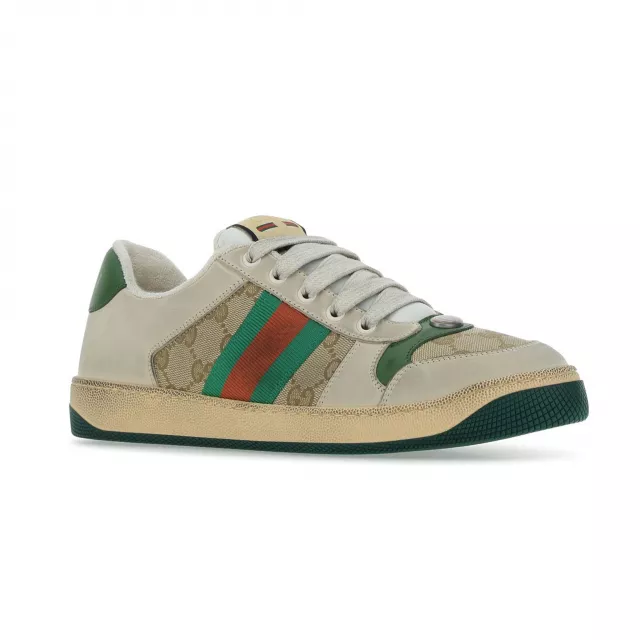
The signature style section on GG monogram, green-red-green stripe, and statement accessories was clean and effective.
The pitfalls chapter alone is worth the download 🎯
I run a small accessories brand and this guide reshaped how I think about every touchpoint. The section on brand authority as expertise, consistency, and exclusivity gave me three pillars I now evaluate against monthly. The copycat branding warning in Chapter 3 made me realize I'd been unconsciously mimicking competitors instead of developing my own design language. The AI prompt for generating Instagram captions for a luxury sustainable launch was the first AI tool I actually used in my workflow — it produced drafts I could edit rather than starting from blank. The hypothetical case study about a brand flooding the market pushed me to cancel a product line expansion that would have diluted my positioning. Six months later my brand perception surveys show measurable improvement.
The heritage storytelling concept — tying collections back to origin — changed my content calendar.
The guide treats brand-building as a long game, which is refreshing.
The section on how campaigns should create experiences rather than just sell products reframed my entire marketing approach. I redesigned my next product launch as a storytelling event instead of a sales page and saw three times the engagement.
The AI sentiment tracking tip for catching PR issues early is something I set up immediately.
Practical, well-structured, and applicable beyond fashion.
Good exploration of authority-building principles using Gucci as the lens. Some overlap between the AI tips scattered across chapters — trend prediction, content creation, and virtual try-ons appear in both Chapter 2 and Chapter 4 without much new depth the second time. The brand pitfalls and copycat branding sections are the most original contributions.
The point about ensuring influencer partnerships align with brand values saved me from a collaboration I would have regretted.
The legacy chapter made me realize my brand had quality but no story — now it has both.
The prompt example for sustainable handbag captions gave my team a starting framework we still use.
I've read dozens of branding books and this guide distills the core principles better than most of them. The expertise-consistency-exclusivity framework for brand authority is simple enough to remember and specific enough to act on. The Chapter 3 pitfalls — overextension, cultural ignorance, messaging inconsistency — read like a field guide for avoiding the exact mistakes I've watched other founders make. The fast-fashion copycat case study was the perfect illustration of why authenticity outperforms imitation every time. I shared the four actionable steps from Chapter 4 with my co-founder and we restructured our brand strategy around them within a week.
The hypothetical brand-losing-its-edge scenario was more instructive than most real case studies.
Short enough to finish in an afternoon, dense enough to reference for months.
The observation that luxury brands thrive on creating experiences rather than selling products hit differently after reading the campaign examples 🔥
The visual identity section — GG monogram, bold patterns, statement accessories — was a clear primer on recognizable design.
Useful content on brand authority and common mistakes. The AI sections mention social listening, sentiment analysis, and content generation without naming specific tools or showing before-and-after results. The principles in Chapters 1 and 3 are strong enough to carry the guide on their own, and the implementation roadmap in Chapter 4 gives a clear path forward.
The iterate step in the implementation roadmap reminded me that authority is maintained, not achieved once.
Every chapter had at least one insight I hadn't found in other brand-building resources.
The cultural shifts warning — failing to embrace sustainability or diversity — is increasingly relevant for any brand in any industry.
The expertise-consistency-exclusivity triad is now my brand's operating framework.
The GucciGram case study showed how digital art collaborations build cultural capital without traditional advertising.
I'd been treating my brand like a product line instead of a personality — this guide fixed that.
The quality-is-non-negotiable step sounds obvious but watching it explained through Gucci's century-long commitment to craftsmanship gave it real weight.
The copycat versus original authority section was confronting in the best way — I recognized patterns in my own work that needed to change. The message that authority comes from authenticity pushed me to develop a signature aesthetic instead of referencing competitors.
Applied the touchpoint audit to my brand and found three major inconsistencies in one afternoon.
👜🔥✨⭐❤️💎
Clean writing, strong structure, and actionable throughout.
The measurable goals step — tracking authority, engagement, and perception — turned vague branding aspirations into concrete targets I review monthly.