





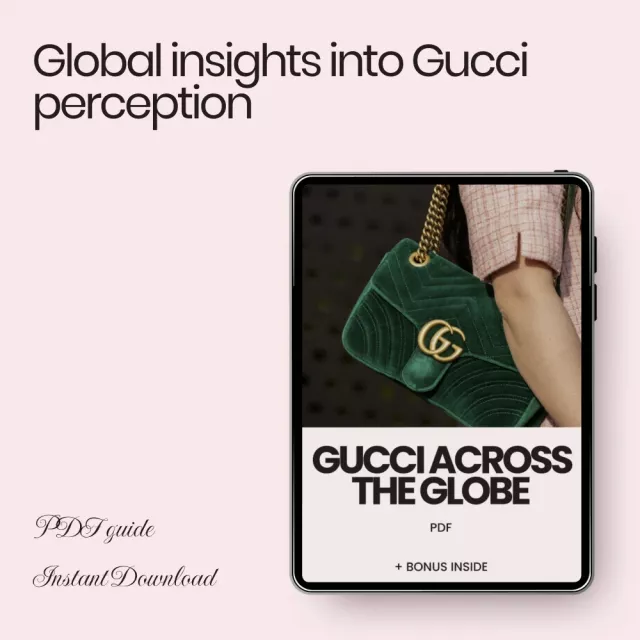
Understand Luxury Beyond Borders
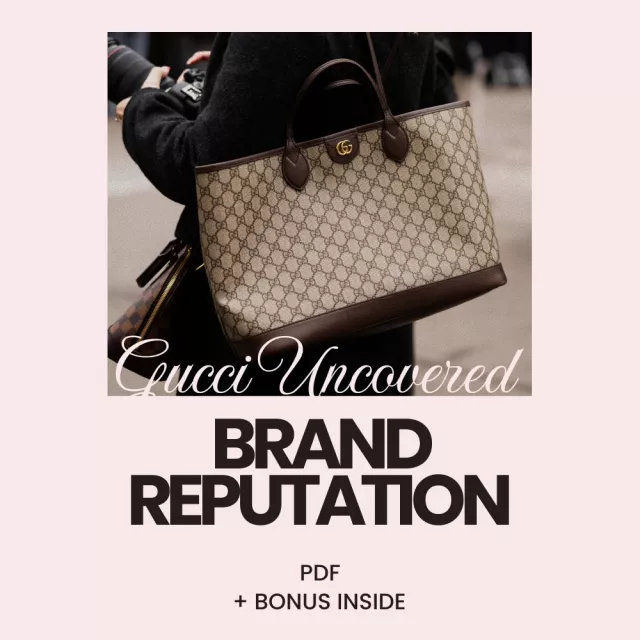
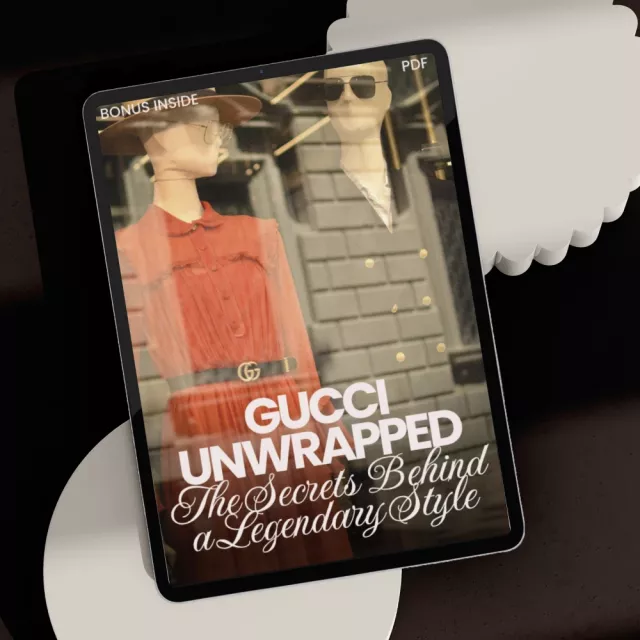
Gucci Across the Globe is a powerful, insight-packed ebook designed for brand strategists, fashion professionals, marketers, and luxury enthusiasts who want to truly understand gucci perception in different countries. Luxury is never one-size-fits-all. What signals status in New York may represent heritage in Rome, exclusivity in Tokyo, or opulence in Dubai. This comprehensive digital guide breaks down how cultural nuance, social identity, AI-driven analytics, and market psychology shape the way Gucci is seen around the world.
If you work in branding, fashion marketing, retail strategy, or are simply fascinated by global luxury culture, this ebook delivers practical, research-driven clarity in a simple, engaging format.
What’s Inside the Ebook?
- Chapter 1: A deep dive into Gucci’s global icon status, brand identity, and its influence on luxury culture.
- Chapter 2: A country-by-country breakdown of gucci perception in different countries across North America, Europe, Asia, the Middle East, Africa, and Latin America.
- Chapter 3: Cultural nuances, symbolism, logos, and social signals that shape consumer interpretation.
- Chapter 4: Real-world case studies including Japan, Italy, and the United States.
- Chapter 5: Global marketing strategy insights, AI-powered digital tactics, and influencer positioning.
- Chapter 6: Common international branding mistakes and how to avoid dilution or cultural missteps.
- Chapter 7: The future of luxury perception through predictive analytics, AI social listening, and virtual experiences.
- Chapter 8: Practical steps for conducting a market perception audit and integrating AI into brand strategy.
Who Is This For?
This ebook is ideal for:
- Luxury brand managers and marketing professionals
- Fashion business students and researchers
- Digital strategists and AI marketing consultants
- Entrepreneurs entering international luxury markets
- Anyone studying gucci perception in different countries
Why This Guide Is Different
Unlike generic fashion marketing ebooks, Gucci Across the Globe blends cultural psychology, real consumer insights, and AI-driven forecasting into one actionable resource. It doesn’t just describe trends—it explains why perceptions differ and how to strategically respond. You’ll gain frameworks you can apply immediately to global campaigns, positioning, and brand audits.
- Clear global comparison frameworks
- Practical AI integration strategies
- Real case studies with cultural context
- Action-oriented checklists and next steps
The Benefits You’ll Gain
- Confidently tailor marketing campaigns to local sensibilities
- Avoid costly cultural branding mistakes
- Understand status signaling across continents
- Use AI insights to predict luxury consumer behavior
- Build globally consistent yet locally relevant brand messaging
Instant Digital Download
This is a digital download ebook, giving you immediate access after purchase. No waiting. No shipping. Start exploring global luxury insights within minutes.
If you want a deeper understanding of gucci perception in different countries and a practical roadmap for navigating international luxury markets, this is your competitive edge.
Download Gucci Across the Globe today and elevate your global brand strategy.
SHIPPING
We are proud to offer international shipping services that currently operate in over 200 countries and islands world wide. Nothing means more to us than bringing our customers great value and service. We will continue to grow to meet the needs of all our customers, delivering a service beyond all expectation anywhere in the world.
Do you ship worldwide?
Yes. We provide free shipping to over 200 countries around the world. However, there are some locations we are unable to ship to. If you happen to be located in one of those countries we will contact you.
What about customs?
We are not responsible for any custom fees once the items have been shipped. By purchasing our products, you consent that one or more packages may be shipped to you and may get custom fees when they arrive to your country.
How long does shipping take?
Shipping time varies by location. These are our estimates:| Location | *Estimated Shipping Time |
|---|---|
| United States | 5-20 Business days |
| Canada, Europe | 5-20 Business days |
| Australia, New Zealand | 5-20 Business days |
| Central & South America | 5-25 Business days |
| Asia | 5-20 Business days |
| Africa | 5-25 Business days |
Do you provide tracking information?
Yes, you will receive an email once your order ships that contains your tracking information. If you haven’t received tracking info within 5 days, please contact us.
My tracking says “no information available at the moment”.
For some shipping companies, it takes 2-5 business days for the tracking information to update on the system. If your order was placed more than 5 business days ago and there is still no information on your tracking number, please contact us.
Will my items be sent in one package?
For logistical reasons, items in the same purchase will sometimes be sent in separate packages, even if you've specified combined shipping.
If you have any other questions, please contact us and we will do our best to help you out.
RETURNS
Order cancellation
All orders can be cancelled until they are shipped. If your order has been paid and you need to make a change or cancel an order, you must contact us within 12 hours. Once the packaging and shipping process has started, it can no longer be cancelled.
Refunds
Your satisfaction is our #1 priority. Therefore, you can request a refund or reshipment for ordered products if:
- If you did not receive the product within the guaranteed time (45 days not including 1-3 day processing) you can request a refund or a reshipment.
- If you received the wrong item you can request a refund or a reshipment.
- If you do not want the product you’ve received you may request a refund but you must return the item at your expense and the item must be unused.
We do not issue the refund if:
- Your order did not arrive due to factors within your control (i.e. providing the wrong shipping address)
- Your order did not arrive due to exceptional circumstances outside the control of cyclonica.com (i.e. not cleared by customs, delayed by a natural disaster).
- Other exceptional circumstances outside the control of cyclonica.com.
*You can submit refund requests within 15 days after the guaranteed period for delivery (45 days) has expired. You can do it by sending a message on Contact Us page
If you are approved for a refund, then your refund will be processed, and a credit will automatically be applied to your credit card or original method of payment, within 14 days.
Exchanges
If for any reason you would like to exchange your product, perhaps for a different size in clothing, you must contact us first and we will guide you through the steps.
Please do not send your purchase back to us unless we authorise you to do so.
Order cancellation
All orders can be cancelled until they are shipped. If your order has been paid and you need to make a change or cancel an order, you must contact us within 12 hours. Once the packaging and shipping process has started, it can no longer be cancelled.
Refunds
Your satisfaction is our #1 priority. Therefore, you can request a refund or reshipment for ordered products if:
- If you did not receive the product within the guaranteed time( 45 days not including 2-5 day processing) you can request a refund or a reshipment.
- If you received the wrong item you can request a refund or a reshipment.
- If you do not want the product you’ve received you may request a refund but you must return the item at your expense and the item must be unused.
We do not issue the refund if:
- Your order did not arrive due to factors within your control (i.e. providing the wrong shipping address)
- Your order did not arrive due to exceptional circumstances outside the control of cyclonica.com (i.e. not cleared by customs, delayed by a natural disaster).
- Other exceptional circumstances outside the control of
*You can submit refund requests within 15 days after the guaranteed period for delivery (45 days) has expired. You can do it by sending a message on Contact Us page
If you are approved for a refund, then your refund will be processed, and a credit will automatically be applied to your credit card or original method of payment, within 14 days.
Exchanges
If for any reason you would like to exchange your product, perhaps for a different size in clothing. You must contact us first and we will guide you through the steps.
Please do not send your purchase back to us unless we authorise you to do so.
Customer Reviews
Write a Review
We Think You’ll Love
Top picks just for you













The section on Asian markets alone was worth the download.
I work in luxury retail and this gave me a new framework for thinking about regional perception. The breakdown of how logos read differently — status signal in Seoul versus gauche in more understated markets — clicked instantly. The AI tools section is a real add.
Didn't expect this much depth in a free PDF.
I've been managing social campaigns for a premium fashion label for three years, and most of what I was doing was guessing. I read this in one sitting and immediately rethought how we were approaching a South Korean launch — we had been leaning hard on Western celebrity content. After reading the cultural nuances around Japan and Korea, I pushed for understated creative and micro-influencer seeding instead. The engagement results on the revised campaign were noticeably stronger. The AI social listening section gave me the exact framing I needed to start asking our tools smarter questions.
Crisp and actionable. No fluff.
The cultural lenses framework is something I've been trying to articulate for years. Italy and France want heritage, Korea and China want logos and exclusivity, the US wants pop culture — laid out plainly and with enough context to actually use. Sharing this with my whole team 🤝
The Dionysus bag example made the AI analytics argument land perfectly.
Really solid overview of how luxury brand perception shifts across markets. The AI analytics section is where it shines — predictive trend analysis, social listening dashboards, image recognition for tracking logo visibility in different regions. My only note is that the Africa and Latin America section felt noticeably thinner than the others and deserves deeper treatment.
The market perception audit steps are immediately usable 🗺️
I teach a brand strategy module at a business school and I've been searching for a resource that bridges global luxury marketing with practical AI applications — most academic materials are either too theoretical or too surface-level. This guide threads that needle well. I've already assigned the regional market breakdown and the digital marketing section as supplementary reading for my students. They particularly responded to the comparison between macro-celebrity campaigns and micro-influencer strategies — the trade-off between reach and authenticity resonated with what they've observed on their own feeds. The China capsule collection example is exactly the kind of concrete case study that makes abstract strategy stick.
The virtual try-on and AR campaign ideas toward the end are where luxury is clearly headed. The Tokyo sneaker concept sparked three ideas for a project I'm currently working on. Really forward-thinking content.
Short and dense — a bit thin on implementation but worth the read.
What stood out most was the nuance around logo visibility — overt display as a status signal in some markets, seen as gauche in others. I'd treated this as obvious, but seeing it paired with the AI image recognition angle made me realize we're not tracking it nearly well enough.
🌍✨💼
Concise and globally minded — rare combo.
There's real substance here, especially the cultural perception breakdown and the AI sentiment analysis angle. The Japan and Italy case studies are the strongest parts. That said, much of the AI content reads like a brief introduction rather than a how-to — if you already work with social listening platforms, you'll find it stops short of where you need it to go.
The overexposure and brand dilution warning is something more brands need to hear.
I've been consulting independently for about two years after leaving a luxury goods company, and this PDF landed right before a pitch I was preparing for a client entering the Japanese market. I had good instincts about the preference for understatement over logo-heavy branding, but hadn't framed it in terms of AI-driven trend tracking. That reframe helped me position my strategy as data-informed rather than intuitive. The client loved it 🎯 The market perception audit framework gave me a three-step structure I'm now using as a repeatable onboarding tool. Would have taken me weeks to build that from scratch.
The example prompts for AI social listening tools are useful starting points — formatted like you'd actually paste them into a system, not just described in the abstract.
Solid entry point into luxury market analysis, though some sections could go deeper 📊
Gucci's 1921 Florence origin to global AI strategy — that arc is well told.
The celebrity versus micro-influencer trade-off is framed better here than in most full-length marketing books. Macro builds awareness, micro builds trust — and AI can match you to the right micro-influencers for your exact demographic. That's a concrete, actionable loop.
🔥💎🌏👜
The strength of this guide is its breadth — it covers a lot of territory well, from brand origins and identity to regional market nuances to AI applications. The cultural section is particularly well-constructed, and I found the distinction between overt logo display and understated luxury useful for a workshop I was running recently. Where I found myself wanting more was the AI content — virtual try-ons and personalized recommendations are named but not explored in terms of implementation or cost. For someone who already understands AI at a surface level, this doesn't get much further than that. A stronger how-to layer would make this a genuinely advanced resource rather than a confident overview.
The Harry Styles collaboration as an example of how Gucci shapes lifestyle and art — not just fashion — was a small detail that opened up a much bigger point. Luxury perception is built in the culture, not at the point of sale.
Exactly what I needed before a client meeting on global expansion.
The brand dilution warning should be required reading for any label even considering discounting or mass-market distribution. The link between overexposure and erosion of luxury perception is made quickly but clearly.
Great regional depth, though the Middle East section could have been expanded.
I picked this up somewhat skeptically — I've read a lot of luxury brand content and most of it either over-romanticizes heritage or chases trend without substance. This guide surprised me. I'm a brand director at a fashion accessories company, and we've been struggling with the exact tension named here directly: how do you maintain prestige when you're actively trying to grow? The brand dilution section put into words something our team had been circling around for months — limit availability and prioritize storytelling over volume sounds simple, but paired with the AI monitoring piece it becomes a real strategy rather than a platitude. The regional breakdown is useful as orientation, though the Asia section is by far the strongest. The point about rare items functioning as pure status signals in Chinese and Korean markets tracks exactly with what we see in our own sales data. What I took away most was the market perception audit framework 🧭 I've adapted those three steps into our quarterly brand health review, mapping perception by region across heritage, status, trendiness, and exclusivity. For a free PDF this punches well above its weight.
Clean framework, real examples. Doesn't waste your time.
The sentiment analysis use case for tracking how Western celebrity campaigns land differently across Asian and European markets — I've seen that exact mismatch play out badly in real campaigns. Glad someone wrote it down clearly.
🌐👌✨