





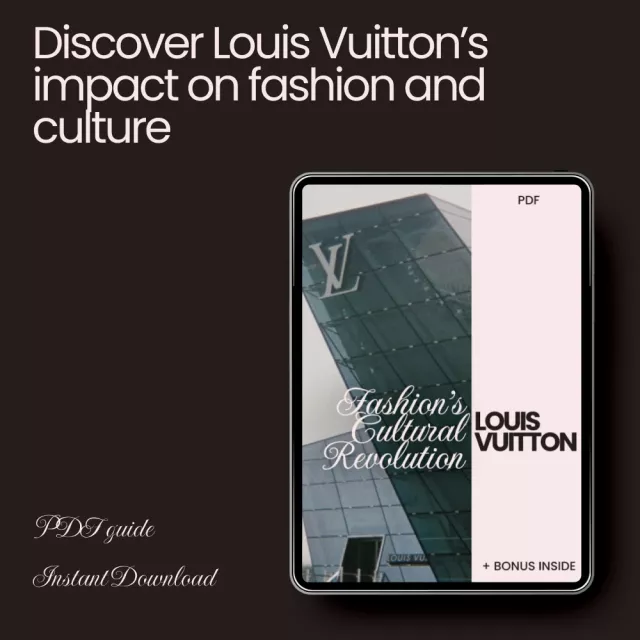
Unlock the Legacy of Louis Vuitton – A Must-Have Guide for Fashion Enthusiasts
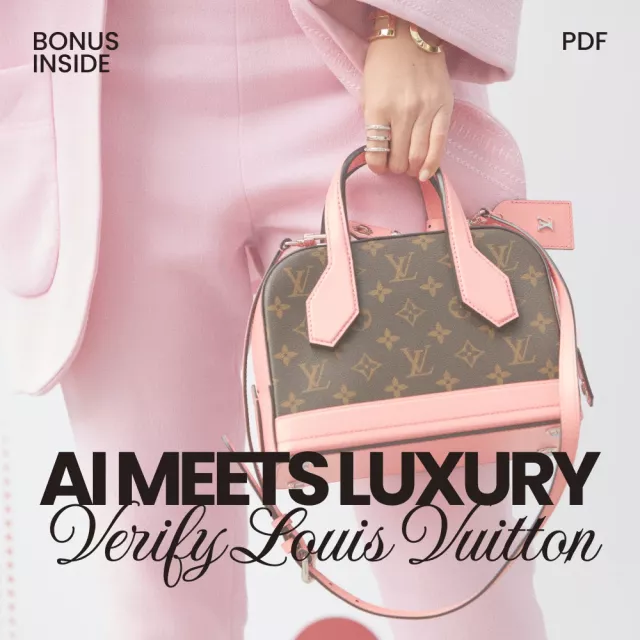
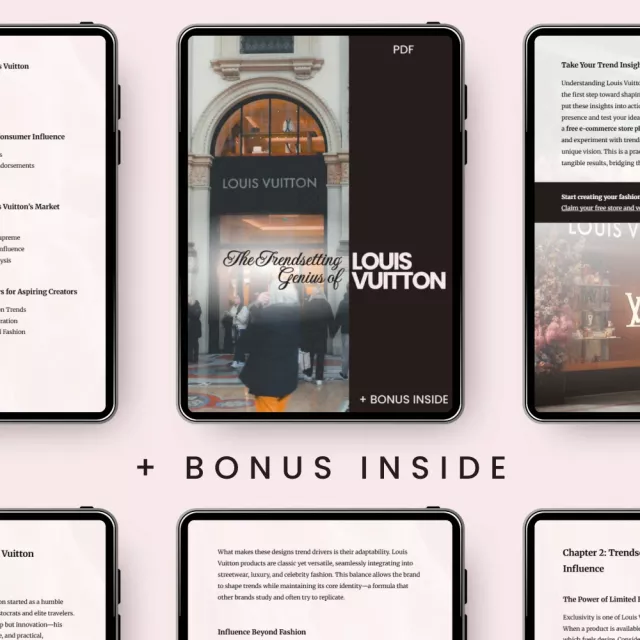
Step into the world of luxury and style with “Louis Vuitton: Fashion’s Cultural Revolution,” an eBook that takes you on a captivating journey through the history, influence, and cultural impact of Louis Vuitton (LV). Whether you’re a fashion lover, aspiring designer, or simply a fan of iconic brands, this guide will show you why Louis Vuitton is a key player in shaping modern fashion culture. Explore the philosophy behind LV’s designs, the evolution of its signature styles, and the ways LV has influenced everything from streetwear to celebrity fashion.
This detailed guide is packed with insights, expert analysis, and interactive exercises that will inspire you to understand LV’s far-reaching impact. From its iconic monogram to high-profile collaborations, learn how Louis Vuitton has shaped global fashion trends and continues to dominate the cultural conversation.
- Chapter 1: Introduction – The Legacy of Louis Vuitton – Discover the origins of an icon and the philosophy that continues to influence modern fashion.
- Chapter 2: Signature Styles and Iconic Creations – Delve into LV’s most recognizable designs, including the Monogram, bags, accessories, and limited-edition releases.
- Chapter 3: Case Studies – LV’s Cultural Footprint – Explore LV’s influence on celebrity fashion, streetwear, and marketing genius.
- Chapter 4: Common Missteps and What to Avoid – Learn how to avoid misusing LV products and steer clear of counterfeit culture.
- Chapter 5: AI and Fashion – Learning from Louis Vuitton – Get insights on how artificial intelligence is transforming the fashion world, inspired by LV’s innovations.
- Chapter 6: Interactive Exercises and Prompts – Engage with creative prompts, including mood board creation and cultural analysis, to apply LV’s influence to your own style.
- Chapter 7: Next Steps – Bringing LV Influence into Your Life – Learn how to incorporate LV’s luxury aesthetics into your everyday fashion and build your personal brand with cultural awareness.
Why This eBook Is Different
“Louis Vuitton: Fashion’s Cultural Revolution” is more than just a fashion guide – it’s an immersive experience. Unlike other digital resources, this eBook goes beyond the surface-level history of Louis Vuitton by diving into the brand’s influence on modern culture and providing actionable steps for applying its principles to your own life. Whether you’re looking to learn from LV’s marketing genius or gain a deeper understanding of its role in shaping global fashion, this guide has you covered.
Who is this eBook for? Whether you’re a fashion professional, a designer, or someone fascinated by luxury brands, this guide will help you understand Louis Vuitton’s powerful influence on fashion culture and how it continues to shape trends today. With easy-to-follow exercises and insightful chapters, this eBook is perfect for anyone eager to dive deeper into the world of high fashion.
Get Your Copy Today!
Don’t miss out on the opportunity to explore Louis Vuitton’s lasting impact on fashion culture. Download “Louis Vuitton: Fashion’s Cultural Revolution” now and start your journey into the world of luxury fashion. Whether you’re looking to understand LV’s history or apply its influence to your personal style, this guide will equip you with the knowledge to elevate your fashion game.
Download your copy now and start your fashion revolution!
SHIPPING
We are proud to offer international shipping services that currently operate in over 200 countries and islands world wide. Nothing means more to us than bringing our customers great value and service. We will continue to grow to meet the needs of all our customers, delivering a service beyond all expectation anywhere in the world.
Do you ship worldwide?
Yes. We provide free shipping to over 200 countries around the world. However, there are some locations we are unable to ship to. If you happen to be located in one of those countries we will contact you.
What about customs?
We are not responsible for any custom fees once the items have been shipped. By purchasing our products, you consent that one or more packages may be shipped to you and may get custom fees when they arrive to your country.
How long does shipping take?
Shipping time varies by location. These are our estimates:| Location | *Estimated Shipping Time |
|---|---|
| United States | 5-20 Business days |
| Canada, Europe | 5-20 Business days |
| Australia, New Zealand | 5-20 Business days |
| Central & South America | 5-25 Business days |
| Asia | 5-20 Business days |
| Africa | 5-25 Business days |
Do you provide tracking information?
Yes, you will receive an email once your order ships that contains your tracking information. If you haven’t received tracking info within 5 days, please contact us.
My tracking says “no information available at the moment”.
For some shipping companies, it takes 2-5 business days for the tracking information to update on the system. If your order was placed more than 5 business days ago and there is still no information on your tracking number, please contact us.
Will my items be sent in one package?
For logistical reasons, items in the same purchase will sometimes be sent in separate packages, even if you've specified combined shipping.
If you have any other questions, please contact us and we will do our best to help you out.
RETURNS
Order cancellation
All orders can be cancelled until they are shipped. If your order has been paid and you need to make a change or cancel an order, you must contact us within 12 hours. Once the packaging and shipping process has started, it can no longer be cancelled.
Refunds
Your satisfaction is our #1 priority. Therefore, you can request a refund or reshipment for ordered products if:
- If you did not receive the product within the guaranteed time (45 days not including 1-3 day processing) you can request a refund or a reshipment.
- If you received the wrong item you can request a refund or a reshipment.
- If you do not want the product you’ve received you may request a refund but you must return the item at your expense and the item must be unused.
We do not issue the refund if:
- Your order did not arrive due to factors within your control (i.e. providing the wrong shipping address)
- Your order did not arrive due to exceptional circumstances outside the control of cyclonica.com (i.e. not cleared by customs, delayed by a natural disaster).
- Other exceptional circumstances outside the control of cyclonica.com.
*You can submit refund requests within 15 days after the guaranteed period for delivery (45 days) has expired. You can do it by sending a message on Contact Us page
If you are approved for a refund, then your refund will be processed, and a credit will automatically be applied to your credit card or original method of payment, within 14 days.
Exchanges
If for any reason you would like to exchange your product, perhaps for a different size in clothing, you must contact us first and we will guide you through the steps.
Please do not send your purchase back to us unless we authorise you to do so.
Order cancellation
All orders can be cancelled until they are shipped. If your order has been paid and you need to make a change or cancel an order, you must contact us within 12 hours. Once the packaging and shipping process has started, it can no longer be cancelled.
Refunds
Your satisfaction is our #1 priority. Therefore, you can request a refund or reshipment for ordered products if:
- If you did not receive the product within the guaranteed time( 45 days not including 2-5 day processing) you can request a refund or a reshipment.
- If you received the wrong item you can request a refund or a reshipment.
- If you do not want the product you’ve received you may request a refund but you must return the item at your expense and the item must be unused.
We do not issue the refund if:
- Your order did not arrive due to factors within your control (i.e. providing the wrong shipping address)
- Your order did not arrive due to exceptional circumstances outside the control of cyclonica.com (i.e. not cleared by customs, delayed by a natural disaster).
- Other exceptional circumstances outside the control of
*You can submit refund requests within 15 days after the guaranteed period for delivery (45 days) has expired. You can do it by sending a message on Contact Us page
If you are approved for a refund, then your refund will be processed, and a credit will automatically be applied to your credit card or original method of payment, within 14 days.
Exchanges
If for any reason you would like to exchange your product, perhaps for a different size in clothing. You must contact us first and we will guide you through the steps.
Please do not send your purchase back to us unless we authorise you to do so.
Customer Reviews
Write a Review
We Think You’ll Love
Top picks just for you
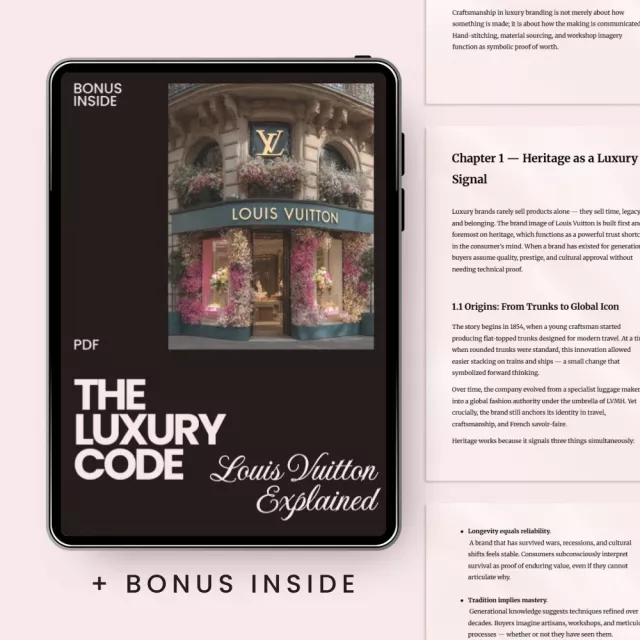












The Virgil Abloh case study alone made this worth downloading.
I study fashion marketing and this connected dots I hadn't seen before. The breakdown of how LV uses scarcity to build cultural hype — limited editions creating conversation, not just sales — gave me a framework I've already applied to a client pitch. The AI trend forecasting section was a bonus I didn't expect from a fashion PDF.
Smart take on why monogram canvas became a global shorthand for luxury.
Read it cover to cover on a flight to Paris and landed feeling like I understood the city's fashion DNA differently. The section on how LV's campaigns sell a lifestyle rather than a product reframed how I think about my own brand's visual storytelling. Practical, not pretentious.
The cultural footprint table is a clean snapshot of how one brand shapes entire decades. Useful for anyone building a marketing deck or studying brand longevity. I just wish the table extended further back — the pre-2018 era of LV collaborations is equally fascinating and would have added depth.
Finally a fashion PDF that respects the reader's intelligence 🤌
The counterfeit culture section hit different.
Solid overview with real cultural analysis, not just brand worship. The styling mistakes table in Chapter 4 is practical and the AI integration sections feel current. Took a star off because the exercises in Chapter 6 feel more like prompts for beginners than anything someone with design experience would use.
👜🔥📚✨
Over-branding vs. understated luxury — that distinction clicked for me here.
The way this traces LV from trunk maker to cultural architect is compelling. I'd been collecting pieces for years without understanding the heritage behind them, and reading about the 1854 origins and how the flat-top trunk was a design innovation made me appreciate what I own on a completely different level. Showed the origins section to my partner and now he gets why I care about craftsmanship over logos.
Sent the AI prompt examples to my entire design team.
Clean writing, good structure, no fluff between chapters.
The section on streetwear integration explains something I've watched happen in real time but never had language for. LV didn't chase youth culture — they invited it in on their own terms. That reframe alone was valuable for how I think about my brand's audience expansion.
I appreciated the historical context and the campaign analysis is genuinely useful. But the AI sections feel bolted on rather than woven into the fashion narrative. Chapter 5 reads like a separate whitepaper about tech that happens to mention LV. Would've preferred the AI content integrated more organically throughout.
Context in fashion statements — such an underrated concept 💫
Quick read with substance. Rare combo.
The mood board exercise pushed me to actually do something creative instead of just reading about fashion theory. Built one in Canva using the steps from Chapter 6 and it became the visual anchor for a freelance branding project I was struggling with. Having the LV philosophy as a creative constraint — balance tradition with innovation — gave my work a coherence it was missing. My client noticed immediately and asked what changed in my process. I told her I studied a trunk maker from 1854.
Good primer on LV's cultural weight. The tables are well organized and the case studies add concrete examples to what could've been vague theory. I wanted more global perspective though — the campaigns discussed lean heavily Western and the brand's massive influence in Asia barely gets a mention.
Didn't expect to learn about AI trend forecasting from a fashion ebook.
The Spirit of Travel campaign breakdown was eye-opening — aspiration over product is such a sharp marketing insight. I've been in luxury retail for six years and this articulated what I've felt but couldn't express to my team. Printed the common mistakes table and pinned it in our staff room.
Balancing heritage with relevance — that's the thread through every chapter and it lands.
The personal branding section in Chapter 7 ties everything together well. Curating signature elements and leveraging storytelling are ideas I've seen elsewhere, but grounding them in LV's actual strategy makes the advice feel earned rather than generic.
Wish this existed when I started my fashion blog three years ago.
⭐👏🤍
Some of the content felt surface-level for anyone already deep into fashion history. The 1854 founding story and the monogram origin are well-known, and the AI sections rehash concepts that are covered more thoroughly in dedicated tech-fashion publications. It's a decent entry point but positioned itself as something more advanced than it delivers.
The common styling mistakes table is getting laminated.
I run a small accessories brand and had been trying to articulate why certain styling choices feel cheap even with expensive pieces. The over-branding section nailed it — stacking logos turns sophistication into noise. Since reading this I've completely reworked how we photograph our products. Less is louder. Our engagement tripled in two weeks after I applied the "one focal point" philosophy from the missteps chapter to our Instagram grid 📈
Tight analysis that doesn't overstay its welcome.
The exercises are helpful and the campaign analysis tables make it easy to follow. I just felt the virtual fashion show section promised more than it delivered — it mentions AI-driven audience insights but doesn't show how those insights actually shaped design decisions. A concrete example would've made that section stronger.
Craftsmanship, exclusivity, innovation — that framework sticks with you.
The Abloh case study is the standout section by far.
Chapter 3 on celebrity influence explains the mechanics behind red carpet moments that most people just scroll past. Understanding that those outfits are strategic cultural storytelling — not just pretty clothes — changed how I interpret fashion content online.
This reads like a mini MBA case study on brand longevity 🎓
Better than three fashion courses I've paid for.
Well-structured and the tables are genuinely useful reference material. The gap for me was in Chapter 7 — the "next steps" felt generic compared to the sharp analysis in earlier chapters. Telling readers to "study brands historically" after providing such specific case studies felt like a step backward in specificity.
Never thought about counterfeits as cultural erosion until this.
Interesting angles on brand strategy but nothing here felt new to me. The historical overview is competent and the tables are handy, but the analysis stays at a level you could piece together from a few long-form articles. The AI sections in particular felt like they were reaching to connect two trending topics without enough depth in either. Fine as a starting point for someone unfamiliar with luxury brand analysis.
I teach a fashion history module at university and I've been looking for something that bridges heritage luxury with contemporary AI applications in a way students can actually engage with. This does that. The exercises in Chapter 6 became the basis for a group project I assigned last semester — students built mood boards using the framework and analyzed LV campaigns using the observation table. Their work was noticeably more structured than previous cohorts. The prompt examples also gave my less tech-savvy students an entry point into AI tools they'd been avoiding. I'll keep using this as supplementary reading.
Luxury as cultural architecture, not just commerce — that idea reshaped my thesis.
❤️🔥👌✨👜
The marketing genius section is where this really shines. Campaigns as storytelling, not product showcases — that distinction is worth the entire download.
Useful tables, solid case studies, good pacing across chapters.
The quality-over-quantity philosophy from Chapter 7 sounds simple but it rewired how I shop. I returned two impulse purchases the week I read this and put the money toward one piece I actually love. My closet feels calmer and everything in it works together now — which is basically the LV approach applied to a normal person's budget.