





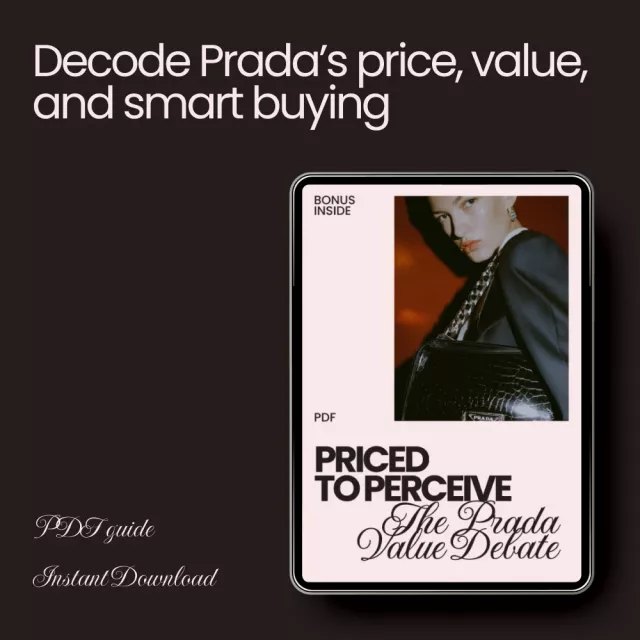
Is Prada Really Worth the Price? Discover the Truth Behind the Label
Luxury is more than a logo—it’s a story, a strategy, and often, a serious investment. Priced to Perceive: The Prada Value Debate is your deep dive into one of fashion’s most talked-about questions: is Prada truly worth it? This comprehensive digital guide unpacks the prada value for money debate with clarity, research, and practical tools you can actually use before making your next luxury purchase.
Whether you’re a first-time luxury buyer, a fashion enthusiast, or a smart shopper who wants transparency before spending four figures on a handbag, this guide gives you insight beyond the marketing. Designed to be informative yet easy to read, it bridges luxury fashion, psychology, and modern technology to help you make confident decisions.
What’s Inside This Digital Guide
- Chapter 1: Understanding Prada’s Luxury Position
- Explore Prada’s legacy from Milan to global icon status
- Breakdown of materials, craftsmanship, branding, and pricing structure
- The psychology behind luxury pricing and perceived value
- Chapter 2: Value for Money—Myth or Reality?
- Price vs. quality comparisons explained clearly
- Case study: Prada bags vs. mid-range alternatives
- Common misconceptions about luxury value
- Chapter 3: Modern Tools for Assessing Luxury Purchases
- How AI and technology help evaluate true worth
- Resale markets, price tracking, and investment potential insights
- The role of social media in shaping brand perception
- Chapter 4: Making Smart Luxury Decisions
- Practical buying tips before investing in Prada
- Value-driven alternatives to consider
- Smart collecting strategies and sustainable fashion guidance
Who Is This Guide For?
This guide is perfect for:
- Luxury shoppers questioning the prada value for money debate
- Fashion lovers who want deeper insight into brand pricing
- Resellers and collectors analyzing long-term value
- Budget-conscious buyers seeking smarter luxury decisions
- Students and professionals interested in luxury brand strategy
What Makes This Guide Different?
Unlike surface-level blog posts or opinion-based videos, this resource combines brand history, pricing psychology, market comparisons, and technology-driven evaluation tools in one structured format. It doesn’t tell you what to buy—it teaches you how to think before you buy. The prada value for money debate is explored from multiple angles, giving you balanced, practical insight rather than hype or brand bias.
Practical Benefits You’ll Gain
- Greater confidence before purchasing luxury items
- Clear understanding of what drives Prada’s pricing
- Tools to assess resale value and long-term investment potential
- Ability to compare luxury vs. mid-range options objectively
- A smarter, more sustainable approach to collecting fashion
Download Now and Make Smarter Luxury Decisions
Luxury should feel empowering—not confusing. If you’ve ever hesitated before clicking “add to cart” on a Prada piece, this guide will change the way you evaluate high-end fashion forever. Download Priced to Perceive: The Prada Value Debate today and approach your next luxury purchase with clarity, strategy, and confidence.
SHIPPING
We are proud to offer international shipping services that currently operate in over 200 countries and islands world wide. Nothing means more to us than bringing our customers great value and service. We will continue to grow to meet the needs of all our customers, delivering a service beyond all expectation anywhere in the world.
Do you ship worldwide?
Yes. We provide free shipping to over 200 countries around the world. However, there are some locations we are unable to ship to. If you happen to be located in one of those countries we will contact you.
What about customs?
We are not responsible for any custom fees once the items have been shipped. By purchasing our products, you consent that one or more packages may be shipped to you and may get custom fees when they arrive to your country.
How long does shipping take?
Shipping time varies by location. These are our estimates:| Location | *Estimated Shipping Time |
|---|---|
| United States | 5-20 Business days |
| Canada, Europe | 5-20 Business days |
| Australia, New Zealand | 5-20 Business days |
| Central & South America | 5-25 Business days |
| Asia | 5-20 Business days |
| Africa | 5-25 Business days |
Do you provide tracking information?
Yes, you will receive an email once your order ships that contains your tracking information. If you haven’t received tracking info within 5 days, please contact us.
My tracking says “no information available at the moment”.
For some shipping companies, it takes 2-5 business days for the tracking information to update on the system. If your order was placed more than 5 business days ago and there is still no information on your tracking number, please contact us.
Will my items be sent in one package?
For logistical reasons, items in the same purchase will sometimes be sent in separate packages, even if you've specified combined shipping.
If you have any other questions, please contact us and we will do our best to help you out.
RETURNS
Order cancellation
All orders can be cancelled until they are shipped. If your order has been paid and you need to make a change or cancel an order, you must contact us within 12 hours. Once the packaging and shipping process has started, it can no longer be cancelled.
Refunds
Your satisfaction is our #1 priority. Therefore, you can request a refund or reshipment for ordered products if:
- If you did not receive the product within the guaranteed time (45 days not including 1-3 day processing) you can request a refund or a reshipment.
- If you received the wrong item you can request a refund or a reshipment.
- If you do not want the product you’ve received you may request a refund but you must return the item at your expense and the item must be unused.
We do not issue the refund if:
- Your order did not arrive due to factors within your control (i.e. providing the wrong shipping address)
- Your order did not arrive due to exceptional circumstances outside the control of cyclonica.com (i.e. not cleared by customs, delayed by a natural disaster).
- Other exceptional circumstances outside the control of cyclonica.com.
*You can submit refund requests within 15 days after the guaranteed period for delivery (45 days) has expired. You can do it by sending a message on Contact Us page
If you are approved for a refund, then your refund will be processed, and a credit will automatically be applied to your credit card or original method of payment, within 14 days.
Exchanges
If for any reason you would like to exchange your product, perhaps for a different size in clothing, you must contact us first and we will guide you through the steps.
Please do not send your purchase back to us unless we authorise you to do so.
Order cancellation
All orders can be cancelled until they are shipped. If your order has been paid and you need to make a change or cancel an order, you must contact us within 12 hours. Once the packaging and shipping process has started, it can no longer be cancelled.
Refunds
Your satisfaction is our #1 priority. Therefore, you can request a refund or reshipment for ordered products if:
- If you did not receive the product within the guaranteed time( 45 days not including 2-5 day processing) you can request a refund or a reshipment.
- If you received the wrong item you can request a refund or a reshipment.
- If you do not want the product you’ve received you may request a refund but you must return the item at your expense and the item must be unused.
We do not issue the refund if:
- Your order did not arrive due to factors within your control (i.e. providing the wrong shipping address)
- Your order did not arrive due to exceptional circumstances outside the control of cyclonica.com (i.e. not cleared by customs, delayed by a natural disaster).
- Other exceptional circumstances outside the control of
*You can submit refund requests within 15 days after the guaranteed period for delivery (45 days) has expired. You can do it by sending a message on Contact Us page
If you are approved for a refund, then your refund will be processed, and a credit will automatically be applied to your credit card or original method of payment, within 14 days.
Exchanges
If for any reason you would like to exchange your product, perhaps for a different size in clothing. You must contact us first and we will guide you through the steps.
Please do not send your purchase back to us unless we authorise you to do so.
Customer Reviews
Write a Review
We Think You’ll Love
Top picks just for you













Assessing motivation before buying — status, design, investment, or use — is the one question that changes everything.
The 'status multiplier' framing for Prada's premium is the most honest I've read on this topic. It acknowledges that material quality alone doesn't account for the full price gap — and that knowing this upfront is useful rather than cynical. The Galleria bag case study put real numbers to a debate I'd been having with myself for months.
I'd spent two years convinced that buying a Galleria bag at full retail was irresponsible. My benchmark was always the gap between Prada's price and a high-end non-luxury alternative at a fraction of the cost — same function, reasonable quality. What this guide gave me was the third variable I'd been missing: resale. The case study showing a Galleria bought in 2018 for $2,500 reselling today at $1,800–$2,000 reframed the whole calculation — that's roughly $100–$175 per year of ownership, versus a mid-range bag that drops 80% of its value the season it's purchased. The motivation checklist — status, design, investment, everyday use — was also more clarifying than I expected; the honest answer was design and investment, and knowing that made the decision feel considered rather than indulgent.
Pre-owned Prada retaining 70–90% of value makes the secondhand argument impossible to ignore.
💼✨🖤💎
The AI image recognition tip for authenticity verification was the most practically useful point in the guide — it directly addresses the counterfeit risk that makes secondhand luxury buying feel risky. The price tracking section is well structured and the Galleria resale case is compelling. What I'd want alongside this is guidance on which specific platforms and tools to use, rather than describing the category alone.
Social media buzz tracked against resale price — that's the due diligence most buyers skip 🔍
I've collected vintage and contemporary bags for close to a decade, and the hardest lesson I learned was about the investment misconception. I bought several Prada pieces in the mid-2010s assuming the label guaranteed value retention, and two of them — both trend-forward seasonal designs — lost more than half their value within three years. The guide's distinction between classic pieces like the Galleria and the Nylon backpack versus trendy designs that depreciate quickly is the most practically valuable content in it; I wish I'd had this framework before those purchases. The AI trend prediction section — machine learning tracking social buzz to anticipate which limited editions might rise — was something I'd seen mentioned in fashion investment communities but never seen clearly explained. I've since started using sentiment analysis tools before buying anything in the first drop window of a collection rather than after the hype has already inflated prices. The five-step pre-purchase checklist is the kind of due diligence I now do automatically, but I had to learn each step the expensive way before I internalized it — having it laid out sequentially would have saved me two costly lessons in the early years ✨
The 'Made in Italy' label and runway exposure named as aura contributors — precise and accurate.
The scarcity principle section makes explicit something most buyers experience without naming: limited availability isn't accidental, it's urgency engineered into the brand strategy 📊 The FOMO and limited drop tracking insight — using AI to anticipate restocks rather than paying inflated resale premiums — is practical and immediate. A guide that arms buyers with the brand's own psychological tools is worth reading before any significant purchase.
Solid on pre-purchase due diligence and resale mechanics; lighter on authentication specifics for secondhand buyers.
Hype outweighing substance is a risk you can now actually quantify with the right sentiment tools.
My approach to luxury buying shifted when I started treating the resale market as the most accurate signal of a piece's actual cultural value — not reviews, not influencer placement, just price retention over time. The guide confirmed this and added tools to the process I'd been doing intuitively. The price tracking section gave structure to cross-referencing retail history with current resale listings to find pieces where secondary market data indicates sustained demand. What strengthened my confidence most was the framing of pre-owned Prada as financially smarter than full retail without sacrificing the design or status dimension — my last two Prada purchases were both certified pre-owned, both bought below resale average, and both currently above what I paid 🖤
Cultural capital is real — this is the first guide I've read that names it without embarrassment.
👜🔍✨📈
The social media amplification section covers ground I hadn't seen addressed directly in a luxury buying guide — specifically how a single celebrity sighting creates demand spikes that AI tools can track before you commit to a price. The sustainable fashion angle at the close is welcome and well-integrated. I'd have valued more on when to time a purchase relative to a hype cycle; the guide implies the insight without fully developing it.
Building a capsule luxury collection around timeless designs rather than trend pieces — obvious in retrospect, but rarely said plainly.
I spent three months deciding whether to buy a secondhand Prada Cahier bag, and the back-and-forth in my head was exactly the debate this guide frames. The misconception about buying used reducing value was the specific belief I needed to get past. The guide dismantles it with resale retention data — 70–90% of value in certified pre-owned — and the Cahier case study showing a $1,200 purchase reselling in the $1,100–$1,300 range was close enough to my situation to feel like direct evidence. I bought the bag for $1,150, used it daily for fourteen months, and sold it for $1,050 when I moved on — a cost of roughly $8 per month of use. The authenticity verification tip also made my in-person inspection more systematic; knowing that AI tools analyze stitching consistency, logo placement, and hardware weight gave me a checklist rather than a vague feeling.
Luxury doesn't have to be blind spending — this reframe changed how I approach every purchase.
The concepts are accurate and the resale case studies are grounded in real numbers, and the pre-purchase checklist covers authenticity, motivation, and budget setting well. Where it falls short is depth: the AI tools section describes capabilities at a category level without enough specificity to be immediately actionable, and the sustainable fashion section addresses a genuinely important topic in a single paragraph. Worth reading for the framework, but leaves real work for the reader.
The 'status multiplier' is the part of luxury pricing that almost no guide will say aloud.
Inspecting stitching, hardware, and leather quality before branding — that's the correct order of evaluation.
What separates this guide from most luxury content is that it's willing to say the quiet part: sometimes you're primarily paying for branding, and that's a legitimate choice as long as you're clear-eyed about it. The misconceptions section — particularly that not every Prada piece is an investment, and that pre-owned often outperforms new retail financially — corrected two assumptions I'd held without examining. The wrap-up framing of luxury as strategic rather than indulgent lands as the right conclusion.
I came to this guide already committed to buying my first Prada piece but unclear on which direction to go — classic investment or something trend-adjacent I loved aesthetically but wasn't sure would hold. The investment potential section's distinction between designs with track records and trendy pieces that depreciate quickly gave me a framework the brand's own marketing would obviously never provide. I went with a Galleria over a more editorial piece from the current season, and the resale tracking data confirmed that decision was defensible on a value basis. The AI price analysis section sent me to platforms I hadn't used before; comparing current listings with the Galleria's five-year price trend showed I was buying at a reasonable moment relative to the average, not at a seasonal hype peak. The motivation assessment question — status, design, investment, or daily use — clarified that my answer was design and investment in roughly equal measure, which pointed toward the classic piece and away from the seasonal one. Two months in, the leather is developing rather than wearing and the hardware hasn't shifted — the guide gave me confidence before the purchase and criteria to evaluate the product after 💡
Good on the Galleria case study and resale retention data; would benefit from broader model coverage beyond one example.
Treating Prada as a strategic decision rather than an indulgent one starts with asking why you actually want it.
The influencer impact point — a celebrity sighting causing immediate demand spikes — explains patterns I'd watched in the resale market without being able to articulate them 💡 The guide puts the consumer back in control by explaining how AI sentiment tracking can identify whether a price spike is brand-driven or hype-driven and time purchases accordingly. That's the kind of information asymmetry the buyer usually doesn't have access to.
Before reading this I'd bought two Prada pieces on impulse and one with proper research, and the difference in how I felt about each purchase was significant — the researched one remains in daily rotation, one impulse buy sits in storage, and the other I sold at a loss. The thread connecting those outcomes was motivation: the guide's question about whether you're buying for status, design, investment, or daily use is deceptively simple but functionally clarifying. The impulse buys were status-driven in the moment but served no other criterion, which is exactly what the misconceptions section describes when it says luxury doesn't automatically equal investment. The social media section also gave me a retroactive explanation for watching one of my pieces spike and deflate in resale value within two months of a major placement — understanding that cycle, and that AI tools can now anticipate it, means I approach even emotional purchases more analytically.
🧠💡👜⭐