





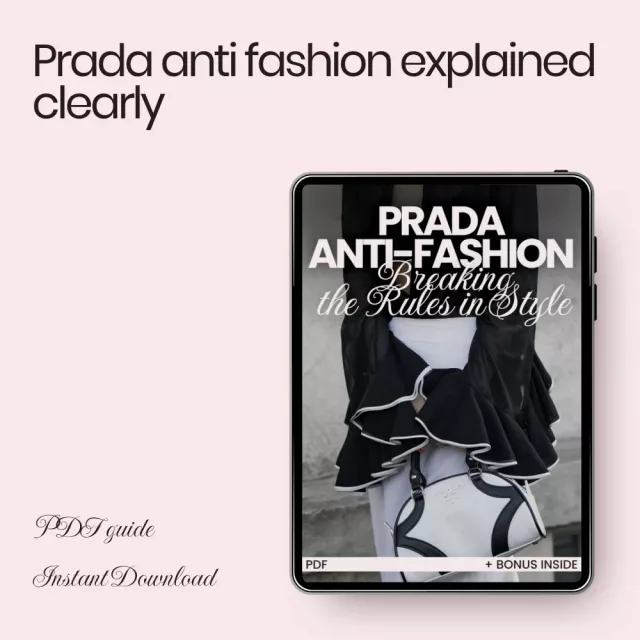
Redefine Style by Breaking Every Rule
What if the most powerful fashion statement you could make was to reject fashion itself? Prada Anti-Fashion: Breaking the Rules in Style is your deep dive into the philosophy, strategy, and cultural impact behind one of the most disruptive movements in modern design. This digital guide goes beyond trends and aesthetics to fully explore prada anti fashion explained in a way that’s clear, inspiring, and practical. Whether you’re a designer, stylist, student, or simply fashion-obsessed, this guide will challenge how you see luxury, minimalism, and self-expression.
What’s Inside This Digital Guide
- Chapter 1: The Anti-Fashion Philosophy – Understand what anti-fashion really means, Prada’s role in redefining fashion, and why anti-fashion matters today.
- Chapter 2: Iconic Prada Anti-Fashion Moments – Explore the 1990s minimalist revolution, the subversion of luxury aesthetics, and a detailed case study of Prada Spring/Summer 2020.
- Chapter 3: Designing with Anti-Fashion in Mind – Learn common missteps to avoid, how to use AI to explore anti-fashion concepts, and how to create your own anti-fashion statement.
- Chapter 4: The Future of Anti-Fashion – Discover rule-breaking trends, lessons for emerging designers, and practical next steps to embrace anti-fashion in your wardrobe.
- Instant digital download – access immediately after purchase.
- Clear, structured format for easy reading and practical application.
Who This Guide Is For
This guide is perfect for fashion students, emerging designers, content creators, stylists, brand strategists, and anyone fascinated by luxury’s rebellious side. If you’ve ever searched for prada anti fashion explained and wanted more than a surface-level summary, this resource was created for you.
Why This Guide Is Different
Unlike generic fashion theory eBooks, this guide blends cultural analysis, runway case studies, and actionable design strategies. It doesn’t just explain Prada’s aesthetic — it breaks down the mindset behind it. You’ll gain clarity on how anti-fashion challenges traditional luxury, how minimalism became radical, and how you can apply these principles to your own creative work.
- Easy-to-understand explanations without academic jargon
- Practical design insights you can apply immediately
- Strategic use of AI tools for creative exploration
- Real-world examples that bring theory to life
Practical Benefits You’ll Gain
- Stronger understanding of anti-fashion philosophy
- Inspiration for bold, rule-breaking design concepts
- Tools to develop a distinctive creative voice
- Confidence to challenge mainstream fashion norms
Fashion evolves when someone dares to question it. If you’re ready to think differently, design differently, and dress differently, download Prada Anti-Fashion: Breaking the Rules in Style today and start redefining the rules on your own terms.
SHIPPING
We are proud to offer international shipping services that currently operate in over 200 countries and islands world wide. Nothing means more to us than bringing our customers great value and service. We will continue to grow to meet the needs of all our customers, delivering a service beyond all expectation anywhere in the world.
Do you ship worldwide?
Yes. We provide free shipping to over 200 countries around the world. However, there are some locations we are unable to ship to. If you happen to be located in one of those countries we will contact you.
What about customs?
We are not responsible for any custom fees once the items have been shipped. By purchasing our products, you consent that one or more packages may be shipped to you and may get custom fees when they arrive to your country.
How long does shipping take?
Shipping time varies by location. These are our estimates:| Location | *Estimated Shipping Time |
|---|---|
| United States | 5-20 Business days |
| Canada, Europe | 5-20 Business days |
| Australia, New Zealand | 5-20 Business days |
| Central & South America | 5-25 Business days |
| Asia | 5-20 Business days |
| Africa | 5-25 Business days |
Do you provide tracking information?
Yes, you will receive an email once your order ships that contains your tracking information. If you haven’t received tracking info within 5 days, please contact us.
My tracking says “no information available at the moment”.
For some shipping companies, it takes 2-5 business days for the tracking information to update on the system. If your order was placed more than 5 business days ago and there is still no information on your tracking number, please contact us.
Will my items be sent in one package?
For logistical reasons, items in the same purchase will sometimes be sent in separate packages, even if you've specified combined shipping.
If you have any other questions, please contact us and we will do our best to help you out.
RETURNS
Order cancellation
All orders can be cancelled until they are shipped. If your order has been paid and you need to make a change or cancel an order, you must contact us within 12 hours. Once the packaging and shipping process has started, it can no longer be cancelled.
Refunds
Your satisfaction is our #1 priority. Therefore, you can request a refund or reshipment for ordered products if:
- If you did not receive the product within the guaranteed time (45 days not including 1-3 day processing) you can request a refund or a reshipment.
- If you received the wrong item you can request a refund or a reshipment.
- If you do not want the product you’ve received you may request a refund but you must return the item at your expense and the item must be unused.
We do not issue the refund if:
- Your order did not arrive due to factors within your control (i.e. providing the wrong shipping address)
- Your order did not arrive due to exceptional circumstances outside the control of cyclonica.com (i.e. not cleared by customs, delayed by a natural disaster).
- Other exceptional circumstances outside the control of cyclonica.com.
*You can submit refund requests within 15 days after the guaranteed period for delivery (45 days) has expired. You can do it by sending a message on Contact Us page
If you are approved for a refund, then your refund will be processed, and a credit will automatically be applied to your credit card or original method of payment, within 14 days.
Exchanges
If for any reason you would like to exchange your product, perhaps for a different size in clothing, you must contact us first and we will guide you through the steps.
Please do not send your purchase back to us unless we authorise you to do so.
Order cancellation
All orders can be cancelled until they are shipped. If your order has been paid and you need to make a change or cancel an order, you must contact us within 12 hours. Once the packaging and shipping process has started, it can no longer be cancelled.
Refunds
Your satisfaction is our #1 priority. Therefore, you can request a refund or reshipment for ordered products if:
- If you did not receive the product within the guaranteed time( 45 days not including 2-5 day processing) you can request a refund or a reshipment.
- If you received the wrong item you can request a refund or a reshipment.
- If you do not want the product you’ve received you may request a refund but you must return the item at your expense and the item must be unused.
We do not issue the refund if:
- Your order did not arrive due to factors within your control (i.e. providing the wrong shipping address)
- Your order did not arrive due to exceptional circumstances outside the control of cyclonica.com (i.e. not cleared by customs, delayed by a natural disaster).
- Other exceptional circumstances outside the control of
*You can submit refund requests within 15 days after the guaranteed period for delivery (45 days) has expired. You can do it by sending a message on Contact Us page
If you are approved for a refund, then your refund will be processed, and a credit will automatically be applied to your credit card or original method of payment, within 14 days.
Exchanges
If for any reason you would like to exchange your product, perhaps for a different size in clothing. You must contact us first and we will guide you through the steps.
Please do not send your purchase back to us unless we authorise you to do so.
Customer Reviews
Write a Review
We Think You’ll Love
Top picks just for you












The distinction between randomness and intentionality in Chapter 3 rewired how I approach design.
The 1990s minimalist revolution section gave me historical context I'd been missing. Understanding that Prada stripped away ostentation while everyone else leaned into it explains so much about where the brand sits today. Brilliant framing.
Concept over trend—three words that changed my entire wardrobe philosophy.
The common missteps section saved me from turning anti-fashion into costume. Starting with one rule-breaking element instead of five was the insight I needed. Already applied it to three outfits this week and the reactions have been completely different from my old approach.
The ugly-chic shoes section made me finally understand why those Prada loafers work 🖤
Miuccia's approach to subverting luxury cues is laid out so clearly here.
The Spring/Summer 2020 case study is where this guide clicks into place. Oversized jackets with delicate fabrics, clashing textures that somehow cohere, gender-fluid aesthetics treated as design logic rather than marketing—it all demonstrates the philosophy in action rather than just theorizing about it.
Read this as a design student and it immediately influenced my thesis direction.
Strong conceptual foundation throughout. The AI sections felt more speculative than practical—I wanted specific tools and workflows rather than general possibilities. The anti-fashion philosophy chapters are where the real value lives.
Mixing masculine and feminine silhouettes in one piece—that section alone was worth the read.
The gender-fluid aesthetics coverage feels genuinely inclusive rather than performative. Refreshing to see it treated as a design principle with roots in Prada's actual runway history.
The nylon backpack story—making the practical fashionable—is the purest example of anti-fashion I've encountered.
I've been afraid to experiment with proportions for years. The tip about starting with one rule-breaking element and building the rest of the look around it gave me a method instead of just vague encouragement. Paired a silk blouse with oversized cargo pants to work last Tuesday and my creative director asked who styled me. Nobody did—I just followed the framework.
The guide presents compelling ideas about anti-fashion philosophy, and the historical context is strong. My concern is that the AI application sections feel shoehorned in—they read more like general tech optimism than fashion-specific guidance. The core content on Prada's design approach deserves to stand on its own without the AI padding.
Subtlety over shock—that principle runs through every chapter and it's what separates this from other fashion theory guides.
The four-step framework for creating your own anti-fashion statement is deceptively simple. Identify a rule, select one unexpected element, balance with subtlety, then iterate. I've been using it as a daily dressing checklist.
Finally a guide that explains anti-fashion without pretension.
The emerging trends section on upcycled materials connected anti-fashion to sustainability in a way I hadn't considered before.
Good overview of the philosophy but the Chapter 4 trends section—digital fashion, NFTs—feels like it's reaching beyond Prada's actual influence into general fashion-tech territory. Tighter focus on what Prada specifically teaches would strengthen it.
The texture mixing advice—satin with denim, nylon with wool—gave me five new outfit ideas before I finished the page 🔥
This reframed anti-fashion from rebellion to intention. Massive difference.
I teach fashion history at university and this guide captures Prada's 90s contribution more accessibly than most textbooks I've used. The section on stripping away ostentation while the rest of the industry doubled down on logos provides exactly the kind of cultural contrast that helps students grasp why minimalism mattered. I've already added it to my recommended reading. The only thing I'd improve is expanding the case studies beyond SS2020—there's a wealth of other collections that reinforce the same thesis. The emerging designer lessons in Chapter 4 are also worth the read for anyone studying concept-driven design, though I wish the AI sections were replaced with more design-process depth.
The point about functionality mattering even in extreme designs is so Prada.
Sent the missteps chapter to every junior designer on my team. The distinction between weird-for-weird's-sake and conceptual intentionality is exactly what they needed to hear.
Well-written and smart. I would have appreciated more visual references or lookbook-style examples alongside the written analysis—anti-fashion is inherently visual and text alone can only do so much. The conceptual framework is solid though.
The silk blouse with cargo pants case example lives in my head rent-free.
Chapter 2 on subverting luxury aesthetics is the strongest section. Pairing sporty utilitarian items with elegant fabrics sounds simple on paper but seeing it framed as a deliberate design philosophy rather than an accident makes you look at Prada's runway output completely differently.
🔥🔥🔥
This is design philosophy disguised as a fashion guide and I'm here for it.
The lesson about embracing discomfort and expecting polarizing reactions is something fashion education rarely addresses directly. This guide doesn't sugarcoat it.
The idea of using AI to simulate audience reactions before production is fascinating, but the guide doesn't go deep enough to make it actionable. The anti-fashion philosophy chapters are excellent—clear, well-argued, historically grounded. I just think the AI content needs its own dedicated guide rather than being woven into this one.
Anti-fashion challenges norms—that framing made me stop trying to fit in and start designing with a point of view.
The proportions advice changed everything. Mixing fitted and loose, asymmetrical cuts, unconventional lengths—I tried all three in one week and the confidence shift was immediate.
Prada making nylon fashionable in the 90s is the ultimate anti-fashion flex and this guide explains why perfectly.
Appreciated the emerging designer lessons. Minor critique: the guide repeats the AI-as-collaborator point across multiple chapters when once would suffice. The core anti-fashion content is strong enough to carry itself.
The concept-over-trend principle applies way beyond fashion. I've started using it in graphic design work too.
I was stuck in a style rut—safe colors, predictable silhouettes, the same rotation every week. The guide's advice to start small with one anti-fashion element per outfit felt manageable rather than overwhelming. First week I swapped my usual flats for sculptural sneakers with a tailored blazer. Second week I tried an oversized coat over a fitted dress. By the third week I was mixing textures without even thinking about it. My partner said I look like a different person. I don't—I just stopped playing it safe.
Intentionality matters—that callout box in Chapter 2 should be tattooed on every fashion student's wrist.
The guide makes a strong case for anti-fashion's relevance, and the 90s history is well-told. I wanted more depth on how individual consumers—not designers—can adopt this philosophy with specific wardrobe pieces at various price points. The practical steps in Chapter 4 scratch the surface but feel more like a teaser than a full guide.
The digital fashion and NFT mention felt forward-thinking without being gimmicky.
Chapter 1 alone is a masterclass in defining a misunderstood concept. Most people hear anti-fashion and think costume or laziness—this guide reframes it as a deliberate, intellectual design choice rooted in questioning conventions. The three pillars—concept over trend, unexpected materials, subverting luxury cues—gave me clear criteria to evaluate my own work against.
Every unconventional choice should tell a story. That one line reframed my entire approach to dressing 🎯
The balance-with-subtlety principle is what most anti-fashion attempts get wrong. Glad this guide addresses it directly.
Smart, tight, and surprisingly applicable to everyday style.
The SS2020 case study—oversized jackets against delicate fabrics—is the kind of concrete example that makes abstract philosophy real. Wish there were more case studies like it throughout.
Anti-fashion isn't about rejecting beauty—it's about redefining it. That thesis carries the whole guide.
The gender-fluid section feels necessary and current. Good to see it anchored in actual Prada runway work rather than treated as abstract theory.
I came in expecting surface-level Prada appreciation and got an actual design philosophy framework. The four lessons for emerging designers in Chapter 4—start with a concept, mix materials intentionally, use AI as a collaborator, embrace discomfort—work just as well for someone getting dressed on a Tuesday morning.
The 90s minimalist section taught me more about brand identity than any marketing book.
Good philosophical grounding. The practical wardrobe steps in 4.3 could go further—mixing textures and playing with proportions are solid starting points but feel like they're just scratching what could be a much deeper conversation. Still recommend it for the first three chapters alone.
That nylon-in-handbags move from the 80s still feels radical when you really think about it.
⭐⭐⭐⭐⭐
I study textile design and the unexpected fabric pairings section—tech fabrics with luxury textiles—directly inspired my latest project. My professor asked where the idea came from.
The guide's thesis that anti-fashion can drive brand identity rather than undermine it is counterintuitive and convincing.
The point about challenging the fashion calendar and avoiding seasonal clichés is something I've never seen articulated so clearly. It explains why Prada collections feel timeless while still feeling new each season. The deliberate avoidance of what's expected is itself a creative strategy, not just contrarianism.
The concept-versus-randomness distinction in Chapter 2 is the most important idea in here.
I appreciate the historical grounding and the design philosophy is well-articulated. The AI sections, however, feel disconnected from the anti-fashion thesis—Prada's rebellion was analog and intuitive, and repeatedly framing AI as the next step undermines that spirit. Would have preferred more runway analysis in those pages.
Less can be more—and this guide proves it about itself too. Lean and focused.
Wore leather with mesh to a gallery opening after reading the texture-mixing section. Three strangers asked about my outfit. Zero would have asked last month.
The guide understands that anti-fashion at its best makes people think, not just look. That's exactly what Miuccia has been doing since the late 80s and this captures it without overcomplicating things.
Good read with a clear point of view. Would benefit from a wider range of case studies—leaning heavily on SS2020 as the primary example leaves other iconic Prada moments underexplored. The philosophy sections are excellent.
The document-and-iterate step sounds basic but it's what turned my random experiments into an evolving personal style 📸
Questioning rules rather than breaking them arbitrarily—that's the whole guide in one line and it's enough to justify reading it.