





Redefining Luxury in the Age of the Scroll
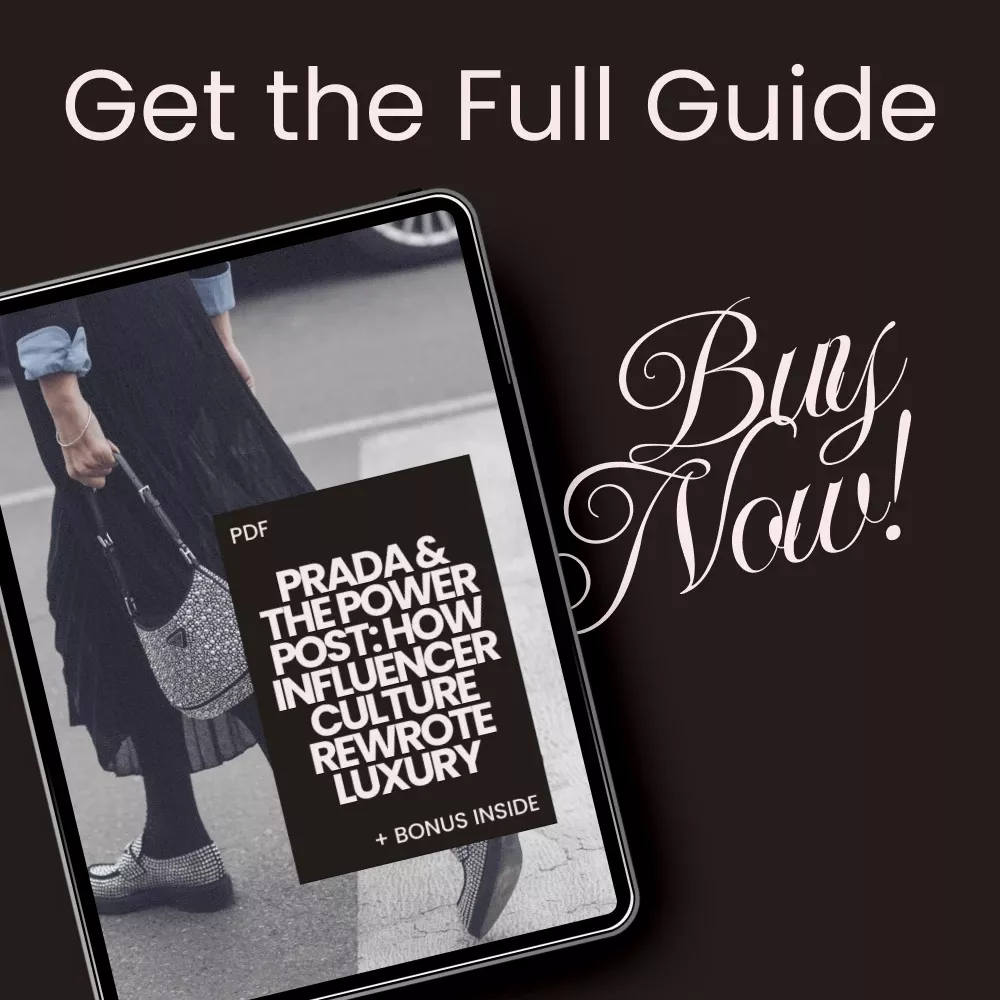
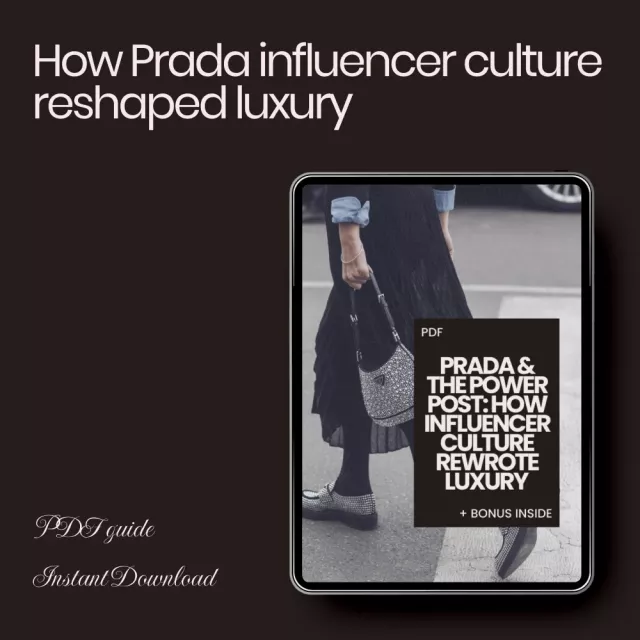
Luxury is no longer defined solely by runway shows and glossy magazine spreads. Today, it lives on feeds, in captions, and inside algorithm-driven conversations. Prada & the Power Post: How Influencer Culture Rewrote Luxury is a powerful, in-depth digital guide that unpacks how one of the world’s most intellectual fashion houses mastered the shift from heritage prestige to digital dominance. If you’ve ever wondered how prada and influencer culture became one of the most fascinating case studies in modern branding, this guide gives you the answers—clearly, strategically, and actionably.
This professionally written guide blends fashion history, marketing analysis, influencer strategy, and AI insights into one cohesive, easy-to-follow resource designed for today’s digital landscape.
What’s Inside the Guide
- Chapter-by-chapter breakdown of Prada’s digital transformation from runway icon to social media powerhouse
- Deep analysis of prada and influencer culture, including the #PradaNylon reboot case study
- Insights into mega vs. micro influencers in the luxury space
- Breakdown of celebrity partnerships—from film stars to TikTok creators
- Strategic lessons on authenticity vs. aspiration in high-end branding
- AI-driven influencer selection strategies and data-backed storytelling methods
- AI-generated campaign prompt examples you can adapt for your own brand
- Ethical considerations of automation in modern luxury marketing
- Action steps for emerging fashion brands building cultural influence
Who This Is For
This guide is perfect for:
- Fashion entrepreneurs and emerging designers
- Marketing students and branding professionals
- Content creators and social media strategists
- Luxury brand consultants
- Anyone fascinated by prada and influencer culture and the evolution of high-end marketing
Why This Guide Is Different
Unlike generic fashion marketing eBooks, this guide combines cultural analysis, real campaign breakdowns, and practical AI tools in one place. It doesn’t just explain what Prada did—it shows you why it worked and how to apply those lessons to your own brand. You’ll gain both strategic clarity and tactical inspiration.
The content is structured, insightful, and easy to digest—no academic jargon, no fluff. Just sharp analysis and actionable insight designed for real-world use.
What You’ll Gain
- A clear understanding of how luxury brands thrive in influencer-driven ecosystems
- Frameworks to choose the right influencers for premium positioning
- Confidence using AI tools for campaign ideation
- A blueprint for building long-term cultural relevance—not just short-term buzz
Download Your Guide Today
If you’re ready to understand how prada and influencer culture reshaped the luxury industry—and how you can use the same principles to elevate your own brand—this digital guide is your next strategic move.
Click “Add to Cart” and download instantly to start building influence, authority, and modern luxury power today.
SHIPPING
We are proud to offer international shipping services that currently operate in over 200 countries and islands world wide. Nothing means more to us than bringing our customers great value and service. We will continue to grow to meet the needs of all our customers, delivering a service beyond all expectation anywhere in the world.
Do you ship worldwide?
Yes. We provide free shipping to over 200 countries around the world. However, there are some locations we are unable to ship to. If you happen to be located in one of those countries we will contact you.
What about customs?
We are not responsible for any custom fees once the items have been shipped. By purchasing our products, you consent that one or more packages may be shipped to you and may get custom fees when they arrive to your country.
How long does shipping take?
Shipping time varies by location. These are our estimates:| Location | *Estimated Shipping Time |
|---|---|
| United States | 5-20 Business days |
| Canada, Europe | 5-20 Business days |
| Australia, New Zealand | 5-20 Business days |
| Central & South America | 5-25 Business days |
| Asia | 5-20 Business days |
| Africa | 5-25 Business days |
Do you provide tracking information?
Yes, you will receive an email once your order ships that contains your tracking information. If you haven’t received tracking info within 5 days, please contact us.
My tracking says “no information available at the moment”.
For some shipping companies, it takes 2-5 business days for the tracking information to update on the system. If your order was placed more than 5 business days ago and there is still no information on your tracking number, please contact us.
Will my items be sent in one package?
For logistical reasons, items in the same purchase will sometimes be sent in separate packages, even if you've specified combined shipping.
If you have any other questions, please contact us and we will do our best to help you out.
RETURNS
Order cancellation
All orders can be cancelled until they are shipped. If your order has been paid and you need to make a change or cancel an order, you must contact us within 12 hours. Once the packaging and shipping process has started, it can no longer be cancelled.
Refunds
Your satisfaction is our #1 priority. Therefore, you can request a refund or reshipment for ordered products if:
- If you did not receive the product within the guaranteed time (45 days not including 1-3 day processing) you can request a refund or a reshipment.
- If you received the wrong item you can request a refund or a reshipment.
- If you do not want the product you’ve received you may request a refund but you must return the item at your expense and the item must be unused.
We do not issue the refund if:
- Your order did not arrive due to factors within your control (i.e. providing the wrong shipping address)
- Your order did not arrive due to exceptional circumstances outside the control of cyclonica.com (i.e. not cleared by customs, delayed by a natural disaster).
- Other exceptional circumstances outside the control of cyclonica.com.
*You can submit refund requests within 15 days after the guaranteed period for delivery (45 days) has expired. You can do it by sending a message on Contact Us page
If you are approved for a refund, then your refund will be processed, and a credit will automatically be applied to your credit card or original method of payment, within 14 days.
Exchanges
If for any reason you would like to exchange your product, perhaps for a different size in clothing, you must contact us first and we will guide you through the steps.
Please do not send your purchase back to us unless we authorise you to do so.
Order cancellation
All orders can be cancelled until they are shipped. If your order has been paid and you need to make a change or cancel an order, you must contact us within 12 hours. Once the packaging and shipping process has started, it can no longer be cancelled.
Refunds
Your satisfaction is our #1 priority. Therefore, you can request a refund or reshipment for ordered products if:
- If you did not receive the product within the guaranteed time( 45 days not including 2-5 day processing) you can request a refund or a reshipment.
- If you received the wrong item you can request a refund or a reshipment.
- If you do not want the product you’ve received you may request a refund but you must return the item at your expense and the item must be unused.
We do not issue the refund if:
- Your order did not arrive due to factors within your control (i.e. providing the wrong shipping address)
- Your order did not arrive due to exceptional circumstances outside the control of cyclonica.com (i.e. not cleared by customs, delayed by a natural disaster).
- Other exceptional circumstances outside the control of
*You can submit refund requests within 15 days after the guaranteed period for delivery (45 days) has expired. You can do it by sending a message on Contact Us page
If you are approved for a refund, then your refund will be processed, and a credit will automatically be applied to your credit card or original method of payment, within 14 days.
Exchanges
If for any reason you would like to exchange your product, perhaps for a different size in clothing. You must contact us first and we will guide you through the steps.
Please do not send your purchase back to us unless we authorise you to do so.
Customer Reviews
Write a Review
We Think You’ll Love
Top picks just for you












The #PradaNylon case study is the best breakdown of a heritage relaunch I've read this year.
The distinction between controlled visibility and invisibility completely reframed how I think about scarcity in luxury branding. I've been treating exclusivity as absence — this guide showed me it's actually about precision. The mega vs. micro influencer layering strategy gave me a concrete model to bring to our next planning session.
The AI prompt examples in chapter 3 are genuinely usable, not just decorative.
The tension between Prada's intellectual aesthetic and influencer culture's immediacy — and how they resolved it — is the most interesting thread in the whole guide. Read it twice.
The part about authenticity vs. aspiration is where this gets sharp.
I manage influencer partnerships for a mid-tier accessories brand, and the common mistakes chapter read like a postmortem of our last three campaigns. Overexposure, short-term thinking, over-controlling creative — we'd done all of it. I printed that page out and pinned it above my desk. Since then we've shifted to two long-term ambassadors instead of rotating through fifteen creators a quarter, and engagement is already up. This guide didn't just teach me Prada's playbook, it exposed what we'd been doing wrong.
The line about luxury living in the scroll now instead of glossy magazines stuck with me for days 🔥
Finally someone explains why one-off influencer posts don't build brand equity.
Solid guide. The AI chapter is forward-thinking and the ethical questions around automation in luxury feel timely. My only small gripe is that the emerging brand action steps could go deeper on budget allocation — the strategy is clear but the financial side stays vague.
The history of Prada's digital evolution in chapter 1 reads like a mini documentary.
The reflection exercise at the end of the influencer chapter forced me to rethink our entire brief. Three questions, zero filler — and I couldn't answer any of them confidently. That discomfort was the most valuable part of the whole guide.
🖤📱✨🔥👏
Concise, well-structured, and respects the reader's intelligence.
The idea that Prada doesn't chase trends but creates them — and then translated that same energy into influencer selection — is the core insight here. Every chapter builds on it without repeating itself.
I work in fashion PR and shared the data-driven storytelling part with my whole team. The breakdown of how AI can reveal that Gen Z prefers behind-the-scenes content while millennials want craftsmanship narratives gave us a framework for segmenting our Fashion Week coverage. Before this we were posting the same content everywhere and wondering why engagement varied so much by platform. Now we tailor every story angle by audience. Our last campaign had double the saves on Instagram and a 35% bump in video completions on TikTok. This PDF paid for itself in the first week.
Short enough to finish in one sitting, dense enough to revisit.
The sustainability angle on the nylon reboot was the part I didn't expect — and the part that resonated most.
The part on detecting fake followers and checking audience overlap should be mandatory reading for anyone spending money on influencers.
Cultural intelligence, long-term ambassadors, narrative consistency, controlled visibility — those four pillars from the lessons chapter became my internal checklist overnight.
Read this on a train and immediately texted my business partner about the micro-influencer credibility approach.
⭐👌🖤
The influencer formula chapter alone is worth the download. The layered strategy of mega for visibility and micro for credibility finally clicked for me after years of treating influencer tiers as either/or. The practical reflection exercise forced honest self-assessment, and the mistakes breakdown read like a mirror. I've already restructured our Q3 influencer roster based on the alignment principles here.
The writing itself feels like Prada — understated and confident 🤌
Every brand manager should read the common mistakes part before signing another influencer contract.
The AI campaign ideation prompts are copy-paste ready.
Good content overall, especially the cultural layering concept and the ethics discussion. I wanted a bit more on how smaller brands without Prada's existing prestige can realistically execute controlled visibility — the principles are sound but the gap between theory and application for non-heritage brands could use more depth.
I run a boutique label in São Paulo and had been skeptical that luxury influencer strategies could scale down to my level. This guide changed my mind. The action steps for emerging brands were practical enough that I started implementing the first one the same afternoon — defining our cultural position before picking a single creator. Within a month I'd identified three micro-influencers whose audiences overlapped perfectly with our customer base, something I never would have prioritized before reading the mega vs. micro breakdown. The regenerated nylon case study also inspired me to lead with our own sustainability story instead of burying it on our About page.
The ethical questions about automation and craftsmanship in the AI chapter add real depth.
Loved how it frames influencer marketing as cultural participation, not advertising.
The opening on Miuccia Prada's intellectual cool sets the tone perfectly for everything that follows.
The regenerated nylon campaign breakdown taught me more about product storytelling than a semester of marketing classes.
Chapter 3 bridges the gap between creative instinct and data in a way that doesn't feel cold. The concept of using AI to protect prestige rather than chase virality is the sharpest framing I've seen on the topic.
Clean formatting, no padding, every chapter earns its spot.
❤️🔥📖👍
The point about one two-year partnership outweighing twenty one-off posts hit hard.
I've been in luxury marketing for twelve years and this is the first guide that articulated something I'd felt but couldn't name: that scarcity today comes from controlled visibility, not invisibility. That single reframe justified every chapter. The common mistakes part confirmed patterns I'd seen across competitor campaigns, and the AI influencer-matching criteria gave me a scoring rubric I immediately adapted for our house. Beyond strategy, the writing quality itself matches the subject — restrained, smart, never overselling. I rarely re-read PDFs but this one lives in my reference folder now.
Passed this to our creative director and she quoted the controlled visibility concept in our next brand deck.
The way it moves from Prada's heritage through digital evolution to AI applications feels like a natural arc, not a forced outline.
The closing chapter on building long-term cultural influence is the quiet star of this guide.
Bought this expecting surface-level trend talk and got a real strategic framework instead.
The breakdown of how Prada collaborates with artists, film actors, and digital creators simultaneously — and why that layering works — gave me a new vocabulary for pitching multi-tier campaigns. I used to lump all influencers into one bucket. Now I map each one to a specific layer of the brand narrative, and the last two proposals I sent out landed meetings within 48 hours. The guide also taught me to stop over-scripting creator content; letting them interpret the brand in their own voice produces work that actually gets shared.
The tone throughout matches the subject matter — intellectual without being pretentious.
Chapter 1 sets the stage so well that by the time you reach the AI part you're already bought in.
I teach a graduate course on fashion marketing and this is going on the syllabus next semester. The #PradaNylon case study gives students a real-world example of heritage reinvention through influencer strategy, and the AI prompts let them practice campaign ideation hands-on. The ethical questions near the end alone generate an entire seminar's worth of debate.
Finished it in under an hour and took a full page of notes 📝
The micro-influencer part validated everything I've been arguing to my team for months.
Smart, tight, and useful from page one to the last chapter.
If you only read one part, make it the data-driven storytelling section — the Fashion Week scenario alone is worth it.