





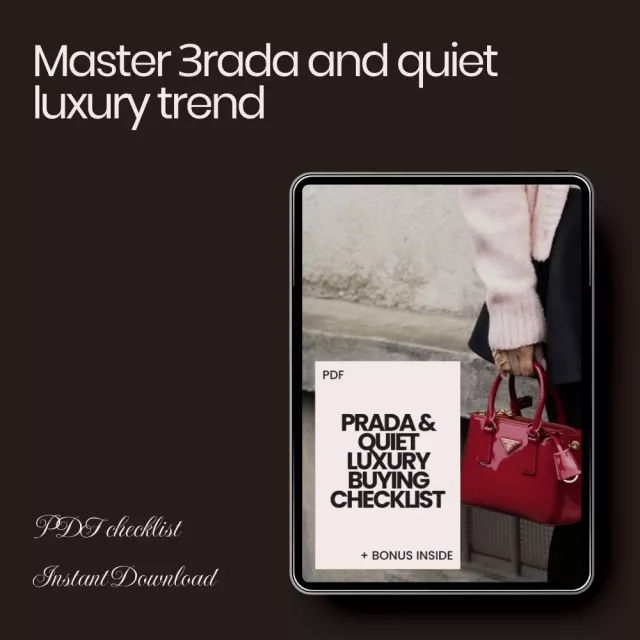
Elevate Your Wardrobe with Intentional Luxury
Quiet luxury is more than a trend—it’s a mindset rooted in refinement, quality, and timeless appeal. The Prada & Quiet Luxury Buying Checklist is your curated digital companion for navigating the prada and quiet luxury trend with confidence and clarity. Whether you’re building a capsule wardrobe, investing in designer staples, or refining your personal style, this expertly designed checklist helps you shop smarter, not louder.
Created for discerning shoppers who value craftsmanship over logos, this downloadable checklist guides you step-by-step through what truly matters when selecting Prada pieces and other understated luxury essentials. No guesswork. No impulse splurges. Just thoughtful, strategic buying.
What You’ll Learn Inside
- How to identify premium materials and Prada’s signature textures
- How to choose timeless neutral colors and minimalist silhouettes
- How to evaluate craftsmanship and subtle detailing
- How to select understated accessories with long-term value
- How to assess longevity and resale potential
Why You’ll Love It
- Shop the prada and quiet luxury trend with clarity and purpose
- Avoid costly trend-driven mistakes
- Build a cohesive, elevated wardrobe that lasts for years
- Make confident designer purchases backed by strategy
- Understand what truly gives luxury items long-term value
Who This Is For
This checklist is perfect for fashion enthusiasts, first-time Prada buyers, capsule wardrobe builders, luxury collectors, personal stylists, and anyone drawn to understated elegance. If you appreciate subtle sophistication and want your purchases to reflect lasting value rather than fleeting hype, this resource was made for you.
What Makes This Different
Unlike generic fashion guides, the Prada & Quiet Luxury Buying Checklist is focused, practical, and immediately usable. It doesn’t just explain quiet luxury—it gives you a structured decision-making tool tailored to one of the most influential houses behind the movement. It bridges aspiration and action, helping you translate inspiration into smart investments.
Download & Refine Your Style Today
Luxury is in the details—and now you’ll know exactly what to look for. Download your Prada & Quiet Luxury Buying Checklist today and start curating a wardrobe that speaks softly but powerfully.
Add it to your cart now and shop with confidence, intention, and timeless sophistication.
SHIPPING
We are proud to offer international shipping services that currently operate in over 200 countries and islands world wide. Nothing means more to us than bringing our customers great value and service. We will continue to grow to meet the needs of all our customers, delivering a service beyond all expectation anywhere in the world.
Do you ship worldwide?
Yes. We provide free shipping to over 200 countries around the world. However, there are some locations we are unable to ship to. If you happen to be located in one of those countries we will contact you.
What about customs?
We are not responsible for any custom fees once the items have been shipped. By purchasing our products, you consent that one or more packages may be shipped to you and may get custom fees when they arrive to your country.
How long does shipping take?
Shipping time varies by location. These are our estimates:| Location | *Estimated Shipping Time |
|---|---|
| United States | 5-20 Business days |
| Canada, Europe | 5-20 Business days |
| Australia, New Zealand | 5-20 Business days |
| Central & South America | 5-25 Business days |
| Asia | 5-20 Business days |
| Africa | 5-25 Business days |
Do you provide tracking information?
Yes, you will receive an email once your order ships that contains your tracking information. If you haven’t received tracking info within 5 days, please contact us.
My tracking says “no information available at the moment”.
For some shipping companies, it takes 2-5 business days for the tracking information to update on the system. If your order was placed more than 5 business days ago and there is still no information on your tracking number, please contact us.
Will my items be sent in one package?
For logistical reasons, items in the same purchase will sometimes be sent in separate packages, even if you've specified combined shipping.
If you have any other questions, please contact us and we will do our best to help you out.
RETURNS
Order cancellation
All orders can be cancelled until they are shipped. If your order has been paid and you need to make a change or cancel an order, you must contact us within 12 hours. Once the packaging and shipping process has started, it can no longer be cancelled.
Refunds
Your satisfaction is our #1 priority. Therefore, you can request a refund or reshipment for ordered products if:
- If you did not receive the product within the guaranteed time (45 days not including 1-3 day processing) you can request a refund or a reshipment.
- If you received the wrong item you can request a refund or a reshipment.
- If you do not want the product you’ve received you may request a refund but you must return the item at your expense and the item must be unused.
We do not issue the refund if:
- Your order did not arrive due to factors within your control (i.e. providing the wrong shipping address)
- Your order did not arrive due to exceptional circumstances outside the control of cyclonica.com (i.e. not cleared by customs, delayed by a natural disaster).
- Other exceptional circumstances outside the control of cyclonica.com.
*You can submit refund requests within 15 days after the guaranteed period for delivery (45 days) has expired. You can do it by sending a message on Contact Us page
If you are approved for a refund, then your refund will be processed, and a credit will automatically be applied to your credit card or original method of payment, within 14 days.
Exchanges
If for any reason you would like to exchange your product, perhaps for a different size in clothing, you must contact us first and we will guide you through the steps.
Please do not send your purchase back to us unless we authorise you to do so.
Order cancellation
All orders can be cancelled until they are shipped. If your order has been paid and you need to make a change or cancel an order, you must contact us within 12 hours. Once the packaging and shipping process has started, it can no longer be cancelled.
Refunds
Your satisfaction is our #1 priority. Therefore, you can request a refund or reshipment for ordered products if:
- If you did not receive the product within the guaranteed time( 45 days not including 2-5 day processing) you can request a refund or a reshipment.
- If you received the wrong item you can request a refund or a reshipment.
- If you do not want the product you’ve received you may request a refund but you must return the item at your expense and the item must be unused.
We do not issue the refund if:
- Your order did not arrive due to factors within your control (i.e. providing the wrong shipping address)
- Your order did not arrive due to exceptional circumstances outside the control of cyclonica.com (i.e. not cleared by customs, delayed by a natural disaster).
- Other exceptional circumstances outside the control of
*You can submit refund requests within 15 days after the guaranteed period for delivery (45 days) has expired. You can do it by sending a message on Contact Us page
If you are approved for a refund, then your refund will be processed, and a credit will automatically be applied to your credit card or original method of payment, within 14 days.
Exchanges
If for any reason you would like to exchange your product, perhaps for a different size in clothing. You must contact us first and we will guide you through the steps.
Please do not send your purchase back to us unless we authorise you to do so.
Customer Reviews
Write a Review
We Think You’ll Love
Top picks just for you








Discreet branding over loud logos — this checklist articulates quiet luxury's entire thesis precisely.
The neutral color palette section is where most quiet luxury guides are vaguely poetic and this one is specific: beige, cream, taupe, navy, and black — five tones that account for the majority of genuinely versatile wardrobe decisions. Prada's soft leather handbags in those palettes are exactly where the material and color sections intersect into something useful ✨ Running every prospective piece through those tonal anchors first has eliminated several purchases I would have later questioned.
Cross-occasion versatility as the minimalist silhouette standard — obvious in retrospect, rarely stated this directly.
Before this checklist, I was approaching quiet luxury acquisitions the way most people approach fashion — responsively, buying what read as elevated in the moment without a coherent selection framework. The result was individually strong pieces that didn't create a unified register: a silk blouse with no tailored fits to anchor it, premium leather accessories that competed rather than complemented. The signature materials section reoriented my thinking around fabric first — cashmere, fine wool, silk, and premium leather as the foundation against which everything else is evaluated. The craftsmanship section added a secondary filter: stitching, hardware, and finishing details as independent evaluation criteria rather than incidental observations. Working through both together on my last three purchases produced better wardrobe integration than three years of unstructured buying had managed. The insider insights point about following runway editorials to anticipate subtle staples — rather than waiting for a piece to become widely recognized — changed how I track the brand between purchase cycles entirely.
Prada nylon versus every imitation of it — craftsmanship is the entire difference 🔍
Materials and silhouette guidance are the strongest sections — specific enough in fabric names and construction criteria to function as an actual evaluation tool at point of purchase rather than general encouragement toward quality. The five-tone color palette is well-defined and eliminates most guesswork at a glance. Where the guide falls short is on care: cashmere, fine wool, and premium leather require maintenance that directly affects longevity, and a brief section there would have extended the investment argument meaningfully.
🤍🕊️✨🌿
Longevity and resale potential framed as selection criteria before purchase shifts how you evaluate any piece before committing. The point that timeless Prada pieces increase in desirability over time connects the investment framing to actual acquisition strategy rather than leaving it as a post-purchase consolation. Both of my last purchases were evaluated against resale trajectory in addition to aesthetics — and both decisions changed at that stage.
Pieces that elevate without announcing — that phrase contains the entire quiet luxury argument.
The insider insights section is where this guide separates from general quiet luxury resources. Following runway updates and curated editorials to anticipate upcoming staples — before they become widely visible — is a genuinely different approach from waiting for pieces to surface in reviews. I started applying it after reading and tracked one specific Prada piece through editorial output for about eight weeks before it appeared on any platform I recognized 🖤 By the time it did, I had enough context to evaluate it immediately rather than from scratch. The distinction between limited editions that align with minimalist aesthetics and those that don't is where the guide's judgment framework becomes most applicable — not every collaboration suits the quiet luxury register, and having a selection lens rather than just release awareness makes the difference.
Named editorial sources would have made the runway tracking section immediately actionable.
Avoiding flashy logos and loud prints is positioned here not as restraint but as where Prada's construction quality becomes visible — a more accurate account of what quiet luxury actually means. The materials section names cashmere, fine wool, silk, and premium leather as evaluation anchors rather than aspirational categories. Reading a piece against those specific fabric criteria before aesthetics produced a more reliable selection process than anything I'd been using before.
Naming cashmere and fine wool as baseline criteria rather than aspirational upgrades changes everything.
Clean lines and tailored fits evaluated for cross-occasion versatility — the minimalist silhouette section reduced decision time at point of purchase significantly. The wardrobe staples argument holds strongest when applied to transition: whether a piece works across contexts, not just whether it looks good in one. A Prada belt with discreet branding proved that logic in practice within a week of my last purchase — worn three different ways before the week ended.
Accurate framework, but too introductory for anyone already past the basics of quiet luxury.
🌿🖤🤍💫
The shift in wardrobe strategy this checklist prompted is specific enough to be worth describing in detail. Before reading it, my approach to quiet luxury was largely intuitive: I recognized the aesthetic when I saw it and bought accordingly, but without any structured evaluation framework. That produced a wardrobe with some excellent pieces and several that didn't integrate — a cashmere sweater in an ivory too warm against my neutral palette, a handbag whose hardware drew more attention than anything around it, tailored silhouettes that individually worked but didn't create a coherent overall register. The signature materials section gave me a vocabulary for what I'd been selecting by instinct: cashmere, fine wool, silk, and premium leather as the foundation, with Prada's nylon as the brand's specific contribution to that materials language — a distinction I'd intuitively valued without being able to articulate. Running every prospective purchase through that filter first, before aesthetics or price, eliminated the wrong-ivory-cashmere problem from future buying ✨ The neutral colors section formalized something I'd been moving toward without naming: beige, cream, taupe, navy, and black as tonal anchors within which everything integrates without requiring deliberate coordination. The craftsmanship section delivered the most practically useful criteria I hadn't already internalized — stitching consistency, hardware quality, and finishing details as independent evaluation points, not just incidental confirmation of a decision already made on other grounds. The accessory guidance, specifically focusing on pieces that elevate without drawing attention, reoriented how I evaluate Prada's entry-level price points: a belt or shoes with discreet branding can carry the brand's material quality into an outfit without positioning the logo as the focal point. The longevity and resale framing is where the investment argument is strongest — treating each acquisition as a long-term decision rather than a present-moment one changes the calculus of what justifies the price, and changed several specific decisions in my last round of purchases.
Hardware quality as an independent criterion is the detail most buyers overlook.
Cashmere, fine wool, silk, and premium leather as named material anchors is more useful than a general quality directive — it creates a checklist item you can verify at point of purchase rather than a judgment call. The stitching and hardware criteria do the same work for the craftsmanship section. The accessory guidance covers handbags, shoes, and belts well but doesn't extend to smaller signature items, where discreet branding decisions are equally consequential to the overall register.
Resale potential positioned as a selection criterion before purchase is one of the more useful framings for anyone approaching quiet luxury as a long-term wardrobe strategy. Prada pieces that increase in desirability over time are also, consistently, the ones that most satisfy the timeless elegance criteria the guide opens with 🤍 That connection between investment value and aesthetic coherence runs through every section without always being stated explicitly — and is worth tracking as you read.
💎🏛️🤍✨🌿
Accessories with discreet branding as the most strategic quiet luxury entry point — the guide's sharpest observation for anyone building the aesthetic deliberately rather than all at once. A belt or shoes operating within a neutral palette carries Prada's material quality into an outfit without positioning the brand as the focal point, and that distinction is the real difference between quiet luxury and status signaling. I applied the insider insights section specifically to accessory tracking, monitoring minimalist-aligned collaborations before they surfaced widely 🖤 The longevity criterion helped distinguish between limited editions genuinely suited to the register and those that were collaborative novelties — a distinction that's harder to make without a clear framework. The tailored silhouette guidance provided the wardrobe context that made those accessory investments more precise: knowing which shapes I was anchoring meant I could evaluate whether a specific piece would actually integrate rather than just photograph well.
The checklist is organized and the criteria are accurate — materials, silhouettes, craftsmanship, and resale value all belong in a quiet luxury framework. What it doesn't address is what specifically distinguishes Prada from the other houses operating in this space; quiet luxury principles apply across multiple brands, and a resource focused specifically on Prada would benefit from going further into what its nylon, hardware choices, and silhouettes contribute that others don't. As a general quiet luxury introduction it holds; as a Prada-specific guide it leaves significant work to do.
Tailored fits across contexts as the standard — stated here without the usual abstraction.
Following runway editorials to anticipate subtle staples before they reach broad recognition changes how you engage with the brand between purchase cycles. Monitoring Prada's curated output rather than just its product launches develops a relationship with the house's direction that makes individual buying decisions quicker and more assured. The minimalist-aligned collaboration filter is where that ongoing engagement pays off most — not every limited release suits the quiet luxury register, and distinguishing those that do is a skill the guide correctly identifies as worth developing.
Precise on five muted tones; warm-versus-cool distinctions within those would sharpen it further.