





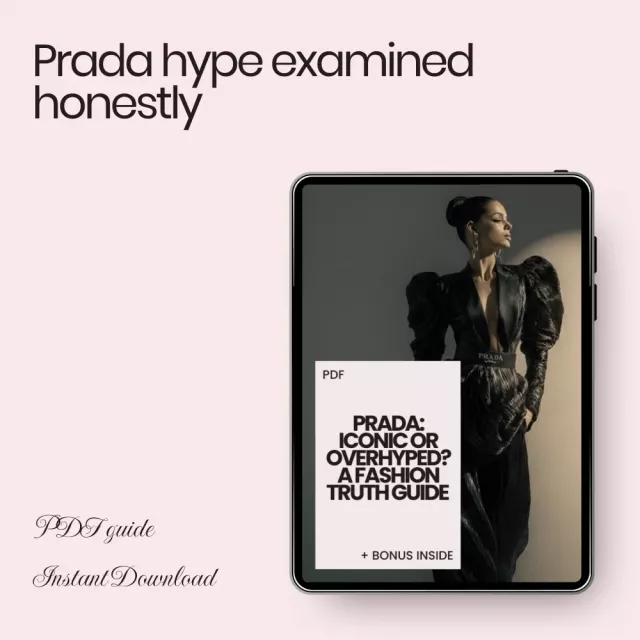
Is Prada Really Worth It? Let’s Break the Hype.
You’ve seen the bags. The runway moments. The celebrity red carpet appearances. But you’re still wondering: prada overrated or not? This in-depth digital download was created for fashion lovers, smart shoppers, and curious skeptics who want real answers—not just brand mythology.
Prada: Iconic or Overhyped? A Fashion Truth Guide is a comprehensive eBook that dives into Prada’s legacy, pricing, cultural influence, and future in the age of AI. Whether you’re considering your first luxury purchase or questioning the value behind the logo, this guide gives you clarity, context, and confidence.
What’s Inside This eBook?
- Chapter-by-chapter breakdown of Prada’s history, heritage, and global rise
- Analysis of signature styles and iconic collections
- Honest discussion on pricing: materials, craftsmanship, and brand markup
- Case study comparing Prada bags vs. other luxury brands
- Exploration of celebrity influence and cultural impact
- Review of notable fashion flops and controversial designs
- AI-powered fashion insights and trend prediction guidance
- Practical prompts to use AI as your personal fashion advisor
- Smart buying tips to avoid costly mistakes
- A final verdict to help you decide: hype or true icon?
Who Is This Guide For?
- Fashion enthusiasts researching luxury brands
- First-time designer buyers who want to spend wisely
- Minimalists building a thoughtful wardrobe
- Luxury skeptics asking, “prada overrated or not?”
- Content creators and fashion students seeking deeper brand analysis
What Makes This Different?
Unlike surface-level blog posts or biased brand praise, this guide combines historical research, pricing breakdowns, cultural commentary, and modern AI analysis. It doesn’t just tell you what to think—it teaches you how to evaluate luxury brands critically. You’ll learn to separate marketing from craftsmanship and trends from timeless design.
This is not a fan page. It’s not a takedown. It’s a balanced, intelligent exploration of one of fashion’s most debated houses.
Practical Benefits You’ll Gain
- Shop luxury with clarity and confidence
- Avoid impulse purchases driven by hype
- Understand what you’re truly paying for
- Use AI tools to assess fashion trends and value
- Build a luxury wardrobe aligned with your personal style
Download Your Fashion Truth Guide Today
If you’ve ever hesitated before clicking “add to cart” on a Prada piece, this eBook is your smart next step. Stop guessing. Stop relying on influencer opinions. Get the facts, weigh the evidence, and decide for yourself: prada overrated or not?
Download Prada: Iconic or Overhyped? A Fashion Truth Guide instantly and start making luxury decisions with confidence today.
SHIPPING
We are proud to offer international shipping services that currently operate in over 200 countries and islands world wide. Nothing means more to us than bringing our customers great value and service. We will continue to grow to meet the needs of all our customers, delivering a service beyond all expectation anywhere in the world.
Do you ship worldwide?
Yes. We provide free shipping to over 200 countries around the world. However, there are some locations we are unable to ship to. If you happen to be located in one of those countries we will contact you.
What about customs?
We are not responsible for any custom fees once the items have been shipped. By purchasing our products, you consent that one or more packages may be shipped to you and may get custom fees when they arrive to your country.
How long does shipping take?
Shipping time varies by location. These are our estimates:| Location | *Estimated Shipping Time |
|---|---|
| United States | 5-20 Business days |
| Canada, Europe | 5-20 Business days |
| Australia, New Zealand | 5-20 Business days |
| Central & South America | 5-25 Business days |
| Asia | 5-20 Business days |
| Africa | 5-25 Business days |
Do you provide tracking information?
Yes, you will receive an email once your order ships that contains your tracking information. If you haven’t received tracking info within 5 days, please contact us.
My tracking says “no information available at the moment”.
For some shipping companies, it takes 2-5 business days for the tracking information to update on the system. If your order was placed more than 5 business days ago and there is still no information on your tracking number, please contact us.
Will my items be sent in one package?
For logistical reasons, items in the same purchase will sometimes be sent in separate packages, even if you've specified combined shipping.
If you have any other questions, please contact us and we will do our best to help you out.
RETURNS
Order cancellation
All orders can be cancelled until they are shipped. If your order has been paid and you need to make a change or cancel an order, you must contact us within 12 hours. Once the packaging and shipping process has started, it can no longer be cancelled.
Refunds
Your satisfaction is our #1 priority. Therefore, you can request a refund or reshipment for ordered products if:
- If you did not receive the product within the guaranteed time (45 days not including 1-3 day processing) you can request a refund or a reshipment.
- If you received the wrong item you can request a refund or a reshipment.
- If you do not want the product you’ve received you may request a refund but you must return the item at your expense and the item must be unused.
We do not issue the refund if:
- Your order did not arrive due to factors within your control (i.e. providing the wrong shipping address)
- Your order did not arrive due to exceptional circumstances outside the control of cyclonica.com (i.e. not cleared by customs, delayed by a natural disaster).
- Other exceptional circumstances outside the control of cyclonica.com.
*You can submit refund requests within 15 days after the guaranteed period for delivery (45 days) has expired. You can do it by sending a message on Contact Us page
If you are approved for a refund, then your refund will be processed, and a credit will automatically be applied to your credit card or original method of payment, within 14 days.
Exchanges
If for any reason you would like to exchange your product, perhaps for a different size in clothing, you must contact us first and we will guide you through the steps.
Please do not send your purchase back to us unless we authorise you to do so.
Order cancellation
All orders can be cancelled until they are shipped. If your order has been paid and you need to make a change or cancel an order, you must contact us within 12 hours. Once the packaging and shipping process has started, it can no longer be cancelled.
Refunds
Your satisfaction is our #1 priority. Therefore, you can request a refund or reshipment for ordered products if:
- If you did not receive the product within the guaranteed time( 45 days not including 2-5 day processing) you can request a refund or a reshipment.
- If you received the wrong item you can request a refund or a reshipment.
- If you do not want the product you’ve received you may request a refund but you must return the item at your expense and the item must be unused.
We do not issue the refund if:
- Your order did not arrive due to factors within your control (i.e. providing the wrong shipping address)
- Your order did not arrive due to exceptional circumstances outside the control of cyclonica.com (i.e. not cleared by customs, delayed by a natural disaster).
- Other exceptional circumstances outside the control of
*You can submit refund requests within 15 days after the guaranteed period for delivery (45 days) has expired. You can do it by sending a message on Contact Us page
If you are approved for a refund, then your refund will be processed, and a credit will automatically be applied to your credit card or original method of payment, within 14 days.
Exchanges
If for any reason you would like to exchange your product, perhaps for a different size in clothing. You must contact us first and we will guide you through the steps.
Please do not send your purchase back to us unless we authorise you to do so.
Customer Reviews
Write a Review
We Think You’ll Love
Top picks just for you











The verdict chapter doesn't pick a side — and that's exactly right.
I came in skeptical and left with a clear framework for deciding when Prada is worth it and when it's just noise. The distinction between buying hype versus buying fit — specifically the oversized nylon tote example that looks cool online but overwhelms everyday outfits — is uncomfortably accurate. I've made that exact mistake twice.
✨🖤💎🔥
The fact that Miuccia Prada's vision — not Mario's original leather goods shop — is what created the iconic fashion house we know reframed how I think about Prada's design DNA entirely. The minimalism, the fearless nylon, the experimental fabrics: all of it comes from one inherited and transformed vision. That context makes the brand's aesthetic choices feel earned rather than arbitrary.
Seven chapters is ambitious and mostly justified here — the misconceptions chapter earns its own space 💡 My reservation is the same one I have with most luxury-meets-AI content: the tools described as predicting which pieces will trend next season or estimating resale values are treated as reliable without acknowledging how often the predictions fall short. The framework is sound; the confidence in AI accuracy needs tempering.
Prada pioneering nylon in luxury in the 1980s — initially confusing critics, now iconic — is the clearest single illustration of why the brand's risk-taking matters.
I've been buying Prada for nine years and had never articulated why the brand frustrates me as often as it excites me until reading this. The fashion flops section is the most honest part — the 2006 Fall/Winter collection described as confusing with clashing textures, the oversized accessories that created social media jokes rather than admiration — this is the reality of a brand that prioritizes audacious creativity over consistent satisfaction. The guide frames this correctly: if you want predictable luxury, Prada will frustrate you. I'd spent years being frustrated and calling it taste rather than admitting I'd chosen the wrong house for certain purchases. The Galleria Bag and Prada loafers are where I've always felt most aligned with the brand — timeless, resale-strong, genuinely wearable. The guide confirms what experience already taught me: Prada rewards intentional buyers and confounds impulsive ones.
Prada as a lens into the evolving world of style, culture, and innovation — the guide earns that framing.
🛍️💫👜⭐🖤
The Spring/Summer 1998 case study — nylon handbags paired with tailored suits, initially puzzling critics, later defining Prada's genius for merging practicality and high fashion — is the best single argument in the guide for why Prada's experimental risk-taking deserves more patience than it typically receives. Most critics who called it confusing eventually reversed their assessments, and the guide notes that arc without editorializing.
Worth reading for the misconceptions chapter alone — hype vs. quality, classic vs. trendy pieces, the double-edged nature of subtle branding — all stated plainly. The AI market evaluation prompt example, comparing Prada's resale value to LV and Gucci over five years, is the most practically useful tool suggestion in the guide. I actually ran a version of that analysis before my most recent purchase.
Good depth on history and brand identity, but the AI chapter lists capabilities — runway analysis, social media monitoring, global trend forecasts — without grounding them in what's currently reliable at the consumer level. The gap between what these tools can theoretically do and what someone actually gets when they try them is wider than the guide suggests.
The Oscars 2020 case study is a smart way to show Prada's dual reputation — timeless yet edgy — in a single documented moment rather than as abstract brand positioning.
I manage a luxury resale business and have recommended this to three buyers who were approaching Prada emotionally rather than analytically. The vintage nylon bag from the early 2000s now fetching two to three times its original price is the kind of concrete data point that shifts how buyers think 📊 The broader principle — buy classics that hold value, integrate trend pieces sparingly, treat the wardrobe as a curated collection rather than a series of impulse decisions — matches what we tell clients daily. This guide says it in half the words.
Six chapters covering history, pricing, style, misconceptions, AI tools, and smart buying — each with something specific to contribute. The practical tip framing Prada shopping as curating art is this guide's most memorable line and its most accurate one.
The Devil Wears Prada turning the brand into shorthand for stylish power beyond fashion insiders is a cultural impact observation that understates how significant that single film was for Prada's mainstream recognition.
I've worked in fashion editorial for six years and still found the Prada vs. Louis Vuitton vs. Gucci comparison useful — specifically the observation that Prada balances subtlety with trend risks where competitors lean toward logo recognition or maximalism. That balance is exactly why Prada pieces can feel worth nothing or worth everything depending on what you already own and how you wear them. The guide captures the conditional nature of Prada's value more honestly than most editorial content I've encountered professionally.
Useful and well-structured overall. The Galleria Bag versus seasonal runway piece case study — timeless resale value compared to fast Instagram depreciation — is the guide's clearest practical illustration. Two stars off because the AI fashion advisor prompt examples present idealized outputs without addressing what happens when the tools return low-confidence or contradictory results, which is common enough to matter.
The nylon revolution context changed how I evaluate Prada's unconventional material choices — knowing that nylon in luxury was once a genuinely shocking idea makes the current experimental fabrics feel like a tradition rather than a gimmick 🧵
The question of whether Prada is overrated is answered correctly: it depends entirely on how intentionally you engage with it. Casual followers chasing hype will often be disappointed, informed buyers who understand the design philosophy and invest in classics will almost always find it justified. The guide makes that distinction clearly without being elitist about it.
Strong on the fundamentals and appropriately balanced — not every luxury guide admits that high price doesn't always guarantee superior functionality, and the case that other brands can offer equal craftsmanship at lower prices is acknowledged here without dismissiveness.
I spent three years believing Prada was overrated because I'd only interacted with the brand through trend pieces that didn't speak to me. A colleague who'd been buying Prada for a decade kept telling me I was looking at the wrong things. This guide was the first time I understood what she meant. The signature aesthetic section — clean minimalism meeting bold statements, subtle surprises rather than loud logos, unexpected materials in luxury contexts — described a design language I actually respond to. I'd been evaluating Prada's seasonal experiments and writing off the entire brand. Since reading this, I went to a boutique specifically to look at the Galleria Bag and Prada loafers, the two classic lines the guide consistently flags as timeless and resale-strong. I bought the loafers. I've worn them nearly every day for four months. The fit is unlike anything I'd owned at any price point. I understand now why the guide frames Prada as a brand that asks for intentional engagement — the reward for that engagement is real, but you have to actually put in the effort to find the right entry point for your own wardrobe and aesthetic.
The practicality scores idea — tools rating items for durability, versatility, and everyday wearability — would be the most useful AI application in the guide if it named tools that actually do this reliably.
❤️👜🔑✨
The 2012 Spring collection polarization example — extreme asymmetry praised for creativity by some critics, seen as impractical and overhyped by others — is the strongest evidence in the guide for why Prada's seasonal pieces are genuinely risky from a resale perspective. It's not theoretical. It happened with a named collection and documented critical response.
Prada as a brand that asks for intentional engagement is the most honest framing of the iconic-versus-overhyped debate I've encountered 💡 The guide argues you can reach either conclusion depending on whether you understood what you were buying before you bought it — and that framing is exactly right.
I study fashion history and came to this expecting a surface-level treatment. The Miuccia Prada narrative — her specific role in the transformation from leather goods shop to global fashion authority, her introduction of fearless minimalism and innovative fabrics — is handled with more precision than I expected from a guide this broad. The 1913 founding context matters because it makes the 1980s nylon revolution legible as radical rather than random.
Seven chapters feels like a lot, and the AI sections do repeat the core message — use tools for resale value, trend prediction, authenticity — across multiple chapters without significantly deepening it. Consolidating those into a single focused chapter would have made the guide tighter without losing substance.
The Re-Edition Nylon Bag AI evaluation case study — checking resale history and market demand before committing — is the most immediately actionable example in the entire guide.
Buying hype, not fit — that three-word diagnosis covers more luxury buyer mistakes than most guides manage in a full chapter. The specific image of an oversized nylon tote that overwhelms everyday outfits makes it concrete rather than abstract advice 🔎
My background is in art curation and the framing of Prada shopping as curating art — collecting items that express style, culture, and status but also need to last and make sense long-term — is the most transferable idea in this guide. The same discipline that makes someone a good collector makes them a good luxury buyer: understand provenance, assess quality independent of hype, think beyond the immediate desire. This guide makes that parallel explicit in a way that will stick with me past the specific Prada content.
The argument for Prada — a century of innovation, cultural influence spanning film and music and red carpets, classic pieces that maintain or grow in value — is presented as evidence rather than advocacy. That tone is what makes the final verdict trustworthy.
Logo minimalism confusion as a double-edged sword — sometimes subtle sophistication, sometimes too bland to justify the cost — is the most honest concession the guide makes about Prada's limitations, and it's accurate enough to be uncomfortable.
I went through all seven chapters over two evenings before making a Prada purchase I'd been delaying for eight months. The AI investment prompt framework — evaluating handbags from 2015 to 2025, ranking by resale value growth and demand — gave me a structure for research I'd been doing informally and incompletely. The piece I bought was the Galleria Bag in a neutral colorway, which every resale signal I could find confirmed as the right call. It arrived last week and the weight and structure of the leather is immediately different from anything I'd owned previously — the guide's claim that Prada craftsmanship is genuinely superior to mid-tier brands isn't marketing language. You feel it.
Worth reading twice — once for the history and once for the smart buying framework.