





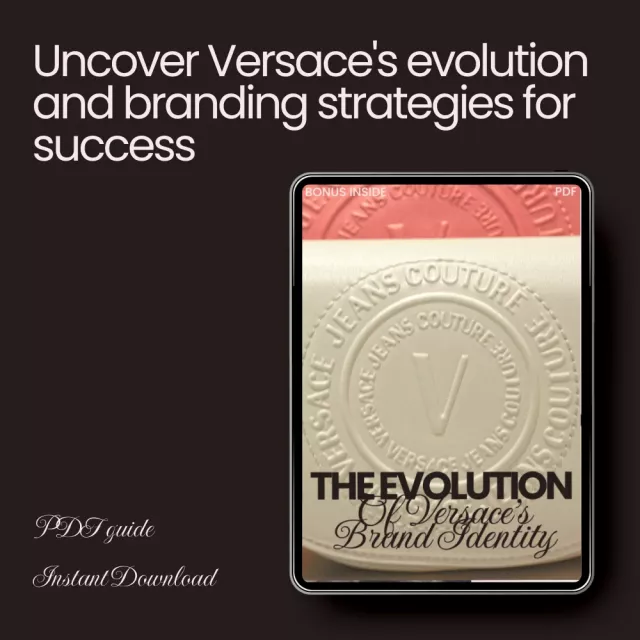
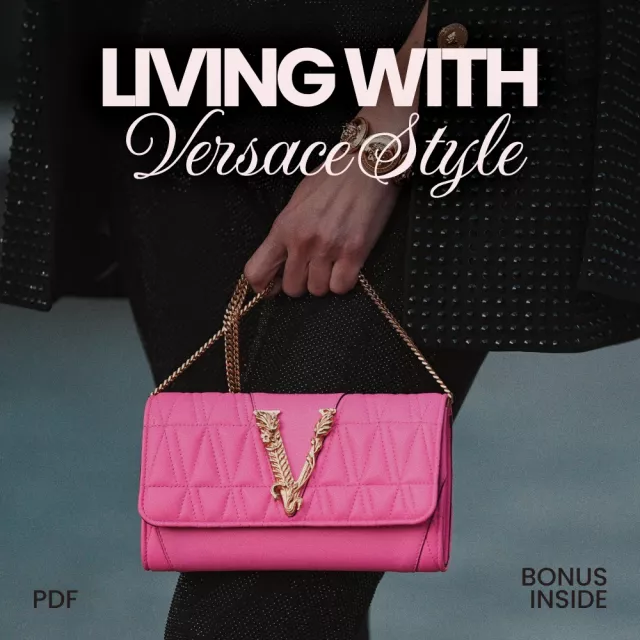
Discover the Fascinating Evolution of Versace’s Brand Identity
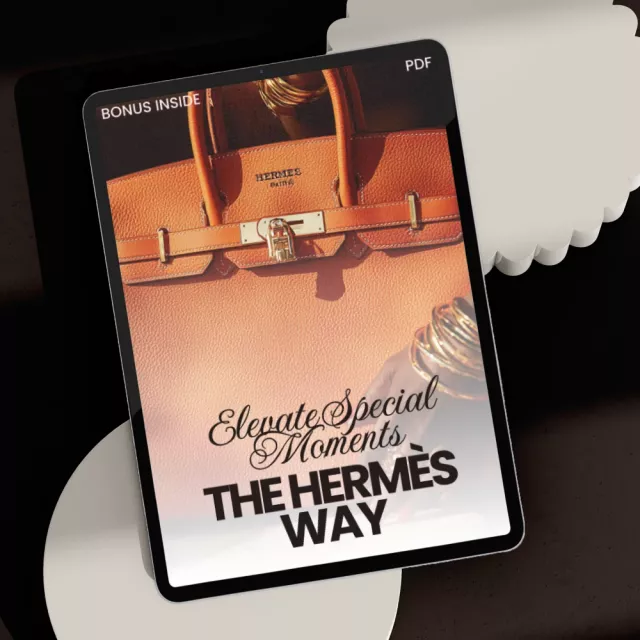
Explore the iconic journey of Versace’s brand identity evolution with this comprehensive digital guide. From its bold beginnings to the iconic status it holds today, this eBook takes you through the defining moments that shaped the Versace empire. Dive into Gianni Versace’s vision, the iconic Medusa logo, and the stunning evolution of its visual language, including color palettes, typography, and collaborations with high-profile artists. Whether you’re a brand creator, fashion enthusiast, or business professional, this guide offers deep insights into the art of building a legacy while staying relevant in a fast-changing world.
In this digital guide, you will find:
- Genesis of Glamour: The birth of Versace and its early vision.
- The Role of Italian Heritage: How Versace embraced its roots and connected with its audience.
- The Medusa Logo: The iconic symbol and its deeper meaning.
- Color Palette and Patterns: How Versace’s distinct style evolved over the decades.
- Typography and Visual Language: Understanding the brand’s unique visual communication.
- Runway to Pop Culture: How celebrity endorsements and red carpet moments solidified the brand’s legacy.
- Leadership Transition: Donatella Versace’s influence and reinvention of the brand.
- Digital & Experiential Identity: How Versace leverages digital platforms to tell its story.
- AI-Powered Branding: Tools and tricks for modern brand development.
- Case Studies and Exercises: Practical tips for applying Versace’s principles to your own brand evolution.
Why This eBook Is a Must-Have
This guide is for anyone fascinated by the Versace brand identity evolution and those looking to harness the power of branding. Whether you’re an aspiring fashion designer, marketing professional, or someone simply interested in the art of luxury branding, this eBook offers unparalleled insights into the strategies behind one of the most successful fashion houses in history.
Unlike other digital resources, this guide delves deeper into the intricate aspects of brand development, highlighting specific campaigns and collaborations that shaped public perception. From learning how to craft a brand narrative to staying ahead of trends with AI-powered tools, you’ll gain practical knowledge to apply to your own branding endeavors.
Download now and unlock the secrets to building a timeless brand like Versace! Gain exclusive insights into how legacy brands evolve and innovate, and how you can apply those principles to your own brand journey.
SHIPPING
We are proud to offer international shipping services that currently operate in over 200 countries and islands world wide. Nothing means more to us than bringing our customers great value and service. We will continue to grow to meet the needs of all our customers, delivering a service beyond all expectation anywhere in the world.
Do you ship worldwide?
Yes. We provide free shipping to over 200 countries around the world. However, there are some locations we are unable to ship to. If you happen to be located in one of those countries we will contact you.
What about customs?
We are not responsible for any custom fees once the items have been shipped. By purchasing our products, you consent that one or more packages may be shipped to you and may get custom fees when they arrive to your country.
How long does shipping take?
Shipping time varies by location. These are our estimates:| Location | *Estimated Shipping Time |
|---|---|
| United States | 5-20 Business days |
| Canada, Europe | 5-20 Business days |
| Australia, New Zealand | 5-20 Business days |
| Central & South America | 5-25 Business days |
| Asia | 5-20 Business days |
| Africa | 5-25 Business days |
Do you provide tracking information?
Yes, you will receive an email once your order ships that contains your tracking information. If you haven’t received tracking info within 5 days, please contact us.
My tracking says “no information available at the moment”.
For some shipping companies, it takes 2-5 business days for the tracking information to update on the system. If your order was placed more than 5 business days ago and there is still no information on your tracking number, please contact us.
Will my items be sent in one package?
For logistical reasons, items in the same purchase will sometimes be sent in separate packages, even if you've specified combined shipping.
If you have any other questions, please contact us and we will do our best to help you out.
RETURNS
Order cancellation
All orders can be cancelled until they are shipped. If your order has been paid and you need to make a change or cancel an order, you must contact us within 12 hours. Once the packaging and shipping process has started, it can no longer be cancelled.
Refunds
Your satisfaction is our #1 priority. Therefore, you can request a refund or reshipment for ordered products if:
- If you did not receive the product within the guaranteed time (45 days not including 1-3 day processing) you can request a refund or a reshipment.
- If you received the wrong item you can request a refund or a reshipment.
- If you do not want the product you’ve received you may request a refund but you must return the item at your expense and the item must be unused.
We do not issue the refund if:
- Your order did not arrive due to factors within your control (i.e. providing the wrong shipping address)
- Your order did not arrive due to exceptional circumstances outside the control of cyclonica.com (i.e. not cleared by customs, delayed by a natural disaster).
- Other exceptional circumstances outside the control of cyclonica.com.
*You can submit refund requests within 15 days after the guaranteed period for delivery (45 days) has expired. You can do it by sending a message on Contact Us page
If you are approved for a refund, then your refund will be processed, and a credit will automatically be applied to your credit card or original method of payment, within 14 days.
Exchanges
If for any reason you would like to exchange your product, perhaps for a different size in clothing, you must contact us first and we will guide you through the steps.
Please do not send your purchase back to us unless we authorise you to do so.
Order cancellation
All orders can be cancelled until they are shipped. If your order has been paid and you need to make a change or cancel an order, you must contact us within 12 hours. Once the packaging and shipping process has started, it can no longer be cancelled.
Refunds
Your satisfaction is our #1 priority. Therefore, you can request a refund or reshipment for ordered products if:
- If you did not receive the product within the guaranteed time( 45 days not including 2-5 day processing) you can request a refund or a reshipment.
- If you received the wrong item you can request a refund or a reshipment.
- If you do not want the product you’ve received you may request a refund but you must return the item at your expense and the item must be unused.
We do not issue the refund if:
- Your order did not arrive due to factors within your control (i.e. providing the wrong shipping address)
- Your order did not arrive due to exceptional circumstances outside the control of cyclonica.com (i.e. not cleared by customs, delayed by a natural disaster).
- Other exceptional circumstances outside the control of
*You can submit refund requests within 15 days after the guaranteed period for delivery (45 days) has expired. You can do it by sending a message on Contact Us page
If you are approved for a refund, then your refund will be processed, and a credit will automatically be applied to your credit card or original method of payment, within 14 days.
Exchanges
If for any reason you would like to exchange your product, perhaps for a different size in clothing. You must contact us first and we will guide you through the steps.
Please do not send your purchase back to us unless we authorise you to do so.
Customer Reviews
Write a Review
We Think You’ll Love
Top picks just for you











The Donatella leadership transition section is the most nuanced take I've read on brand reinvention after loss. She preserved the Medusa and baroque DNA while pulling the brand toward a younger, edgier audience — and the guide explains exactly how that balance works. Genuinely useful framework for anyone managing a brand through change.
The decade-by-decade color palette breakdown made the evolution tangible instead of abstract 🔥
Eight chapters and not a single one felt like padding.
The Jungle Collection case study alone justifies the read. Seeing how one dress created a cultural ripple effect and what that teaches about timing, celebrity placement, and visual boldness — that's the kind of analysis you pay consultants for. The AI branding section at the end was a nice modern cherry on top.
Finally a PDF that treats typography as part of brand identity, not an afterthought.
The visual identity exercises in the last chapter gave me a weekend project that completely reshaped my brand's look.
Strong guide with real depth on how Versace built desire through spectacle and scarcity. The section on collaborations shaping public perception was especially sharp. I would've liked more detail on the H&M partnership — it's mentioned but not fully unpacked. Still a worthwhile read for anyone studying luxury positioning.
The flagship store section made me rethink how physical space communicates brand.
👑✨🔥💯
That line about Medusa appearing in everything from belt buckles to runway prints — I never noticed the visual thread before and now I can't unsee it.
The storytelling-through-multimedia section is where this guide separates itself from typical fashion PDFs. Most focus on clothes; this one explains how video campaigns, AR filters, and editorial spreads all reinforce the same identity. I run a small accessories brand and I immediately audited my own channels for consistency after reading it. Found three places where my messaging was contradicting itself.
Crisp writing that respects your time on every page.
The mistakes-to-avoid section hit close to home — I've been chasing trends instead of building identity 🧠
Good content overall and the structure flows well from origins through to modern digital strategy. I felt the AI tools section listed options without going deep enough on any single workflow. The branding fundamentals in chapters one through five are excellent though and worth the download alone.
The Italian heritage section grounded everything that came after.
Risk mixed with refinement — that framing of Gianni's approach unlocked something for me.
I teach a brand strategy course at a community college and I've been looking for a case study that covers origins, evolution, crisis management, and modern digital adaptation in one place. This does it. The Donatella section works perfectly for discussing leadership transitions, the Jungle Collection case study illustrates cultural momentum, and the mistakes-to-avoid page gives students concrete pitfalls to watch for. I assigned the visual identity exercises as homework and the quality of submissions jumped noticeably. Already planning to use it again next semester.
The capsule collection prompt example was surprisingly practical.
Covers the full arc from 1978 to TikTok without losing focus.
The distinction between Gianni's theatricality and Donatella's modern minimalism gave me language for a tension I couldn't articulate in my own brand. Bold but refined versus sleek but rooted — now I know which direction I'm pulling toward.
Interesting and well-researched. The pop culture chapter does a great job connecting red carpet moments to brand amplification strategy. My only critique is the trendspotting section at the end felt rushed compared to the depth of earlier chapters. Would read an expanded version.
❤️🔥👌
The section on digital campaigns as a brand stage — not just a store — reframed my entire e-commerce approach.
Tight, well-paced, and smarter than most branding books twice its length.
I run a streetwear brand and the section on maintaining legacy while innovating was exactly the tension I've been struggling with. The guide frames it as retaining your visual DNA while experimenting at the edges — collaborations, digital campaigns, limited runs. I restructured my next drop around that principle and presales doubled. The AI prompts for capsule collection ideation saved me three rounds of back-and-forth with my designer.
That Elizabeth Hurley safety pin dress breakdown is a masterclass in moment marketing.
Solid branding resource with actionable takeaways. The visual identity development exercises are well-designed and the case studies provide real context. I wished the ChatGPT prompts section included more examples beyond the one caption prompt — felt like it could've been a standalone chapter. The core content more than delivers though.
The Greek key motif analysis was a detail I haven't seen covered anywhere else.
Every brand builder should read the collaboration pitfalls section before signing a partnership deal.
The way it connects Gianni's original vision to Donatella's evolution to the current digital strategy creates a through-line most brand guides lack. You see the logic behind every shift instead of just a timeline of events. The exercises at the end turn passive reading into active brand work.
The color palette evolution from 80s neons to modern metallics and pastels told a story on its own 🎨
Clean structure, no wasted pages, real strategic depth.
Decent overview of Versace's brand journey with some solid observations, especially on how exclusivity drives desire and how collaborations can both strengthen and dilute identity. The AI section felt bolted on rather than woven into the narrative. The first six chapters carry the weight here.
The experiential retail section made me realize my online store has zero personality.
Reads like a brand strategy deck disguised as a fashion history.
I've been building a fragrance brand for two years and hitting a wall on visual identity. This guide's approach — define a core symbol, lock in your palette, then enforce consistency across every touchpoint — gave me a clear sequence to follow. The mood board exercise using AI-generated imagery produced better results in an afternoon than three months of Pinterest collecting. The mistakes section about neglecting cohesive storytelling across channels called out exactly what I was doing wrong.
The lifestyle branding pivot — from fashion shows to homeware and fragrances — is analyzed better here than in most MBA case studies.
Good read with clear takeaways for brand creators. The Medusa symbolism analysis and the pop culture chapter are standouts. I felt the next steps section could have pushed further into specifics — it stays at the principle level where I wanted concrete action plans. The exercises partially fill that gap.
Gianni's approach to fashion as storytelling reframed my whole content strategy.
The serif-vs-sans-serif typography breakdown was a small detail that made a big difference in how I think about brand materials.
✨👑🖤🔥✨
Compelling guide that covers decades of brand strategy in a surprisingly tight package. The reinvention chapter on Donatella's era is particularly strong — the analysis of how she shifted messaging toward millennials and Gen Z while keeping heritage cues intact is the kind of insight that usually costs consulting fees. I do think the collaboration case studies could have included one or two failures alongside the successes for balance. The visual identity exercises at the end are excellent and I've already worked through all three.
The framing of brand evolution as natural, not forced — that's the line I needed to hear.
Eight chapters that build on each other like a brand itself — foundation first, then spectacle.
The guide touches on some genuinely important brand strategy concepts, and the Versace lens makes the theory sticky. I wanted the AI branding chapter to feel less like a tool directory and more like an integrated part of the brand analysis. Chapters one through six are sharp enough to recommend on their own merits.
The observation that Versace stores function as mini-museums changed how I design my pop-up spaces 🔥
Storytelling as brand currency — four words that restructured my marketing plan.
The scope is impressive — origins, symbols, pop culture, tragedy, digital, case studies, AI tools, and exercises all in one guide. It never feels overstuffed because each section earns its place and builds toward the next. The Medusa analysis alone gave me a framework for developing my own brand's core symbol.
Practical enough to use today, deep enough to revisit next year.
The way it frames red carpet appearances as performance art — not just outfit displays — completely shifted my perspective on brand visibility strategy.
Good analysis of how strategic celebrity visibility creates aspirational association. The whole pop culture chapter delivers. Would've appreciated one more case study beyond the Jungle Collection and the safety pin dress — perhaps something from the 2010s or 2020s. The branding fundamentals and exercises still make this well worth the time.
The best brand evolution guide I've read this year — and it's about fashion.