





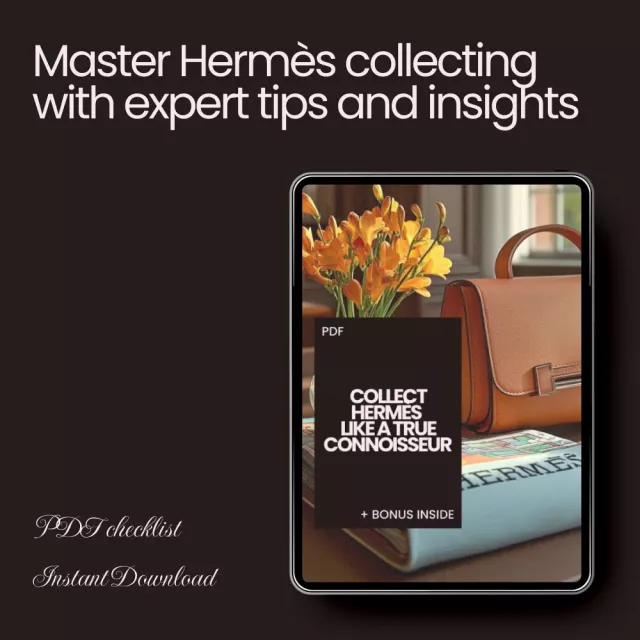
Unlock the Secrets to Curating Your Own Hermès Collection
If you’ve ever dreamed of collecting Hermès like a true connoisseur, this is the guide you’ve been waiting for. Whether you’re new to Hermès or looking to refine your approach, our digital checklist is designed to provide you with expert strategies to build a timeless, valuable collection. From iconic bags to rare scarves and small leather goods, you’ll learn how to navigate the world of Hermès with confidence and precision. Make informed, smart decisions that elevate your collection with this essential tool.
Key Features of the “Collect Hermès Like a True Connoisseur” Checklist:
- Define your collector strategy: Focus on the right pieces for your style and goals.
- Research iconic Hermès models and heritage lines: Gain insight into the timeless designs that matter most.
- Set a clear annual collecting budget: Ensure you stay within your financial limits while building a valuable collection.
- Study market demand: Learn how to predict which pieces will gain value over time.
- Track prices across platforms: Compare boutique pricing with reputable resale platforms.
- Focus on proven investment pieces: Discover classic silhouettes and limited editions that are sure to hold or increase in value.
- Verify authenticity: Know how to authenticate your items with precision, from stitching to hardware quality.
- Protect and track your collection: Organize your pieces, store them properly, and monitor their market value.
Why This Checklist is a Must-Have for Serious Collectors
This digital guide is perfect for anyone serious about collecting Hermès. Whether you’re looking to focus on bags, scarves, or small leather goods, this checklist gives you the roadmap to refine your strategy and avoid impulse buys. You’ll benefit from expert advice on researching iconic Hermès models, setting budgets, and prioritizing pieces that will maintain or increase in value. By focusing on Hermès shopping tips for collectors, you’ll gain insights into how to track demand, understand market fluctuations, and even compare pricing to make the best purchasing decisions.
What makes this checklist stand out from other digital resources is its focus on providing both practical guidance and long-term investment strategies. With tips on authenticity verification, understanding waitlist trends, and proper care for your pieces, this guide goes beyond surface-level information to help you become a true expert in the world of Hermès.
Download Now and Start Curating Your Collection
Ready to collect Hermès like a true connoisseur? Download the Collect Hermès Like a True Connoisseur checklist now and start your journey toward building an iconic, valuable collection. Whether you’re a seasoned collector or just beginning, this guide is the perfect tool to help you make informed, strategic decisions with every purchase.
SHIPPING
We are proud to offer international shipping services that currently operate in over 200 countries and islands world wide. Nothing means more to us than bringing our customers great value and service. We will continue to grow to meet the needs of all our customers, delivering a service beyond all expectation anywhere in the world.
Do you ship worldwide?
Yes. We provide free shipping to over 200 countries around the world. However, there are some locations we are unable to ship to. If you happen to be located in one of those countries we will contact you.
What about customs?
We are not responsible for any custom fees once the items have been shipped. By purchasing our products, you consent that one or more packages may be shipped to you and may get custom fees when they arrive to your country.
How long does shipping take?
Shipping time varies by location. These are our estimates:| Location | *Estimated Shipping Time |
|---|---|
| United States | 5-20 Business days |
| Canada, Europe | 5-20 Business days |
| Australia, New Zealand | 5-20 Business days |
| Central & South America | 5-25 Business days |
| Asia | 5-20 Business days |
| Africa | 5-25 Business days |
Do you provide tracking information?
Yes, you will receive an email once your order ships that contains your tracking information. If you haven’t received tracking info within 5 days, please contact us.
My tracking says “no information available at the moment”.
For some shipping companies, it takes 2-5 business days for the tracking information to update on the system. If your order was placed more than 5 business days ago and there is still no information on your tracking number, please contact us.
Will my items be sent in one package?
For logistical reasons, items in the same purchase will sometimes be sent in separate packages, even if you've specified combined shipping.
If you have any other questions, please contact us and we will do our best to help you out.
RETURNS
Order cancellation
All orders can be cancelled until they are shipped. If your order has been paid and you need to make a change or cancel an order, you must contact us within 12 hours. Once the packaging and shipping process has started, it can no longer be cancelled.
Refunds
Your satisfaction is our #1 priority. Therefore, you can request a refund or reshipment for ordered products if:
- If you did not receive the product within the guaranteed time (45 days not including 1-3 day processing) you can request a refund or a reshipment.
- If you received the wrong item you can request a refund or a reshipment.
- If you do not want the product you’ve received you may request a refund but you must return the item at your expense and the item must be unused.
We do not issue the refund if:
- Your order did not arrive due to factors within your control (i.e. providing the wrong shipping address)
- Your order did not arrive due to exceptional circumstances outside the control of cyclonica.com (i.e. not cleared by customs, delayed by a natural disaster).
- Other exceptional circumstances outside the control of cyclonica.com.
*You can submit refund requests within 15 days after the guaranteed period for delivery (45 days) has expired. You can do it by sending a message on Contact Us page
If you are approved for a refund, then your refund will be processed, and a credit will automatically be applied to your credit card or original method of payment, within 14 days.
Exchanges
If for any reason you would like to exchange your product, perhaps for a different size in clothing, you must contact us first and we will guide you through the steps.
Please do not send your purchase back to us unless we authorise you to do so.
Order cancellation
All orders can be cancelled until they are shipped. If your order has been paid and you need to make a change or cancel an order, you must contact us within 12 hours. Once the packaging and shipping process has started, it can no longer be cancelled.
Refunds
Your satisfaction is our #1 priority. Therefore, you can request a refund or reshipment for ordered products if:
- If you did not receive the product within the guaranteed time( 45 days not including 2-5 day processing) you can request a refund or a reshipment.
- If you received the wrong item you can request a refund or a reshipment.
- If you do not want the product you’ve received you may request a refund but you must return the item at your expense and the item must be unused.
We do not issue the refund if:
- Your order did not arrive due to factors within your control (i.e. providing the wrong shipping address)
- Your order did not arrive due to exceptional circumstances outside the control of cyclonica.com (i.e. not cleared by customs, delayed by a natural disaster).
- Other exceptional circumstances outside the control of
*You can submit refund requests within 15 days after the guaranteed period for delivery (45 days) has expired. You can do it by sending a message on Contact Us page
If you are approved for a refund, then your refund will be processed, and a credit will automatically be applied to your credit card or original method of payment, within 14 days.
Exchanges
If for any reason you would like to exchange your product, perhaps for a different size in clothing. You must contact us first and we will guide you through the steps.
Please do not send your purchase back to us unless we authorise you to do so.
Customer Reviews
Write a Review
We Think You’ll Love
Top picks just for you


















I've been buying Hermès impulsively for years — a scarf here, a charm there, whatever caught my eye in the boutique. My collection felt scattered and I couldn't explain why. This checklist gave me the framework I was missing. Setting a core theme and sticking to it immediately sharpened my focus. I've passed on three impulse buys since reading it and feel better about my collection than I have in a long time.
The authenticity verification section alone is worth the download. Practical and precise.
Printed it, laminated it, and keep it in my bag journal. This is the collecting companion I didn't know I needed — especially the tip about tracking resale values periodically. Turned my hobby into something intentional.
Short, strategic, and immediately actionable 🔥
Good framework overall, but I wish it went deeper on how to research heritage lines specifically. The advice to do it is solid but a beginner wouldn't know where to start. Still a helpful resource.
The reminder to set an annual collecting budget sounds obvious but it stopped me from overextending twice this quarter already.
Finally a collecting guide that treats Hermès as an investment, not just a flex.
I started collecting Hermès scarves about two years ago with no real plan. I'd grab whatever design I loved at the moment, which meant I had twelve scarves that didn't really work together and three that I never wore. After going through this checklist, I defined my focus around equestrian-themed prints in neutral tones and started tracking which designs held value on resale platforms. In six months, I sold four pieces that didn't fit my theme, reinvested in two that did, and my collection finally feels cohesive. The advice about avoiding random purchases outside your core theme was the turning point for me. I refer back to this checklist before every purchase now 👜
Clean and organized. No fluff, just the right questions to ask yourself.
Comparing boutique pricing with resale platforms — such a simple habit that I somehow never formalized until now. Already saved me from one overpriced pre-owned purchase.
Useful as a starting point but too surface-level for anyone who's been collecting seriously. The checklist format works but I expected more nuance around seasonal variations and leather types.
Exactly what a first-time collector needs. Nothing more, nothing less.
I was about to buy a trendy colorway that everyone on social media was raving about. This checklist made me pause and check whether it had any track record of holding value. It didn't. Went with gold hardware in étoupe instead and already feeling smarter about it.
The storage advice is basic but important — dust bags and stable environment. I had two scarves developing creases because I wasn't storing them properly. Fixed it the same day I read this.
🧡👜✨⭐
Wish there was a section on building relationships with SAs at boutiques. That's a huge part of collecting that this doesn't touch. The rest of the checklist is well-structured though and I've already started using the tracking suggestions.
Discipline over desire — that's the thread running through this whole thing and it's exactly right.
Started documenting purchase dates and prices like the checklist suggests. Already seeing patterns in my spending I was blind to.
I've spent close to $40,000 on Hermès over the past three years and have almost nothing to show for it strategically. Random bags in colors that don't match, accessories bought on vacation impulses, and two pieces I've never even used. This checklist arrived at exactly the right moment. I went through every item, realized I had no collector strategy whatsoever, and spent a full weekend reorganizing my approach. Defined my focus as classic bag silhouettes in neutral leathers, set a strict annual budget, and started tracking resale values monthly. It's only been four months but the shift is dramatic — I've made two purchases that both fit my theme and both appreciated in value on the secondary market. My husband says I went from shopping to curating. He's right.
Tiny PDF, massive clarity. Keep it on my phone for boutique visits.
The tip about favoring neutral or signature colorways is so practical for someone just starting out. Keeps the collection versatile while you figure out your preferences.
I liked the investment framing but the guide doesn't mention insurance or appraisals at all. For a collection-focused resource, that feels like a gap. The authenticity and tracking sections are well done though.
Rotate usage to maintain condition — noted, applied, grateful.
This is the checklist I wish existed when I bought my first Kelly.
My mother collected Hermès for decades without any system. Beautiful pieces but no documentation, no tracking, no strategy. When she passed some of her collection to me, I had no idea what anything was worth or when it was purchased. This checklist made me determined not to repeat that. I now photograph every piece, log every receipt, and review values quarterly. It sounds clinical but it actually deepened my appreciation because I understand what I own and why each piece matters.
Smart, focused, and respects your time.
The market demand section is helpful but could benefit from naming specific platforms or tools for tracking resale values. As-is, the advice is directionally correct but vague on execution.
Passed on two impulse purchases this month because of the core theme filter. Already paying for itself 💡
The stitching and hardware inspection tips gave me confidence to buy pre-owned for the first time. Ended up finding an excellent Constance at a fair price because I knew exactly what to look for.
Every collector needs a system. This is a great one to start with.
Nothing here that an experienced collector doesn't already practice intuitively. The format is nice and the advice is sound, but it reads as introductory. Would love a version aimed at intermediate collectors dealing with questions like when to sell, how to assess condition grades, or how to evaluate rare colorways.
Reviewed my entire collection after reading this and realized three pieces don't fit my theme at all. Listed two, kept one for sentimental reasons. Collection feels tighter already.
This made collecting feel like a practice instead of a habit.
Quick read with lasting impact. The annual budget checkpoint alone changed my approach.
❤️👜🔥👌
I collect small leather goods specifically and this validated so much of what I was doing instinctively — focusing on classic silhouettes, sticking to signature colors, checking resale trends. But the documentation piece was a wake-up call. I had zero records. Now everything is logged in a spreadsheet with dates, prices, and condition notes. Took one afternoon and now I feel like an actual collector instead of someone who just accumulates things.
Good bones but I wanted more. The checklist format works for quick reference but doesn't explore the reasoning behind each point. Why classics over trends? What makes a colorway hold value? A few sentences of context per section would elevate this significantly.
Texted a photo of this to my best friend mid-read. We now share a collecting spreadsheet.
The caution against trend-driven designs saved me real money already.
Request detailed photos for pre-owned purchases — yes. I cannot stress enough how important this is and I'm glad it's on the checklist. Avoided one questionable seller because of this exact step.
Concise enough to use, thorough enough to trust.
My collecting journey before this: see bag, want bag, buy bag, repeat. My collecting journey after: define focus, research models, compare pricing, verify authenticity, then maybe buy. The transformation sounds small on paper but in practice it's completely changed my relationship with luxury purchases. I'm spending less, enjoying more, and every piece in my collection now has a reason for being there. The storage and tracking section also made me realize I was damaging pieces through careless storage — silk scarves folded wrong, bags without stuffing. Fixed all of it in one weekend. This free PDF probably saved me thousands in the long run.
A patient collector's best friend.
Straightforward and well-organized. I only wish there was a follow-up version for scarf collectors specifically, since the nuances of print rarity and artist collaborations deserve their own checklist.
I've been eyeing a Picotin for months but couldn't decide on the color. The advice to favor neutral or signature colorways simplified the decision instantly — went with gold and haven't looked back.
Treats collecting as a discipline, not a hobby. That reframe alone is valuable.
Saved this to my home screen. Check it before every purchase.
This covers the basics well but skips over the emotional side of collecting — how to decide between something you love and something that's strategically sound. That tension is the hardest part of building a collection and I'd like to see it addressed.
I showed this to my sister who just started getting into Hermès and she said it prevented at least two poor choices in her first month. Starting with structure instead of scrambling to build one later makes all the difference.
Monitoring availability patterns and waitlist trends — such a simple addition to my routine that's given me way more confidence in timing my purchases.
The checklist format makes it easy to revisit without re-reading everything. Smart design choice.
Brief but potent. Exactly the guardrails a new collector needs 🧡
I appreciated the structure but the guide assumes you're collecting primarily for value. Some of us collect for personal joy and aesthetic pleasure, and those priorities can coexist with investment thinking. A bit more balance between heart and strategy would strengthen this.
My first Hermès purchase was an impulse buy — a bright seasonal color that felt exciting in the moment and now sits unused in my closet. My second purchase was after reading this checklist. Classic silhouette, neutral tone, strong resale track record. The difference in how I feel about each piece is night and day. One feels like a mistake I'm stuck with. The other feels like the start of something real. I check this guide every single time now before even walking into a boutique.
Tracks value, protects pieces, prevents regrets. What more do you need?
Keep receipts and authenticity materials organized — I know this sounds basic but I found seven receipts stuffed in different drawers after reading this. Now they're all in one binder with photos. Feels like I actually respect my collection now.
This took me fifteen minutes to read and it's reshaping years of bad collecting habits.
Every point earns its spot on the list. Nothing redundant.
👜🤎✨👏
I collect vintage Hermès scarves and the authenticity section was a needed reminder to stay rigorous. Got complacent with a seller I trusted and nearly missed a questionable piece. Back to inspecting every detail now.
Good for absolute beginners. If you've been collecting for more than a year or two, most of this will already be second nature. I'd rate it higher if it covered resale timing or how to assess leather aging.
My husband and I collect together and we've started using this as our shared decision framework. Prevents arguments about whether something is a smart buy or an emotional one. We both check the list and if it doesn't pass, we wait. Has probably saved our marriage as much as our budget 😂
I'd love to see a version that includes a printable tracking template alongside the checklist. The advice to document purchases is great — a ready-made format to do it in would make it even easier to implement.
The point about limited editions with documented demand is subtle but important. Not every limited piece is valuable — only the ones people actually want. That distinction saved me from a bad purchase last month.
Collecting without strategy is just shopping. This made that distinction crystal clear.
Focused and clean. I reference it weekly now.
The most useful free resource I've found on Hermès collecting. The investment section alone reframed how I evaluate every potential purchase.
I've been buying Hermès accessories for about five years now — mostly small leather goods and a few scarves. Before this checklist, my approach was entirely emotional. I'd walk into a boutique, fall in love with a color or a texture, and walk out with something I hadn't planned to buy. My collection grew quickly but incoherently. Some pieces I adored, others sat untouched. I never tracked resale values, never compared boutique prices with the secondary market, and never thought about whether a design had long-term staying power. This guide changed all of that. I sat down one evening and went through every checkbox, honestly evaluating my habits. I didn't have a core theme. I didn't have a budget. I wasn't storing pieces properly. It was humbling but clarifying. Since then, I've defined my focus as compact wallets and card holders in classic Hermès colors, set a quarterly spending cap, started photographing and logging every piece with purchase details, and moved everything into proper dust bags in a humidity-controlled closet. Four pieces that didn't fit my theme went to consignment. The proceeds funded one piece that did — a beautiful calvi in gold Epsom that I use daily. My collection is smaller now but it finally tells a story. I genuinely look forward to each addition because it's deliberate, not impulsive.
Solid checklist for newcomers. Would love an advanced version covering auction strategy and condition grading scales. What's here is reliable and well-formatted though.
This is the kind of thing you save and open every time you're tempted by a bad purchase.
Passion plus precision — that framing in the opening line set the tone perfectly. The whole checklist lives up to it.
Straightforward enough to use immediately. No overthinking required.
Shared it with my collecting group chat and three people reorganized their approach that same week. This works.