





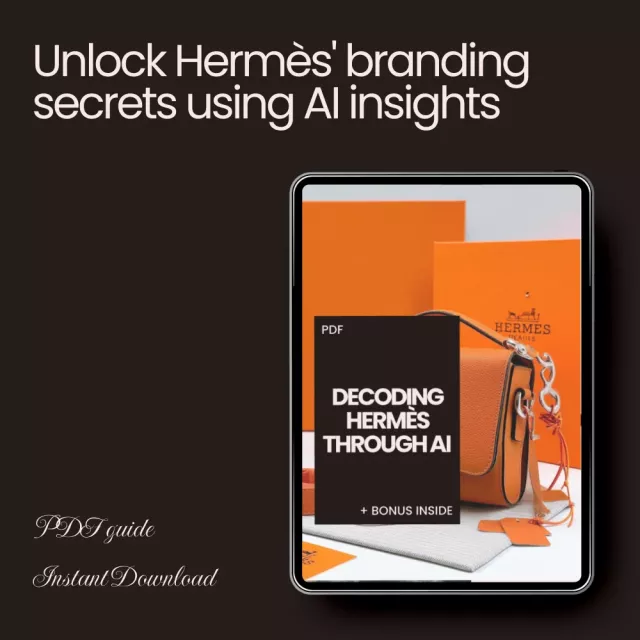
Uncover the Secrets of Hermès’ Timeless Brand Identity with AI
Step into the world of Hermès like never before with the “Decoding Hermès Through AI” guide. This digital download is the ultimate resource for anyone seeking to understand the powerful essence of one of the most iconic luxury brands in the world. Whether you’re a marketer, brand strategist, or luxury enthusiast, this guide offers invaluable AI-driven insights on Hermès brand identity and reveals the key components that contribute to its enduring success. Armed with cutting-edge AI analysis, you’ll unlock hidden patterns and signals that define the Hermès aura, taking your understanding of luxury branding to new heights.
What’s Inside?
- Chapter 1: What Makes the Hermès Identity So Powerful – Explore the core brand signals, how heritage meets modern desire, and the importance of consistency in luxury branding.
- Chapter 2: How AI Reveals the Hermès Formula – Delve into pattern recognition, visual and emotional signals AI can detect, and a fascinating case study mapping the Hermès aura.
- Chapter 3: Mistakes Brands Make When Analyzing Luxury – Understand the common pitfalls of data analysis and how to smartly interpret brand insights for success.
- Chapter 4: Applying AI Insights to Your Own Brand – Learn practical AI tools, prompt examples, and strategic steps to apply AI insights to elevate your brand identity.
Why You Need This Guide
This guide is perfect for professionals in the luxury branding, marketing, and business strategy sectors who are eager to gain a deeper understanding of Hermès’ brand identity. By applying AI insights on Hermès brand identity, you’ll be able to leverage powerful techniques to enhance your own brand’s positioning. Discover how AI can detect visual and emotional signals that resonate with high-end consumers, and avoid common mistakes that many brands make when analyzing luxury. With “Decoding Hermès Through AI,” you’ll learn how to decode luxury branding strategies to stand out in an increasingly competitive market.
Practical Benefits for You
- Unlock AI-driven insights that uncover the essence of Hermès’ powerful brand identity.
- Gain clarity on applying AI insights to refine your own brand strategy.
- Avoid costly branding mistakes with smart interpretation strategies and practical AI tools.
- Enhance your brand’s emotional connection with consumers through AI-detected visual and emotional signals.
Ready to Decode the Secrets of Luxury Branding?
Download “Decoding Hermès Through AI” today and gain access to the most advanced AI insights on Hermès brand identity. Whether you’re looking to refine your own branding strategy or simply want to understand how Hermès maintains its luxury status, this guide is an invaluable resource. Take the first step towards mastering luxury branding by clicking download now!
SHIPPING
We are proud to offer international shipping services that currently operate in over 200 countries and islands world wide. Nothing means more to us than bringing our customers great value and service. We will continue to grow to meet the needs of all our customers, delivering a service beyond all expectation anywhere in the world.
Do you ship worldwide?
Yes. We provide free shipping to over 200 countries around the world. However, there are some locations we are unable to ship to. If you happen to be located in one of those countries we will contact you.
What about customs?
We are not responsible for any custom fees once the items have been shipped. By purchasing our products, you consent that one or more packages may be shipped to you and may get custom fees when they arrive to your country.
How long does shipping take?
Shipping time varies by location. These are our estimates:| Location | *Estimated Shipping Time |
|---|---|
| United States | 5-20 Business days |
| Canada, Europe | 5-20 Business days |
| Australia, New Zealand | 5-20 Business days |
| Central & South America | 5-25 Business days |
| Asia | 5-20 Business days |
| Africa | 5-25 Business days |
Do you provide tracking information?
Yes, you will receive an email once your order ships that contains your tracking information. If you haven’t received tracking info within 5 days, please contact us.
My tracking says “no information available at the moment”.
For some shipping companies, it takes 2-5 business days for the tracking information to update on the system. If your order was placed more than 5 business days ago and there is still no information on your tracking number, please contact us.
Will my items be sent in one package?
For logistical reasons, items in the same purchase will sometimes be sent in separate packages, even if you've specified combined shipping.
If you have any other questions, please contact us and we will do our best to help you out.
RETURNS
Order cancellation
All orders can be cancelled until they are shipped. If your order has been paid and you need to make a change or cancel an order, you must contact us within 12 hours. Once the packaging and shipping process has started, it can no longer be cancelled.
Refunds
Your satisfaction is our #1 priority. Therefore, you can request a refund or reshipment for ordered products if:
- If you did not receive the product within the guaranteed time (45 days not including 1-3 day processing) you can request a refund or a reshipment.
- If you received the wrong item you can request a refund or a reshipment.
- If you do not want the product you’ve received you may request a refund but you must return the item at your expense and the item must be unused.
We do not issue the refund if:
- Your order did not arrive due to factors within your control (i.e. providing the wrong shipping address)
- Your order did not arrive due to exceptional circumstances outside the control of cyclonica.com (i.e. not cleared by customs, delayed by a natural disaster).
- Other exceptional circumstances outside the control of cyclonica.com.
*You can submit refund requests within 15 days after the guaranteed period for delivery (45 days) has expired. You can do it by sending a message on Contact Us page
If you are approved for a refund, then your refund will be processed, and a credit will automatically be applied to your credit card or original method of payment, within 14 days.
Exchanges
If for any reason you would like to exchange your product, perhaps for a different size in clothing, you must contact us first and we will guide you through the steps.
Please do not send your purchase back to us unless we authorise you to do so.
Order cancellation
All orders can be cancelled until they are shipped. If your order has been paid and you need to make a change or cancel an order, you must contact us within 12 hours. Once the packaging and shipping process has started, it can no longer be cancelled.
Refunds
Your satisfaction is our #1 priority. Therefore, you can request a refund or reshipment for ordered products if:
- If you did not receive the product within the guaranteed time( 45 days not including 2-5 day processing) you can request a refund or a reshipment.
- If you received the wrong item you can request a refund or a reshipment.
- If you do not want the product you’ve received you may request a refund but you must return the item at your expense and the item must be unused.
We do not issue the refund if:
- Your order did not arrive due to factors within your control (i.e. providing the wrong shipping address)
- Your order did not arrive due to exceptional circumstances outside the control of cyclonica.com (i.e. not cleared by customs, delayed by a natural disaster).
- Other exceptional circumstances outside the control of
*You can submit refund requests within 15 days after the guaranteed period for delivery (45 days) has expired. You can do it by sending a message on Contact Us page
If you are approved for a refund, then your refund will be processed, and a credit will automatically be applied to your credit card or original method of payment, within 14 days.
Exchanges
If for any reason you would like to exchange your product, perhaps for a different size in clothing. You must contact us first and we will guide you through the steps.
Please do not send your purchase back to us unless we authorise you to do so.
Customer Reviews
Write a Review
We Think You’ll Love
Top picks just for you
















I run a small accessories label and the section on overcopying surface aesthetics called me out hard. I'd been mimicking luxury color palettes without understanding the discipline underneath. After reading this, I stripped my brand back to three core visual codes and committed to them. Within a few months my Instagram engagement shifted from casual browsers to people who actually remembered my brand between posts. The case study on mapping the Hermès aura gave me a concrete framework I still reference weekly.
Clean, strategic, and surprisingly actionable for a short read 🔥
The distinction between extraction and imitation is worth the download alone. I've shared it with my entire creative team.
This reframed how I think about consistency in branding. Not boring repetition — intentional discipline.
Really solid introduction to using AI for brand analysis. The prompt examples gave me a starting point I didn't have before, though I found myself wanting more advanced use cases for someone already familiar with sentiment tools.
Read it in one sitting on the train and immediately opened my brand guidelines doc to audit myself.
The bit about coherent touchpoints clicked something for me. I'd been obsessing over my logo when the real gap was between my website tone and my packaging 👀
Practical without being dumbed down.
I teach a branding seminar for early-stage founders and this is going on the reading list. The way it breaks down how AI can validate what your gut already suspects about visual consistency is exactly the bridge most beginners need. Not everyone has the budget for a brand strategist, but everyone can run the kind of audit this PDF describes.
Good content overall. Some sections felt a bit surface-level for anyone who's already studied luxury positioning, but the AI angle adds a fresh lens. The case study was the strongest part.
Short, focused, and zero fluff.
The chapter on mistakes brands make when analyzing luxury should be required reading before anyone touches a mood board. I've watched three startups in my accelerator cohort try to look like Hermès and end up looking like each other instead. This PDF explains exactly why that happens and how to avoid it.
🧡🖤✨👏⭐
Finally someone said it — high visual similarity scores don't equal strong identity.
I appreciated the nuance here. It doesn't just worship Hermès — it asks you to think critically about which principles actually transfer to your own context. The section on pairing every AI insight with a human question is a mindset shift I needed 💡
Useful primer but I wanted deeper dives into specific AI tools and workflows. The recommendations stayed fairly general.
Made me rethink my entire approach to brand evolution.
The heritage-meets-modern-desire framework is deceptively simple. I used it to audit my own skincare brand and realized I was leaning too far into trend-chasing at the expense of the origin story that made people care in the first place. Pulled back, refocused on three heritage touchpoints, and my repeat purchase rate went up within a quarter. Didn't expect a PDF about Hermès to fix my retention problem but here we are.
Grabbed this expecting luxury fluff and got a legitimate brand strategy resource instead.
The concept of using AI as a compass rather than a shortcut stuck with me. Really thoughtful framing throughout.
Decent read. I liked the structure and the case study was interesting, but some of the AI claims felt vague — would have preferred links to actual tools or more specific methodology behind the brand scan they reference.
Tight and well-organized ✨
Sent this to my business partner at 1am with the message "we need to talk about our color palette." That's the kind of PDF this is.
As someone building a DTC menswear brand, the section on controlled variation versus constant reinvention was a wake-up call. I'd been changing my visual direction every season trying to stay fresh and wondering why nobody could describe what my brand looked like. This guide made the connection between consistency and recognition feel obvious in hindsight. Already locked in my core palette and committed to a twelve-month visual freeze. Scary but necessary.
Straightforward enough for beginners, sharp enough for people already in the game.
The takeaway about identity strength growing through intentional restraint — that one sentence restructured my whole branding philosophy 🎯
Worth the read for the mistakes chapter alone.
I found the content well-intentioned but slightly repetitive across chapters. The core insight — consistency builds trust — is strong, but it gets restated in similar ways throughout. Tighter editing would make this sharper.
The emotional signals section opened my eyes. I'd been focused entirely on visual branding and completely ignoring how people describe my brand in their own words. Ran a quick sentiment scan after reading this and the gap between what I thought I was projecting and what people actually felt was humbling.
Punchy and useful.
👌🔥💯
Good foundational framework. I wish the prompt examples section had five or six more detailed prompts — the three included were solid but I burned through them fast and wanted more to work with.
My co-founder and I have been arguing about whether to rebrand for months. This PDF settled it. We don't need a rebrand — we need discipline. The section comparing dramatic repositioning to small consistent improvements gave us a shared language to move forward. We picked two high-impact refinements like the guide suggests and shelved the rest. Three weeks in and even our designer said the work feels more focused.
Every founder trying to look premium needs to read the overcopying chapter before spending another dollar on design.
Clear writing, smart structure, no wasted pages.
I've read a lot of branding PDFs and most recycle the same advice. This one earns its keep by connecting brand analysis to AI tooling in a way that's approachable without being shallow. The case study section is where it really comes together 👏
Interesting angle but left me wanting more depth on the AI methodology.
Downloaded it for the Hermès analysis, stayed for the brand-building advice.
The part about data without context is the most important section. AI can show you patterns all day but if you don't understand the cultural engine behind them you'll build a hollow copy. That framing alone separates this from the typical branding content flooding my feed.
Quick read with lasting impact.
Good overall. Some sections assume you already have access to AI analysis tools without really guiding you to specific ones, which might frustrate true beginners. The strategic thinking is sound though.
Bookmarked, highlighted, and added to my brand strategy Notion board within ten minutes of finishing 🙌
Not just about Hermès — it's a lens for understanding why any strong brand works.
Before finding this I was spending hours on Pinterest trying to reverse-engineer why certain luxury brands felt so cohesive while mine felt scattered. The pattern recognition section gave me a framework to actually diagnose the problem instead of just feeling frustrated. I ran a color audit across my last twelve Instagram posts and found I was using seventeen different tones when I thought I was using five. Fixed that one thing and my grid immediately looked more intentional. Then I applied the consistency principles to my product descriptions and email headers. Small moves but the cumulative effect was noticeable fast — two clients independently told me my brand felt more polished. This PDF taught me that coherence compounds.