





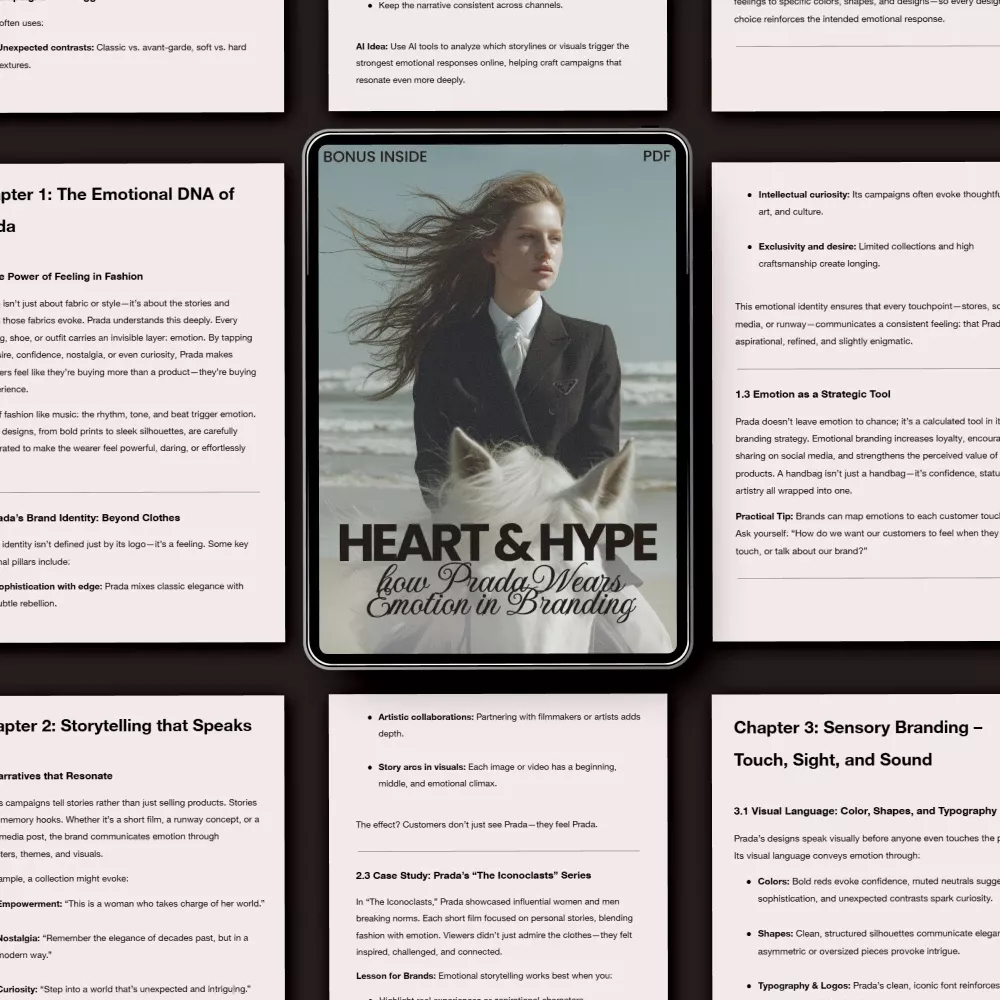


Turn Emotion Into Influence. Turn Influence Into Iconic Branding.
What makes Prada more than a fashion house? Why do its campaigns linger in our minds long after the runway lights fade? Heart & Hype: How Prada Wears Emotion in Branding is a deep dive into the psychology, storytelling, and strategy behind one of the world’s most emotionally intelligent luxury brands. If you’ve ever wondered how prada uses emotion in branding to create desire, loyalty, and cultural relevance, this eBook unpacks it all—clearly, strategically, and practically.
This professionally crafted digital download blends fashion insight with actionable marketing strategy, making it a must-read for creatives, brand owners, and marketers who want to build brands people feel—not just buy.
What’s Inside This eBook
- Chapter 1: The Emotional DNA of Prada – understanding emotion as a strategic tool
- Chapter 2: Storytelling that Speaks – including a case study of Prada’s “The Iconoclasts” series
- Chapter 3: Sensory Branding – how touch, sight, and sound elevate brand perception
- Chapter 4: Aspirational Identity – exclusivity, desire, and emotional loyalty
- Chapter 5: Digital Emotion – AI, personalization, and emotional campaign prompts
- Chapter 6: Measuring Emotional Impact – sentiment analysis and metrics beyond sales
- Chapter 7: Your Next Steps – creating your own emotional branding blueprint
Who This Is For
This eBook is perfect for:
- Fashion entrepreneurs and boutique owners
- Marketing professionals and brand strategists
- Content creators and storytellers
- Students studying branding or luxury marketing
- Small business owners who want premium positioning
Why This Guide Is Different
Unlike generic branding guides, this resource focuses specifically on how prada uses emotion in branding as a masterclass in strategic feeling. It doesn’t just analyze campaigns—it translates them into frameworks you can apply immediately. You’ll discover how emotion drives exclusivity, how sensory cues shape perception, and how AI can enhance emotional engagement without losing authenticity.
With real examples, strategic breakdowns, and AI prompt inspiration included, this guide bridges luxury fashion theory with practical execution for modern brands.
What You’ll Gain
- A clear understanding of emotional branding in luxury markets
- Tools to craft campaigns that resonate deeply
- Insights into measuring emotional engagement beyond revenue
- Practical steps to build long-term brand loyalty
- Confidence to position your brand with intention and impact
Download Now & Start Building Emotional Impact
If you’re ready to move beyond surface-level marketing and create a brand that connects on a human level, Heart & Hype: How Prada Wears Emotion in Branding is your next strategic advantage. Download your copy today and start transforming emotion into your most powerful branding asset.
SHIPPING
We are proud to offer international shipping services that currently operate in over 200 countries and islands world wide. Nothing means more to us than bringing our customers great value and service. We will continue to grow to meet the needs of all our customers, delivering a service beyond all expectation anywhere in the world.
Do you ship worldwide?
Yes. We provide free shipping to over 200 countries around the world. However, there are some locations we are unable to ship to. If you happen to be located in one of those countries we will contact you.
What about customs?
We are not responsible for any custom fees once the items have been shipped. By purchasing our products, you consent that one or more packages may be shipped to you and may get custom fees when they arrive to your country.
How long does shipping take?
Shipping time varies by location. These are our estimates:| Location | *Estimated Shipping Time |
|---|---|
| United States | 5-20 Business days |
| Canada, Europe | 5-20 Business days |
| Australia, New Zealand | 5-20 Business days |
| Central & South America | 5-25 Business days |
| Asia | 5-20 Business days |
| Africa | 5-25 Business days |
Do you provide tracking information?
Yes, you will receive an email once your order ships that contains your tracking information. If you haven’t received tracking info within 5 days, please contact us.
My tracking says “no information available at the moment”.
For some shipping companies, it takes 2-5 business days for the tracking information to update on the system. If your order was placed more than 5 business days ago and there is still no information on your tracking number, please contact us.
Will my items be sent in one package?
For logistical reasons, items in the same purchase will sometimes be sent in separate packages, even if you've specified combined shipping.
If you have any other questions, please contact us and we will do our best to help you out.
RETURNS
Order cancellation
All orders can be cancelled until they are shipped. If your order has been paid and you need to make a change or cancel an order, you must contact us within 12 hours. Once the packaging and shipping process has started, it can no longer be cancelled.
Refunds
Your satisfaction is our #1 priority. Therefore, you can request a refund or reshipment for ordered products if:
- If you did not receive the product within the guaranteed time (45 days not including 1-3 day processing) you can request a refund or a reshipment.
- If you received the wrong item you can request a refund or a reshipment.
- If you do not want the product you’ve received you may request a refund but you must return the item at your expense and the item must be unused.
We do not issue the refund if:
- Your order did not arrive due to factors within your control (i.e. providing the wrong shipping address)
- Your order did not arrive due to exceptional circumstances outside the control of cyclonica.com (i.e. not cleared by customs, delayed by a natural disaster).
- Other exceptional circumstances outside the control of cyclonica.com.
*You can submit refund requests within 15 days after the guaranteed period for delivery (45 days) has expired. You can do it by sending a message on Contact Us page
If you are approved for a refund, then your refund will be processed, and a credit will automatically be applied to your credit card or original method of payment, within 14 days.
Exchanges
If for any reason you would like to exchange your product, perhaps for a different size in clothing, you must contact us first and we will guide you through the steps.
Please do not send your purchase back to us unless we authorise you to do so.
Order cancellation
All orders can be cancelled until they are shipped. If your order has been paid and you need to make a change or cancel an order, you must contact us within 12 hours. Once the packaging and shipping process has started, it can no longer be cancelled.
Refunds
Your satisfaction is our #1 priority. Therefore, you can request a refund or reshipment for ordered products if:
- If you did not receive the product within the guaranteed time( 45 days not including 2-5 day processing) you can request a refund or a reshipment.
- If you received the wrong item you can request a refund or a reshipment.
- If you do not want the product you’ve received you may request a refund but you must return the item at your expense and the item must be unused.
We do not issue the refund if:
- Your order did not arrive due to factors within your control (i.e. providing the wrong shipping address)
- Your order did not arrive due to exceptional circumstances outside the control of cyclonica.com (i.e. not cleared by customs, delayed by a natural disaster).
- Other exceptional circumstances outside the control of
*You can submit refund requests within 15 days after the guaranteed period for delivery (45 days) has expired. You can do it by sending a message on Contact Us page
If you are approved for a refund, then your refund will be processed, and a credit will automatically be applied to your credit card or original method of payment, within 14 days.
Exchanges
If for any reason you would like to exchange your product, perhaps for a different size in clothing. You must contact us first and we will guide you through the steps.
Please do not send your purchase back to us unless we authorise you to do so.
Customer Reviews
Write a Review
We Think You’ll Love
Top picks just for you












The breakdown of Prada's three emotional pillars—sophistication with edge, intellectual curiosity, and exclusivity and desire—gave me a clear framework I could actually apply to my own work. I'd been struggling to articulate why certain campaigns felt off, and the section on maintaining emotional consistency across stores, social media, and the runway clicked immediately. The practical tip about mapping emotions to every customer touchpoint is now part of every brief I write.
The 'visual emotion map' concept from Chapter 3 changed how I brief designers.
Before reading this, I treated branding as mostly aesthetic—colors, fonts, a tagline. The case study on Prada's Milan store stopped me cold: marble floors, soft lighting, and curated textures working together to emotionally connect customers before they even try on a product. I'd never thought about physical retail that way. The sensory branding chapter pushed me to rethink our own store layout entirely, which we redesigned three months later. Customer dwell time increased noticeably. The 'Iconoclasts' case study reinforced something I needed to hear: align the story with your core brand values and keep the narrative consistent across channels. This guide gave me a real before/after shift in how I approach brand experience design.
Chapter 4's argument that emotional loyalty outperforms transactional loyalty isn't new, but the framing here—through Prada's VIP programs, storytelling campaigns, and consistent brand values—makes it actionable rather than abstract. The A/B testing example, where two video concepts are evaluated emotionally before global release, is the kind of concrete detail that actually sticks 📌
Finally, someone explains exclusivity without making it sound like just raising prices.
The warning about overusing gimmicks in Chapter 4 is genuinely useful—forced scarcity without narrative is called out plainly, and it's a pattern I've watched too many brands fall into. The point that emotion is credible only when consistent and authentic cuts straight through a lot of expensive nonsense in fashion marketing. Sharp and honest.
The AI sections are thoughtful—sentiment analysis, predictive engagement, AR/VR for simulating tactile experiences online—and I appreciated the framing of AI as a collaborator rather than a replacement for human creativity. The emotional branding blueprint in Chapter 7 is worth the read on its own. My only hesitation is that some AI applications feel more aspirational than immediately actionable for smaller or independent teams.
🎯✨🖤
The soundscapes section made me rethink our entire event audio strategy 🎵
I run a small luxury skincare brand and picked this up skeptically—Prada operates in a different universe than what I sell. By Chapter 2, I had started taking notes. The storytelling framework is sharp: using characters, themes, and visuals to create memory hooks rather than simply pushing product. Chapter 5 hit differently when I realized our chatbot was doing service, not guidance—there's a real distinction between the two, and the section on personalized digital touchpoints helped me articulate it to my developer. The metrics in Chapter 6 gave me a new reporting structure: tracking time spent, repeat visits, and sentiment analysis alongside conversion rather than instead of it. The 'Iconoclasts' case study reinforced a critical distinction between customers who admire your product and customers who feel connected to it.
The section on music and soundscapes is an underrated gem. The point that attendees associate the emotions felt during Prada's runway shows directly with the brand itself—not just the show—reframes sound as a branding tool rather than atmosphere. I've since started building sound guidelines into every client brand system 🎧
Emotion framed as a calculated strategic tool—not an afterthought—is the reframe I needed.
Chapter 7's checklist is now my campaign kickoff template.
What I appreciated most was the honesty about common branding mistakes—specifically the point about inconsistency breaking emotional connection when campaigns, packaging, and store design send mixed signals. I learned this the hard way last year when we launched a new product line and the in-store experience contradicted everything our social campaign had promised. Sales were fine, but customer sentiment felt hollow and short-lived. Reading Chapter 4 was clarifying: the issue wasn't the product, it was emotional incoherence across touchpoints. We've since built a touchpoint audit into every launch, using exactly the kind of questions this guide frames. The section on emotional versus transactional loyalty is now a standing agenda item in our quarterly brand reviews ❤️
There's solid thinking here, especially in the sensory branding chapter and the visual language breakdown—color, shapes, and typography mapped to specific emotional responses. The practical tips throughout are genuinely useful and clearly articulated. That said, the content relies so heavily on Prada as a case study that applying lessons to non-luxury or B2B contexts requires considerable translation work.
💡💼🔥❤️
Every brand manager needs to read the social listening and crisis prevention section.
I work in brand strategy for a mid-size consumer goods company and picked this up skeptically—Prada operates in a different universe than the categories I manage. By Chapter 2, I'd already started annotating. The storytelling framework made me realize we'd been doing narrative backwards: leading with product, tacking on story as decoration. The 'Iconoclasts' case study illustrated what it looks like done right—viewers felt inspired and connected, not merely impressed 💡 What surprised me most was Chapter 3's tactile section. We'd never treated packaging as an emotional instrument, and the idea that unboxing can function as a ritual rather than a transaction led us to redesign our outer packaging and internal wrap entirely. The shift in how customers talk about receiving our products on social media since then has been measurable. Chapter 4's point about authenticity in exclusivity was personally vindicating—we'd run a limited-edition release with no supporting narrative last spring, and it landed flat. Now I understand exactly why. The emotional branding blueprint in Chapter 7 is where I direct every new team member: four steps, no filler, immediately applicable.
⭐⭐⭐⭐⭐🙌
A/B testing with emotional response data before global rollout—obvious once you read it.
The aspirational identity chapter reframed something I'd been getting wrong: aspiration isn't just price point, it's uniqueness, scarcity, and personalized experience working together. The point about curated VIP events and private previews elevating the emotional experience beyond the product itself was particularly sharp. I've restructured our launch events around this thinking and the difference in client conversation has been immediate.