





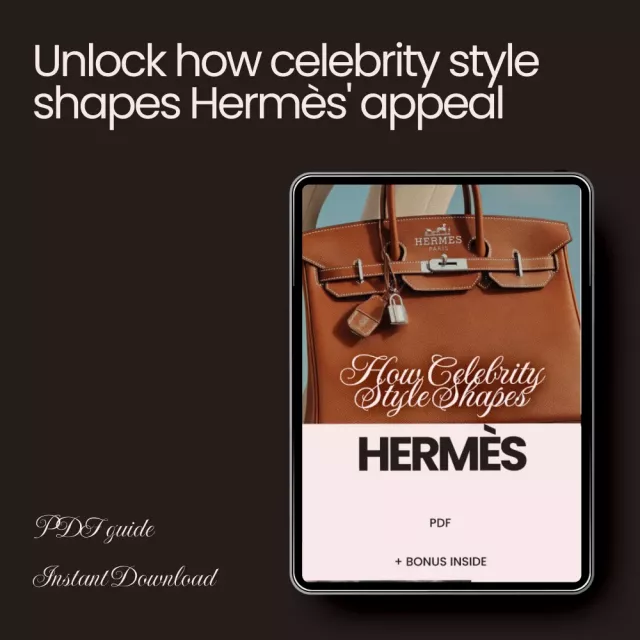
Discover How Celebrity Fashion Influences Hermès and the Luxury Market
Unlock the powerful connection between celebrity fashion and the iconic Hermès brand with this insightful guide. “How Celebrity Style Shapes Hermès” explores how the influence of high-profile figures drives demand, shapes perceptions, and impacts the long-term value of luxury products. Whether you’re a fashion enthusiast, an aspiring trendspotter, or a collector of Hermès pieces, this guide will give you a deeper understanding of the subtle and profound ways that celebrity fashion affects Hermès. Perfect for anyone curious about the relationship between fashion, media, and luxury, this digital download will provide a fresh perspective on how style shapes one of the most prestigious brands in the world.
Main Features & Contents:
- Chapter 1: Why Celebrity Influence Matters for Hermès – Explore the psychology of fashion imitation, how celebrity visibility impacts luxury brands, and why Hermès uses a subtle approach in marketing.
- Chapter 2: Real Impact on Demand and Perception – Learn how celebrity sightings move markets, with a case study of a celebrity carry moment and how the halo effect influences everyday buyers.
- Chapter 3: Where Celebrity Influence Gets Misread – Understand the common mistakes buyers make, the difference between hype and long-term value, and smarter ways to interpret trends.
- Chapter 4: Using AI to Track Celebrity Impact – Discover AI tools for trend monitoring, and gain high-value prompt ideas to track and interpret celebrity influence on luxury fashion.
Practical Benefits:
- Gain a deeper understanding of how celebrity fashion affects Hermès and luxury markets.
- Learn to separate hype from long-term value in celebrity-driven trends.
- Discover tools for tracking celebrity influence with AI to stay ahead of the trends.
- Enhance your ability to make smarter, more informed purchases and investments in luxury fashion.
This guide is perfect for anyone who wants to gain insight into the intersection of celebrity culture and luxury fashion. It’s ideal for fashion lovers, Hermès collectors, or those working in the fashion industry who need to stay on top of trends. With a unique approach to understanding how celebrity style shapes Hermès, this guide provides valuable insights that you won’t find in other resources.
Don’t miss out on this exclusive opportunity to understand the profound influence of celebrity fashion on Hermès. Download “How Celebrity Style Shapes Hermès” today and start mastering the trends!
SHIPPING
We are proud to offer international shipping services that currently operate in over 200 countries and islands world wide. Nothing means more to us than bringing our customers great value and service. We will continue to grow to meet the needs of all our customers, delivering a service beyond all expectation anywhere in the world.
Do you ship worldwide?
Yes. We provide free shipping to over 200 countries around the world. However, there are some locations we are unable to ship to. If you happen to be located in one of those countries we will contact you.
What about customs?
We are not responsible for any custom fees once the items have been shipped. By purchasing our products, you consent that one or more packages may be shipped to you and may get custom fees when they arrive to your country.
How long does shipping take?
Shipping time varies by location. These are our estimates:| Location | *Estimated Shipping Time |
|---|---|
| United States | 5-20 Business days |
| Canada, Europe | 5-20 Business days |
| Australia, New Zealand | 5-20 Business days |
| Central & South America | 5-25 Business days |
| Asia | 5-20 Business days |
| Africa | 5-25 Business days |
Do you provide tracking information?
Yes, you will receive an email once your order ships that contains your tracking information. If you haven’t received tracking info within 5 days, please contact us.
My tracking says “no information available at the moment”.
For some shipping companies, it takes 2-5 business days for the tracking information to update on the system. If your order was placed more than 5 business days ago and there is still no information on your tracking number, please contact us.
Will my items be sent in one package?
For logistical reasons, items in the same purchase will sometimes be sent in separate packages, even if you've specified combined shipping.
If you have any other questions, please contact us and we will do our best to help you out.
RETURNS
Order cancellation
All orders can be cancelled until they are shipped. If your order has been paid and you need to make a change or cancel an order, you must contact us within 12 hours. Once the packaging and shipping process has started, it can no longer be cancelled.
Refunds
Your satisfaction is our #1 priority. Therefore, you can request a refund or reshipment for ordered products if:
- If you did not receive the product within the guaranteed time (45 days not including 1-3 day processing) you can request a refund or a reshipment.
- If you received the wrong item you can request a refund or a reshipment.
- If you do not want the product you’ve received you may request a refund but you must return the item at your expense and the item must be unused.
We do not issue the refund if:
- Your order did not arrive due to factors within your control (i.e. providing the wrong shipping address)
- Your order did not arrive due to exceptional circumstances outside the control of cyclonica.com (i.e. not cleared by customs, delayed by a natural disaster).
- Other exceptional circumstances outside the control of cyclonica.com.
*You can submit refund requests within 15 days after the guaranteed period for delivery (45 days) has expired. You can do it by sending a message on Contact Us page
If you are approved for a refund, then your refund will be processed, and a credit will automatically be applied to your credit card or original method of payment, within 14 days.
Exchanges
If for any reason you would like to exchange your product, perhaps for a different size in clothing, you must contact us first and we will guide you through the steps.
Please do not send your purchase back to us unless we authorise you to do so.
Order cancellation
All orders can be cancelled until they are shipped. If your order has been paid and you need to make a change or cancel an order, you must contact us within 12 hours. Once the packaging and shipping process has started, it can no longer be cancelled.
Refunds
Your satisfaction is our #1 priority. Therefore, you can request a refund or reshipment for ordered products if:
- If you did not receive the product within the guaranteed time( 45 days not including 2-5 day processing) you can request a refund or a reshipment.
- If you received the wrong item you can request a refund or a reshipment.
- If you do not want the product you’ve received you may request a refund but you must return the item at your expense and the item must be unused.
We do not issue the refund if:
- Your order did not arrive due to factors within your control (i.e. providing the wrong shipping address)
- Your order did not arrive due to exceptional circumstances outside the control of cyclonica.com (i.e. not cleared by customs, delayed by a natural disaster).
- Other exceptional circumstances outside the control of
*You can submit refund requests within 15 days after the guaranteed period for delivery (45 days) has expired. You can do it by sending a message on Contact Us page
If you are approved for a refund, then your refund will be processed, and a credit will automatically be applied to your credit card or original method of payment, within 14 days.
Exchanges
If for any reason you would like to exchange your product, perhaps for a different size in clothing. You must contact us first and we will guide you through the steps.
Please do not send your purchase back to us unless we authorise you to do so.
Customer Reviews
Write a Review
We Think You’ll Love
Top picks just for you











The aspirational mirroring concept in Chapter 1 completely reframed how I understand my own buying behavior. I always thought I was immune to celebrity influence until I realized I'd purchased three pieces after seeing them carried casually in paparazzi shots — not ads, not campaigns, just someone I admire going about their day. This guide put language to a pattern I couldn't name.
The halo effect section explained something I've felt but never articulated.
The case study on the celebrity carry moment was the strongest part. I'd always noticed how certain models seem to get hotter overnight and then just stay there — this PDF finally explained why Hermès doesn't crash back down the way trend-driven brands do. The structural advantage argument is convincing and well-supported.
Tight analysis and surprisingly nuanced for a free PDF.
The quiet luxury positioning section alone changed how I think about brand marketing. Hermès not chasing loud endorsements is the whole strategy and this guide unpacks it clearly.
I work in fashion PR and the distinction between celebrity exposure creating demand versus accelerating existing demand is something most people in my field don't grasp. This PDF nails it. Shared it with my entire team 🙌
Read it on a flight and landed with a completely different perspective on my wish list.
The common buyer mistakes chapter was a mirror. I once chased an exact bag I saw on a style icon without thinking about whether it fit my actual wardrobe. It sat in my closet for a year before I consigned it. This guide would have saved me that expensive lesson — the advice about buying for personal lifestyle fit over celebrity association is dead on.
🔥👜✨⭐
Smart, measured, zero hype — ironic for a guide about hype.
The section about how increased visibility intensifies waiting lists rather than flooding the market is a detail most luxury content completely ignores. That single insight explains why celebrity moments help Hermès instead of diluting it.
Good analysis but the guide never names specific celebrities or carry moments, which makes it feel abstract. Real examples with actual search data would have made the case study chapter significantly more persuasive.
The dual perception point — insiders reading the signal immediately while casual observers just see taste — was brilliant.
Forwarded to my group chat within five minutes of finishing.
I used to scroll celebrity outfit breakdowns and immediately search for whatever bag they were carrying. After reading Chapter 3, I now filter those impulses through a much clearer lens — does the piece align with timeless Hermès design language, or is it a seasonal outlier? That one question has already stopped me from two reactive purchases.
The restraint argument is the real thesis here and it holds up.
Chapter 4 on AI tools felt like a different guide bolted on at the end. The first three chapters build a tight, specific argument about celebrity influence on Hermès, and then the AI section drops into generic prompt suggestions without connecting them back to the actual analysis. Would have preferred a deeper treatment of the hype-versus-value framework instead.
The point about celebrity adoption appearing authentic because Hermès avoids sponsorship cues — that's the whole quiet luxury playbook in one sentence 💡
Practical and concise. No padding.
I study consumer psychology and the aspirational mirroring framework here is solid. The guide correctly identifies that buyers aren't just purchasing a product — they're buying into a perceived lifestyle. Most luxury content dances around this idea without stating it plainly. Appreciated the directness.
The smarter ways to interpret trends section gave me a filter I now use for every fashion decision.
Strong framework but I wanted the case study to include actual resale price data — before and after a specific celebrity moment — rather than describing the pattern in general terms. The argument is convincing conceptually but hard data would have clinched it.
The overexposure warning hit different. I'd never thought about how too much celebrity visibility could weaken a luxury brand's positioning until this guide spelled it out.
❤️👌🔥
Every section builds on the last. Tight structure.
I run a resale business and the insight about price movement being gradual rather than explosive for Hermès is something I've observed but never seen articulated this well. Celebrity moments for other brands create spikes that crash. Hermès just drifts upward and stays. This guide explains exactly why that structural difference exists.
The layered effect concept — organic sightings building on each other over time — was the most original idea in the whole PDF.
Solid content overall but the AI chapter needs work. Suggesting prompts without showing output examples or naming specific tools makes it feel like an afterthought rather than an integrated chapter.
I've been deep in the Hermès world for years and this still taught me something new. The idea that celebrity fashion acts as an accelerant rather than a foundation for prestige is a distinction most enthusiasts don't make. I used to think visibility drove the brand's appeal entirely. This PDF showed me the demand was already built — celebrities just turn up the volume. That shift in framing changed how I evaluate new sightings. Now I ask whether the piece has existing structural demand before I let a paparazzi photo influence my thinking. My last three purchases have felt significantly more intentional as a result.
Clean writing, no filler, respects the reader's intelligence.
The section about filtering audiences through subtlety — attracting people who appreciate nuance over noise — was such a sharp observation 🧠
The hype versus long-term value chapter should be mandatory reading before anyone's first luxury purchase.
Appreciated how the guide separates emotional excitement from strategic value. That framing alone is worth the read.
The point about treating celebrity signals as directional clues rather than buying instructions gave me a framework I'll use permanently.
My friends and I used to debate whether celebrity carry moments actually affect prices. Sent them this PDF and the conversation leveled up immediately. The case study section settled the argument — prices move, but gradually, and only when the piece already has strong fundamentals.
I was hoping for deeper analysis of how different types of celebrities — actors versus entrepreneurs versus royalty — influence Hermès demand differently. The guide treats all celebrity visibility as one category, but the aspirational mirroring effect likely varies a lot depending on who's carrying. Still a strong read overall.
Punchy, smart, and done before my espresso cooled.
⭐⭐⭐👜🧡
I teach a fashion marketing course at university and just added this to my supplementary reading list. The distinction between Hermès' organic celebrity strategy and the heavy-handed ambassador model used by most luxury houses is exactly the kind of real-world contrast my students need. The guide's treatment of quiet luxury positioning is rigorous without being academic, which is a hard balance to strike. My only critique is that the AI tools chapter doesn't meet the analytical standard set by the first three chapters — I'd rather it had been omitted than included at a lower depth.
The demand acceleration concept was new to me and immediately useful.
Interesting angle but the case study felt generic. Without naming actual celebrity moments or citing measurable search volume changes, it reads more like a thought exercise than a real case study. Chapters 1 and 3 carry the weight.
The argument that Hermès lets product quality and heritage lead the narrative while other brands lead with celebrity — that contrast stuck with me. I now notice the difference constantly when I scroll fashion content.
Shared this with my sister who was about to impulse-buy a bag she saw on Instagram. She paused, actually thought about wardrobe fit, and chose a different piece that she's now worn every week for three months 😊
Short, sharp, and immediately applicable.
The connection between controlled production and how celebrity visibility intensifies waiting lists instead of flooding the market was the single most insightful point. That's what makes Hermès fundamentally different from every other house discussed in mainstream fashion media.
Appreciated the nuance throughout. This isn't a celebrity worship guide — it's a strategic framework for understanding influence patterns.
The guide is well-written but I think it underplays how social media has accelerated the celebrity-to-purchase pipeline compared to the pre-Instagram era. The analysis feels slightly behind the curve on how quickly influence translates to resale movement in today's market.
This guide made me realize I'd been a hype-cycle shopper disguised as a strategic buyer.
The observation that celebrity exposure reinforces Hermès' image rather than redefining it is subtle but important. Most brands get reshaped by whoever's carrying them. Hermès stays Hermès regardless.
Well-argued and refreshingly honest about the limits of celebrity influence on actual value.
My husband reads zero fashion content and I handed him this over dinner. He finished it in twenty minutes and said it was the first luxury analysis that made strategic sense to him. The psychology of imitation section landed especially hard — he finally gets why I care about this brand differently.
The buyer mistakes chapter saved me from overpaying on the resale market for a bag I only wanted because I saw it in a street style photo. Stepped back, evaluated lifestyle fit, and realized it wasn't for me.
Chapter 4 felt rushed. The earlier chapters set up a genuinely interesting analytical framework about how celebrity influence operates differently for Hermès, and then the AI section just lists three generic prompts. Would have preferred a chapter on how to build your own celebrity-to-demand tracking workflow, even a simple one. The rest of the guide is excellent though — particularly the hype versus long-term value breakdown in Chapter 3.
Concise, original, zero wasted pages.
The social validation point about products feeling endorsed without aggressive advertising is exactly how I experienced my first Hermès purchase. Nobody sold me on it. I just kept seeing it on people whose taste I respected until it felt inevitable 🎯
Strong overall but the AI tools section needs specific platform names and real examples to be useful. Right now it's more conceptual than actionable.
The idea that overexposure weakens quiet luxury perception is something every brand manager should internalize.
This PDF connected dots I'd never thought to connect. I'd always treated celebrity fashion content and resale market data as separate worlds. This guide showed me they're part of the same demand ecosystem — and that understanding the relationship between them makes you a smarter buyer. The framework for interpreting trends as directional clues rather than purchase triggers is something I now apply instinctively. I also appreciated that the guide doesn't dismiss celebrity influence as superficial. It takes it seriously as a market force while keeping readers grounded in what actually drives long-term Hermès value: design consistency, scarcity, and condition.
Read it twice. Even better the second time.
The guide's thesis — that celebrity influence accelerates but doesn't create Hermès demand — is simple, original, and holds up across every example I can think of.
Good content but I wanted a deeper dive into how regional differences in celebrity culture affect Hermès demand. The analysis reads as very Western-centric — K-pop and C-drama celebrity influence on Asian luxury markets deserves its own section.