





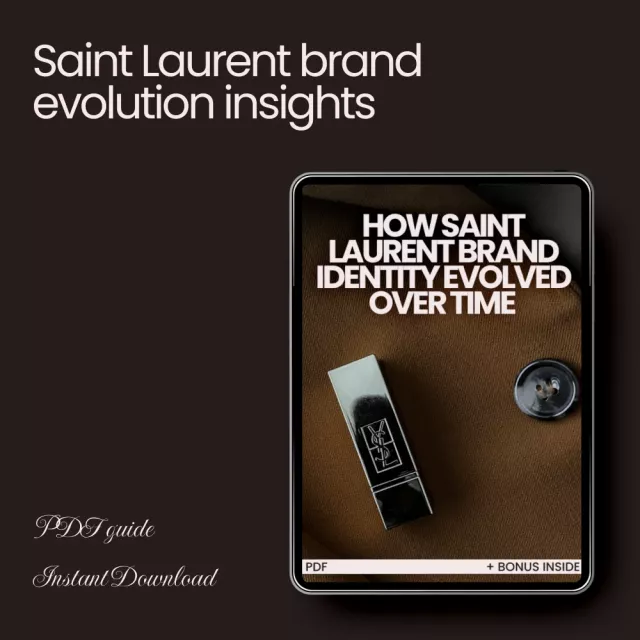
Product Description
Discover the captivating journey of one of the most iconic fashion houses in the world with our digital guide, How Saint Laurent Brand Identity Evolved Over Time. This comprehensive eBook takes you through the fascinating evolution of the Saint Laurent brand, from its groundbreaking inception to its modern-day reinvention. Whether you’re a fashion enthusiast, brand strategist, or creative professional, this guide provides invaluable insights into how a powerful brand identity is built, reinvented, and maintained across generations.
Inside this carefully curated guide, you’ll uncover the key moments that shaped Saint Laurent’s distinct and ever-evolving brand identity. Learn about the legacy of Yves Saint Laurent’s vision, the impact of Hedi Slimane’s transformative era, and the smooth continuation under Anthony Vaccarello’s creative leadership. This guide isn’t just a history lesson; it’s a roadmap for understanding the principles of brand evolution and how you can apply them to your own brand-building efforts.
Key Features:
- Chapter 1: The Foundations of Saint Laurent Identity – Explore Yves Saint Laurent’s original vision and the birth of the Parisian edge.
- Chapter 2: Modern Reinvention and Creative Shifts – Delve into the pivotal shifts during the Hedi Slimane era and how Anthony Vaccarello brought continuity with fresh perspectives.
- Chapter 3: Common Mistakes Brands Make During Rebranding – Avoid costly rebranding pitfalls such as changing too much too fast and losing emotional consistency.
- Chapter 4: Using AI to Track and Guide Brand Evolution – Learn how AI tools can help you analyze brand perception and create smarter strategies for brand growth.
Practical Benefits:
- Gain a deeper understanding of the Saint Laurent brand identity evolution and what made it a symbol of style and sophistication.
- Learn about the key creative shifts and leadership decisions that helped shape the brand’s lasting success.
- Discover actionable insights that will help you avoid common mistakes brands make during rebranding.
- Understand how to leverage AI in guiding your brand’s evolution and maintaining relevance in a fast-changing market.
This guide is perfect for marketers, brand managers, designers, or anyone with an interest in fashion branding. It’s not just a look back at the history of Saint Laurent; it’s a masterclass in how to approach brand identity evolution in a way that’s both strategic and emotionally resonant. Whether you’re starting your own brand or looking to refine an existing one, this resource is an essential tool for anyone wanting to understand the intricate details of brand identity evolution.
Download Now
Ready to dive into the world of Saint Laurent and unlock the secrets behind their successful brand evolution? Download the guide today and start your journey toward mastering brand identity evolution. Whether you’re building a new brand or reimagining an existing one, this guide is the perfect resource to ensure you’re on the right path.
SHIPPING
We are proud to offer international shipping services that currently operate in over 200 countries and islands world wide. Nothing means more to us than bringing our customers great value and service. We will continue to grow to meet the needs of all our customers, delivering a service beyond all expectation anywhere in the world.
Do you ship worldwide?
Yes. We provide free shipping to over 200 countries around the world. However, there are some locations we are unable to ship to. If you happen to be located in one of those countries we will contact you.
What about customs?
We are not responsible for any custom fees once the items have been shipped. By purchasing our products, you consent that one or more packages may be shipped to you and may get custom fees when they arrive to your country.
How long does shipping take?
Shipping time varies by location. These are our estimates:| Location | *Estimated Shipping Time |
|---|---|
| United States | 5-20 Business days |
| Canada, Europe | 5-20 Business days |
| Australia, New Zealand | 5-20 Business days |
| Central & South America | 5-25 Business days |
| Asia | 5-20 Business days |
| Africa | 5-25 Business days |
Do you provide tracking information?
Yes, you will receive an email once your order ships that contains your tracking information. If you haven’t received tracking info within 5 days, please contact us.
My tracking says “no information available at the moment”.
For some shipping companies, it takes 2-5 business days for the tracking information to update on the system. If your order was placed more than 5 business days ago and there is still no information on your tracking number, please contact us.
Will my items be sent in one package?
For logistical reasons, items in the same purchase will sometimes be sent in separate packages, even if you've specified combined shipping.
If you have any other questions, please contact us and we will do our best to help you out.
RETURNS
Order cancellation
All orders can be cancelled until they are shipped. If your order has been paid and you need to make a change or cancel an order, you must contact us within 12 hours. Once the packaging and shipping process has started, it can no longer be cancelled.
Refunds
Your satisfaction is our #1 priority. Therefore, you can request a refund or reshipment for ordered products if:
- If you did not receive the product within the guaranteed time (45 days not including 1-3 day processing) you can request a refund or a reshipment.
- If you received the wrong item you can request a refund or a reshipment.
- If you do not want the product you’ve received you may request a refund but you must return the item at your expense and the item must be unused.
We do not issue the refund if:
- Your order did not arrive due to factors within your control (i.e. providing the wrong shipping address)
- Your order did not arrive due to exceptional circumstances outside the control of cyclonica.com (i.e. not cleared by customs, delayed by a natural disaster).
- Other exceptional circumstances outside the control of cyclonica.com.
*You can submit refund requests within 15 days after the guaranteed period for delivery (45 days) has expired. You can do it by sending a message on Contact Us page
If you are approved for a refund, then your refund will be processed, and a credit will automatically be applied to your credit card or original method of payment, within 14 days.
Exchanges
If for any reason you would like to exchange your product, perhaps for a different size in clothing, you must contact us first and we will guide you through the steps.
Please do not send your purchase back to us unless we authorise you to do so.
Order cancellation
All orders can be cancelled until they are shipped. If your order has been paid and you need to make a change or cancel an order, you must contact us within 12 hours. Once the packaging and shipping process has started, it can no longer be cancelled.
Refunds
Your satisfaction is our #1 priority. Therefore, you can request a refund or reshipment for ordered products if:
- If you did not receive the product within the guaranteed time( 45 days not including 2-5 day processing) you can request a refund or a reshipment.
- If you received the wrong item you can request a refund or a reshipment.
- If you do not want the product you’ve received you may request a refund but you must return the item at your expense and the item must be unused.
We do not issue the refund if:
- Your order did not arrive due to factors within your control (i.e. providing the wrong shipping address)
- Your order did not arrive due to exceptional circumstances outside the control of cyclonica.com (i.e. not cleared by customs, delayed by a natural disaster).
- Other exceptional circumstances outside the control of
*You can submit refund requests within 15 days after the guaranteed period for delivery (45 days) has expired. You can do it by sending a message on Contact Us page
If you are approved for a refund, then your refund will be processed, and a credit will automatically be applied to your credit card or original method of payment, within 14 days.
Exchanges
If for any reason you would like to exchange your product, perhaps for a different size in clothing. You must contact us first and we will guide you through the steps.
Please do not send your purchase back to us unless we authorise you to do so.
Customer Reviews
Write a Review
We Think You’ll Love
Top picks just for you












The logo case study alone made this worth reading — keeping the YSL monogram on accessories while modernizing the main wordmark is such a smart move.
I run a small fashion label and Chapter 3 stopped me from making a huge rebranding mistake. I was about to overhaul my logo, packaging, tone, and product line all at once because I wanted to signal growth. The section on changing too much too fast made me realize I was about to create identity shock for my existing customers. Instead I mapped my non-negotiable elements first — exactly like the guide suggests — and now I'm rolling changes out gradually. My audience has responded so much better to the slower approach.
The Parisian edge concept — sophistication meets rock-inspired attitude — is the clearest definition of the YSL mood I've seen.
Read it in under an hour. Every chapter builds on the last.
Chapter 2 comparing the Slimane and Vaccarello eras side by side was fascinating. Sharpening vs refining — two completely different strategies that both worked because they stayed aligned with the house's emotional core. The guide makes it clear that the market accepted both shifts because neither felt random. That's the real insight here. I've been studying brand strategy for years and this is one of the most concise breakdowns of successful creative director transitions I've come across.
The emotional consistency section in Chapter 3 is something every brand builder needs to internalize.
Smart, tight, and practical. No padding.
The point about identity being built through disciplined repetition — not single moments — reframed how I think about branding entirely.
⭐🖤🔥👏
Chapter 1 on Yves Saint Laurent's original vision gave me chills. Modern elegance mixed with quiet rebellion — that tension is what makes the brand magnetic even decades later.
Solid brand analysis but the AI section felt lighter than the rest — I wanted specific tool recommendations alongside the prompts.
The section on ignoring core audience expectations while chasing new markets is a trap I've seen destroy brands firsthand.
The distinction between visual evolution and emotional consistency is the most valuable framework in this entire guide. I manage brand strategy for a mid-size company and we were about to launch a rebrand focused almost entirely on new visuals — new colors, new typography, new photography style. After reading Chapter 3 I went back to my team and asked a question we'd never discussed: what feelings need to stay constant? That one question changed our entire approach. We kept the emotional core and updated the surface. The response from our customers has been overwhelmingly positive.
Finished this on a flight and immediately started mapping my own brand's non-negotiable identity elements.
The Vaccarello section on refined continuity is a masterclass in how to take over a brand without breaking it.
How the guide frames growth as expanding the brand world rather than rejecting the original community — that's the line I keep thinking about.
Concise and insightful. Reads more like a brand strategy deck than a typical fashion PDF.
The early signals section in Chapter 1 — black tones, sharp silhouettes, ties to music and nightlife — explains exactly how a brand trains consumers to feel something specific over time 🤍
That concept of mental shortcuts built through disciplined repetition applies way beyond fashion.
I teach a fashion marketing course and I'm adding this to my reading list. The Slimane era analysis is particularly well done — it shows how intensifying existing DNA is different from reinvention. The guide explains that he didn't abandon the brand's codes, he sharpened them. Skinnier tailoring, deeper music culture ties, more youthful energy — but all within the Parisian edge framework the house had already established. My students need to understand this difference between evolution and disruption, and this PDF explains it better than most textbooks.
The logo transition case study is the best example of balancing modernization with heritage protection I've read.
Short enough to read in one sitting, dense enough to reference for months.
The AI prompts for comparing audience sentiment before and after rebranding moves are surprisingly practical.
Chapter 3 on rebranding mistakes should be printed and framed in every CMO's office.
The way this connects Yves's original vision to what the brand looks like today shows just how stable the emotional core has been across sixty years.
Wish the Vaccarello section went a bit deeper into specific collections, but the strategic framing is excellent.
I launched my own brand two years ago and I've already made the mistake of changing too much too fast. Twice. The first time I overhauled my visual identity because I got bored with it — not because my customers were confused. Sales dipped for three months while people figured out if we were still the same company. Reading Chapter 3 was like reading a post-mortem of my own decisions. The advice about preserving key visual and emotional anchors during transitions is something I now treat as a rule. This guide would have saved me six figures if I'd found it earlier.
The balance between elegance and edge as a long-term brand advantage — perfectly articulated.
❤️✨👌🔥🖤
The concept of evolution without confusion — that's the whole thesis and it's delivered beautifully.
Finally a branding guide that uses a real example instead of abstract theory. Every point is grounded in what Saint Laurent actually did.
The prompt about identifying which visual elements remain most consistent across campaigns is one I've already started using for my own brand audit.
The Parisian edge section in Chapter 1 explained something I always felt about YSL but couldn't name.
Clean writing, zero filler, and every chapter connects to actionable takeaways.
I work in luxury retail and the section on how Saint Laurent expanded to younger audiences under Slimane without fully alienating long-time customers is the exact challenge every heritage brand faces. Most guides either ignore this tension or oversimplify it. This one explains the mechanism — the shift felt logical because it stayed within the existing emotional framework. Youthful energy, yes. Music culture connection, yes. But still Parisian cool, still confident, still sharp. That's how you grow without losing people.
The rebranding mistakes chapter is applicable to any industry, not just fashion.
Sent Chapter 3 to my business partner who wanted to completely rebrand us overnight. She changed her mind.
The point about digital clarity driving the logo simplification — that's a detail most brand analyses skip entirely.
Tight, strategic, and grounded in real brand decisions. Not just another fashion history recap.
The closing advice about refining, reinforcing, and repeating with discipline is the simplest and most accurate brand strategy I've ever encountered.
Chapter 1 alone is a better brand foundations lesson than most marketing courses offer.
The creative director comparison answered a question I've had for years — how does a house survive multiple leadership changes without losing itself?
The section about cultural positioning reinforcing the modern and slightly rebellious image explains why YSL stays relevant when other houses feel stale 🔍
I used the AI prompt about analyzing brand tone shifts over the past decade on my own company and the results were genuinely useful.
The emotional consistency framework from Chapter 3 is something I now apply to every brand decision I make. Before this guide I was focused entirely on visuals — new fonts, new color palette, new photography direction. I never stopped to ask whether the underlying feeling was staying coherent. After reading the section on how Saint Laurent maintained its mood of Parisian cool across every creative director transition, I realized that's the real anchor. Visuals are the surface. Emotion is the structure. This reframing has made my last two brand updates significantly smoother.
The framework for mapping non-negotiable identity elements before making changes is incredibly practical.
Worth reading even if you have zero interest in fashion — this is really about how to evolve anything without losing what made it work.
Comprehensive brand strategy content — my only note is I'd love a follow-up that compares YSL's approach to other luxury houses side by side.
That line about customers never feeling the brand lost its identity during leadership changes — that's the benchmark.
The way it explains how slim tailoring, dark palettes, and sleek eveningwear created a signature mood that consumers instinctively recognize — even non-fashion people get this.
Smart and strategic. Gave me more brand insight in 15 minutes than a week of marketing podcasts.
The section on how the logo shift from Yves Saint Laurent to Saint Laurent Paris initially sparked debate but ultimately strengthened digital presence is a lesson in trusting long-term strategy over short-term reaction. I went through a similar logo change for my brand last year and got pushback from loyal followers. Reading this case study reassured me that the initial discomfort doesn't mean the direction is wrong — as long as you're preserving your emotional anchors and the change serves a clear strategic purpose.
The original vision section — fashion for real life, nightlife, and confident self-expression — still defines the brand perfectly.
🖤👠⭐💯
Every brand builder should read Chapter 3 before touching their identity. The three mistakes — changing too fast, losing emotional consistency, ignoring core audiences — are the exact three I see companies make over and over.
The way Slimane sharpened the DNA rather than replacing it is such an important distinction.
Read it twice. Different sections hit harder the second time.
The guide's thesis — strong brands refine and repeat with discipline — is the kind of simple truth that's easy to say and hard to execute. This PDF shows you the execution.
The section on how Saint Laurent's duality lets it appeal to both classic luxury buyers and fashion-forward audiences without committing to either extreme is pure strategic gold.
I'm a graphic designer specializing in luxury brand identities and the logo evolution case study is one of the best I've seen. What makes it special is the nuance — the guide doesn't just say the logo changed, it explains why the simplified wordmark improved digital clarity while the YSL monogram on accessories preserved heritage recognition. That dual approach is something I now recommend to every client who wants to modernize. You don't have to choose between contemporary and classic. You can layer them.
The prompt suggesting ways to modernize a luxury brand while preserving heritage cues is one I've used three times already.
Fashion analysis that's actually useful for business strategy. Rare combination.
The evolution from sharpening under Slimane to refining under Vaccarello — two very different energies, same emotional thread. That continuity is why the brand never stumbles.
Small course corrections over time beat dramatic overhauls — the guide proves this point clearly with real examples.
The early signals chapter taught me more about brand-building fundamentals than an entire semester of marketing classes did. The idea that consistent repetition of the same emotional signals creates mental shortcuts in consumers' minds is not new, but seeing it play out through specific Saint Laurent decisions — the persistent use of black, the nightlife connection, the minimal confident branding — made it click in a way theory alone never did. I've completely restructured how I approach my own brand's visual consistency as a result.
Chapter 4 on using AI for brand perception monitoring is a smart addition that makes this guide feel current.
The lesson about identity not being built in one moment but through disciplined repetition — printing that on a poster.
Genuinely changed how I approach brand evolution. Evolve the surface, anchor the emotion.
Sent this to my entire marketing team on Monday morning. We restructured our rebrand timeline by Wednesday.