





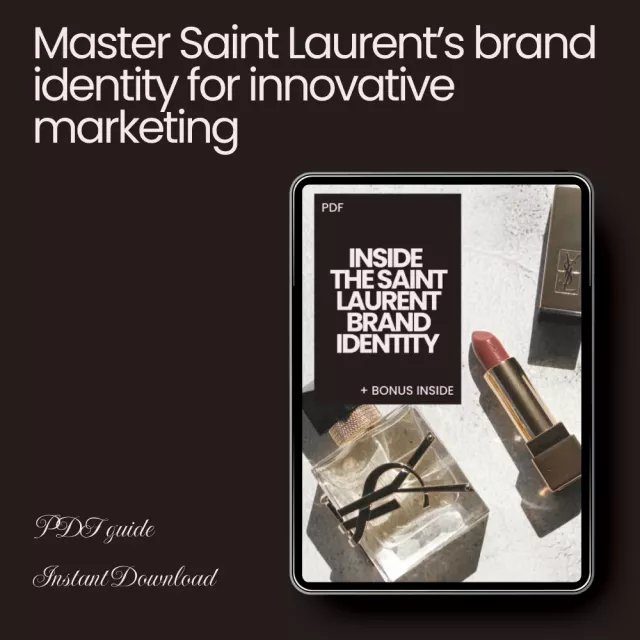
Unlock the Secrets of Saint Laurent’s Revolutionary Brand Identity
Step into the world of one of the most iconic luxury brands in history with our comprehensive digital guide, “Inside the Saint Laurent Brand Identity.” This eBook delves into the essence of Saint Laurent, uncovering the brand’s minimalist yet provocative aesthetic, its profound impact on fashion, and how it has continuously reinvented itself through the years. Whether you’re a designer, entrepreneur, or fashion enthusiast, this guide offers invaluable insights into the strategies that have made Saint Laurent an enduring symbol of style and sophistication.
Key Features:
- In-depth exploration of the birth and evolution of Saint Laurent’s iconic brand identity
- Insights into the creative vision of Yves Saint Laurent and the brand’s lasting cultural influence
- Analysis of key signature pieces like the Le Smoking tuxedo and leather jacket archetype
- Case studies on how Saint Laurent competes in the luxury fashion market
- Practical tips for applying Saint Laurent’s identity to your own brand or design projects
- AI tools and prompts to help you analyze style and create Saint Laurent-inspired concepts ethically
Practical Benefits:
- Gain a deeper understanding of Saint Laurent’s unique brand identity and the core principles that have shaped its legacy
- Learn how creative directors like Hedi Slimane and Anthony Vaccarello helped modernize the brand while preserving its iconic image
- Discover how to apply minimalist yet bold design elements to your own projects
- Get inspired by Saint Laurent’s marketing strategies and how they’ve achieved global appeal without overexposure
- Unlock the secrets to staying relevant in the luxury market without compromising on your brand’s core values
This digital guide is perfect for creatives, entrepreneurs, or anyone looking to learn how to build a strong brand identity rooted in timeless design principles. Whether you’re exploring fashion history or developing your own business, “Inside the Saint Laurent Brand Identity” will provide you with the tools to stand out in a competitive market.
Why Choose This Guide?
Unlike other resources, this eBook goes beyond surface-level marketing tips. It dives deep into the psychology behind Saint Laurent’s brand identity, offering you a roadmap to create a brand that is not only visually compelling but also rich in culture and meaning. If you’ve ever wondered why Saint Laurent continues to lead the luxury fashion world or how it competes against heritage rivals, this guide has all the answers.
Download Now
Are you ready to uncover the secrets of one of the most influential brands in the world? Download “Inside the Saint Laurent Brand Identity” today and start applying these powerful principles to your own brand. Your journey to mastering brand identity begins here!
SHIPPING
We are proud to offer international shipping services that currently operate in over 200 countries and islands world wide. Nothing means more to us than bringing our customers great value and service. We will continue to grow to meet the needs of all our customers, delivering a service beyond all expectation anywhere in the world.
Do you ship worldwide?
Yes. We provide free shipping to over 200 countries around the world. However, there are some locations we are unable to ship to. If you happen to be located in one of those countries we will contact you.
What about customs?
We are not responsible for any custom fees once the items have been shipped. By purchasing our products, you consent that one or more packages may be shipped to you and may get custom fees when they arrive to your country.
How long does shipping take?
Shipping time varies by location. These are our estimates:| Location | *Estimated Shipping Time |
|---|---|
| United States | 5-20 Business days |
| Canada, Europe | 5-20 Business days |
| Australia, New Zealand | 5-20 Business days |
| Central & South America | 5-25 Business days |
| Asia | 5-20 Business days |
| Africa | 5-25 Business days |
Do you provide tracking information?
Yes, you will receive an email once your order ships that contains your tracking information. If you haven’t received tracking info within 5 days, please contact us.
My tracking says “no information available at the moment”.
For some shipping companies, it takes 2-5 business days for the tracking information to update on the system. If your order was placed more than 5 business days ago and there is still no information on your tracking number, please contact us.
Will my items be sent in one package?
For logistical reasons, items in the same purchase will sometimes be sent in separate packages, even if you've specified combined shipping.
If you have any other questions, please contact us and we will do our best to help you out.
RETURNS
Order cancellation
All orders can be cancelled until they are shipped. If your order has been paid and you need to make a change or cancel an order, you must contact us within 12 hours. Once the packaging and shipping process has started, it can no longer be cancelled.
Refunds
Your satisfaction is our #1 priority. Therefore, you can request a refund or reshipment for ordered products if:
- If you did not receive the product within the guaranteed time (45 days not including 1-3 day processing) you can request a refund or a reshipment.
- If you received the wrong item you can request a refund or a reshipment.
- If you do not want the product you’ve received you may request a refund but you must return the item at your expense and the item must be unused.
We do not issue the refund if:
- Your order did not arrive due to factors within your control (i.e. providing the wrong shipping address)
- Your order did not arrive due to exceptional circumstances outside the control of cyclonica.com (i.e. not cleared by customs, delayed by a natural disaster).
- Other exceptional circumstances outside the control of cyclonica.com.
*You can submit refund requests within 15 days after the guaranteed period for delivery (45 days) has expired. You can do it by sending a message on Contact Us page
If you are approved for a refund, then your refund will be processed, and a credit will automatically be applied to your credit card or original method of payment, within 14 days.
Exchanges
If for any reason you would like to exchange your product, perhaps for a different size in clothing, you must contact us first and we will guide you through the steps.
Please do not send your purchase back to us unless we authorise you to do so.
Order cancellation
All orders can be cancelled until they are shipped. If your order has been paid and you need to make a change or cancel an order, you must contact us within 12 hours. Once the packaging and shipping process has started, it can no longer be cancelled.
Refunds
Your satisfaction is our #1 priority. Therefore, you can request a refund or reshipment for ordered products if:
- If you did not receive the product within the guaranteed time( 45 days not including 2-5 day processing) you can request a refund or a reshipment.
- If you received the wrong item you can request a refund or a reshipment.
- If you do not want the product you’ve received you may request a refund but you must return the item at your expense and the item must be unused.
We do not issue the refund if:
- Your order did not arrive due to factors within your control (i.e. providing the wrong shipping address)
- Your order did not arrive due to exceptional circumstances outside the control of cyclonica.com (i.e. not cleared by customs, delayed by a natural disaster).
- Other exceptional circumstances outside the control of
*You can submit refund requests within 15 days after the guaranteed period for delivery (45 days) has expired. You can do it by sending a message on Contact Us page
If you are approved for a refund, then your refund will be processed, and a credit will automatically be applied to your credit card or original method of payment, within 14 days.
Exchanges
If for any reason you would like to exchange your product, perhaps for a different size in clothing. You must contact us first and we will guide you through the steps.
Please do not send your purchase back to us unless we authorise you to do so.
Customer Reviews
Write a Review
We Think You’ll Love
Top picks just for you












The mutable vs immutable elements framework in Chapter 3 is the clearest explanation of brand evolution I've encountered
I run a small design studio and Chapter 9 on translating attitude into design gave me a concrete process I could apply the same afternoon. The question about what personality your brand would have if it were a person reframed our entire creative brief for a client.
The retail experience chapter is worth the entire read. Store B vs Store A — that comparison alone changed how I think about my own brand's physical presence.
Tight, intelligent, no wasted pages
I came in as a branding student expecting surface-level luxury worship and left with transferable frameworks I can use across industries. The section on disciplined reinvention — how Slimane preserved the emotional DNA while completely overhauling the visual language — is the kind of strategic thinking that most brand textbooks skip over entirely. The case study on balancing accessibility with exclusivity through controlled expansion answered questions I've been wrestling with for my own startup. Chapter 8 on using AI for style analysis without copying protected designs was a bonus I didn't expect. Already using the persona prompt exercise with my team.
🖤🔥⭐✨
The Le Smoking section frames it as a cultural intervention, not just a fashion moment — and that distinction matters for anyone building a brand with real conviction 🖤
Visual simplicity plus psychological intensity as a brand formula — I keep coming back to that
Chapter 5 on marketing without noise should be mandatory reading for every social media manager drowning in content calendars. The idea that ambiguity creates intrigue and over-explaining signals insecurity flipped my entire content strategy. I've cut our brand's output in half and engagement went up.
Finished it on a Tuesday evening and rewrote my brand guidelines by Thursday
The leather jacket archetype chapter captures something most fashion writing misses — how a single piece can bridge subculture and high fashion simultaneously
Sent this to every founder in my network 🔥
What struck me most is how the guide positions Saint Laurent not as a fashion brand that does marketing, but as a cultural force that happens to sell clothing. The distinction between selling products and selling persona clarified something I've been struggling to articulate about my own brand for years. The chapter on common misunderstandings — especially why minimalism requires more precision than decoration — gave me the confidence to strip back our packaging design instead of adding more. Less has felt risky until now.
Chapter 7 on misconceptions is quietly the most useful section for brand strategists
The three strategic qualities of signature pieces — recognizable without logos, emotionally charged, consistent across decades — is a checklist I now apply to every product we develop
As someone who works in luxury retail, the sensory touchpoint analysis in the retail theater section validated instincts I've had for years but couldn't articulate to corporate. Dim lighting, sparse displays, gallery-like atmosphere — the PDF explains why these choices feel more expensive even with identical inventory. I printed the Store A vs Store B comparison and taped it above my desk.
The AI chapter alone is worth the download
Clean writing, zero filler, every chapter earns its spot
I've read brand identity books from major publishers that don't cover half of what this PDF distills into nine chapters. The section tracing how the Rive Gauche line democratized luxury without diluting attitude is a masterclass in market positioning. The framework for growth without dilution — limited categories, consistent visual codes, strategic pricing, avoidance of excessive licensing — applies directly to the DTC brand I'm building.
The Slimane case study on brand modernization without dilution is the best I've seen on the topic
👏🖤🔥👌
Positioning against heritage rivals by leading with attitude instead of tradition — that reframe is pure gold for anyone competing in a crowded market
The fact that Kering allows creative autonomy within corporate structure explains so much about why some conglomerates produce vibrant brands and others produce bland ones. This is strategic analysis disguised as fashion writing.
Confidence through contradiction as a brand thesis — refined yet rebellious, classic yet disruptive. That tension is what makes the whole identity work and the PDF nails why.
Read it in one sitting on a flight to Seoul
I teach a branding course at a design school and I've already added Chapter 2 on brand DNA and Chapter 7 on misconceptions to my syllabus. The Outfit A vs Outfit B practical example in Section 7.3 demonstrates that identity comes from proportion and subtle cues, not surface decoration — and it lands with students far better than any case study I've previously used. The only thing I'd add is more competitor comparisons beyond the general positioning framework, since students benefit from direct side-by-side analyses.
More strategic depth than most $300 branding courses
The celebrity alignment section explains why some brand partnerships feel organic and others feel forced — it's about artistic credibility over mass-market reach 🖤
Unexpectedly practical for entrepreneurs. The three lessons at the end of Chapter 6 — differentiate emotionally, commit to a personality, grow carefully — are now pinned to our team's Notion board.
The way this frames black not as an aesthetic default but as a strategic signal carrying authority, mystery, and sophistication gave me an entirely new vocabulary for discussing color choices in brand design. I work in packaging and this shifted how I present monochrome palettes to clients — not as safe choices but as deliberate power moves.
Short, sharp, and immediately applicable
The writing mirrors the brand it's analyzing — precise, confident, no excess
I bought this as casual reading and it ended up reshaping my startup's entire visual identity. The section on how campaigns should invite interpretation rather than dictate meaning was the breakthrough. We've since moved from explaining our product to letting the imagery speak, and our conversion rate actually improved. The AI prompts for defining brand persona in Chapter 8 were the tool I used to pressure-test whether our messaging was consistent, and it exposed three contradictions in our tone we'd never noticed.
Maximum impact through minimum explanation as a marketing philosophy — that paradox restructured my content approach overnight
Chapter 1 sets the historical context without dragging. Chapter 9 delivers actionable frameworks. Everything between connects them with real substance.
The archetype framework in Chapter 7 — the rebel, the artist, the outsider, the nocturnal sophisticate — is the most elegant brand positioning model I've encountered. Timeless personas instead of seasonal trends.
Solid throughout with genuinely transferable branding principles. I docked a star only because the AI chapter, while useful, covers ground that could be its own standalone guide and feels slightly compressed relative to the depth of the other chapters.
The discipline section on what must change versus what must stay untouchable applies to every brand, not just luxury
🖤✨🔥
The insight that customers buy a persona — bold, intelligent, slightly dangerous — rather than clothing was the shift in thinking I needed. Applies directly to every category, not just fashion.
Every entrepreneur should read the growth without dilution section before scaling
I'm a filmmaker, not a fashion person, and this still changed how I approach visual storytelling. The discussion of Vaccarello's campaigns resembling noir film stills — stark lighting, architectural compositions, themes of isolation and desire — reads like a cinematography brief. The idea that ambiguity creates engagement because audiences project themselves onto it is exactly how I want my work to function. Didn't expect a branding PDF to become my most-referenced creative resource this year.
That line about brands that over-explain risking appearing insecure hit different
Nine chapters, zero padding — matching the subject's own philosophy of restraint
The practical insight on how one defining product can communicate more about your brand than an entire marketing campaign is the sharpest takeaway for founders
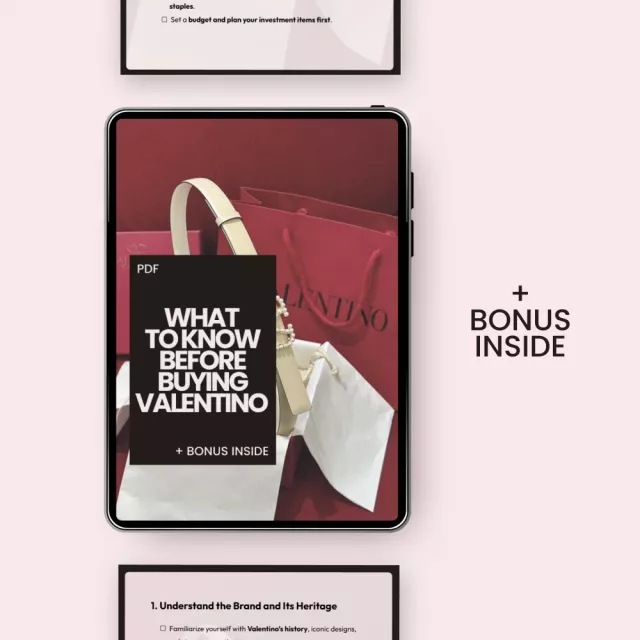
Read this alongside the Shopping Tips PDF and the two complement each other perfectly — one for understanding the brand, one for navigating it as a consumer
The Rive Gauche analysis on democratizing luxury without sacrificing attitude is the strategic insight I wish I'd had two years ago when we were pricing our first collection. We tried to be accessible and lost our edge. This PDF explains exactly why that happened and how to prevent it.
Fashion writing that doubles as a business strategy manual — rare and valuable
Bookmarked, highlighted, and already referencing Chapter 5 in client decks 🔥
The emotional blueprint concept in Chapter 9 — define the feeling first, then let every design decision reinforce it — is deceptively simple advice that most brands get backwards
This treats the reader as an intelligent adult. No hand-holding, no filler, no repetition. Exactly the energy the brand itself projects.
Studied luxury marketing at HEC and this PDF articulates principles my professors spent entire semesters circling around