





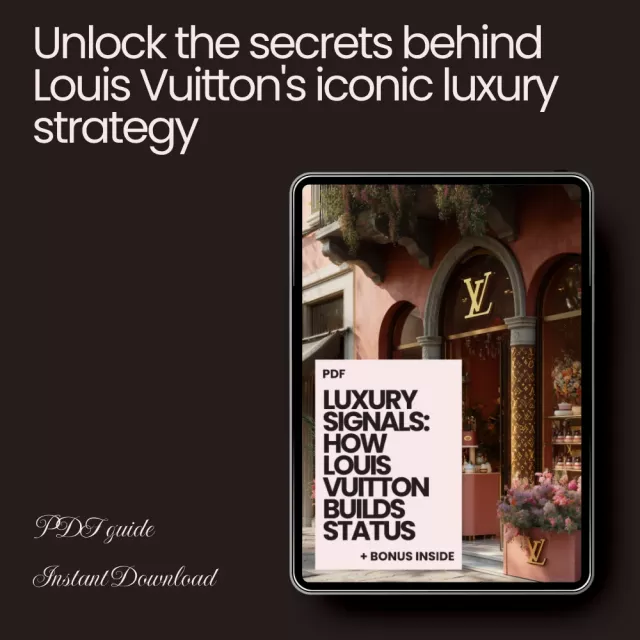
Product Description
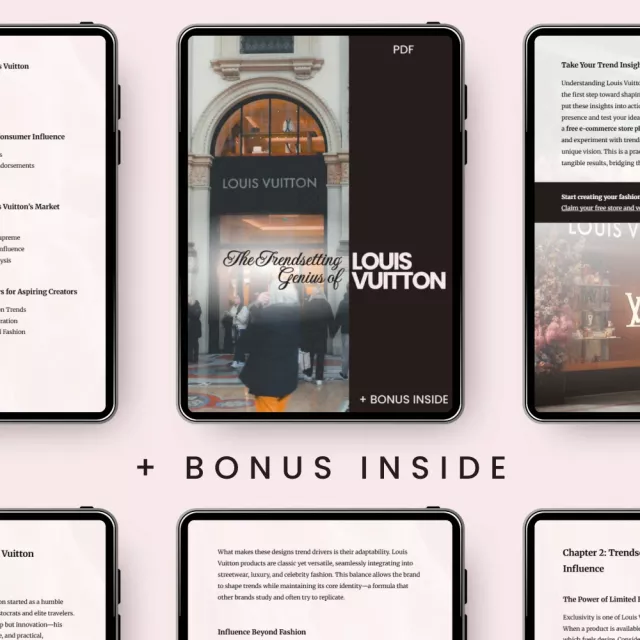
Ever wondered how Louis Vuitton, a brand synonymous with luxury, has built its empire of status and desire? “Luxury Signals: How Louis Vuitton Builds Status” is your comprehensive guide to understanding the unique strategies behind the world’s most coveted brand. This guide unveils the core principles that have shaped LV’s incredible power and influence in the fashion industry. From scarcity to the psychology of exclusivity, this guide dives deep into the tactical choices Louis Vuitton uses to maintain its elite status across generations.
Whether you’re a brand strategist, an entrepreneur, or simply fascinated by luxury marketing, this digital download offers valuable insights into how Louis Vuitton creates the ultimate symbol of status. Learn how to apply these tactics to your own business or personal brand to elevate your image and influence. From understanding the power of a name to analyzing the role of digital presence in brand positioning, this guide offers step-by-step guidance on leveraging the same strategies that make Louis Vuitton a household name in luxury.
Key Features
- In-depth analysis of how Louis Vuitton builds status through scarcity, storytelling, and iconic designs
- Four comprehensive chapters covering foundational status-building, visual language, psychological mechanics, and practical next steps
- Case studies like the “It Bag” phenomenon, offering real-world examples of luxury marketing at its finest
- Actionable insights on how you can apply LV’s tactics in your own life or business
- AI exploration prompts to guide your journey into innovative brand development
Why This Guide is Different
What sets this guide apart is its focus on the psychological and social mechanics that make Louis Vuitton’s marketing so effective. While other digital resources might skim over branding basics, this guide gives you a deeper understanding of the social proof mechanisms, exclusivity, and comparison tactics that drive demand. You’ll learn not just what Louis Vuitton does, but why it works and how you can use these principles to elevate any brand, whether luxury or not.
Who is This For?
- Brand strategists looking to understand luxury marketing
- Entrepreneurs wanting to create a premium brand image
- Fashion industry professionals eager to learn from the masters
- Anyone passionate about the psychology behind successful brands
Practical Benefits
- Learn the core principles that make Louis Vuitton synonymous with status
- Master the art of scarcity and exclusivity in your own marketing efforts
- Understand the role of visual language and in-store experience in building a luxurious brand
- Explore proven tactics for applying LV’s branding principles to your business or personal brand
- Gain exclusive insights into luxury consumer behavior and social proof
Take the Next Step
If you’re ready to unlock the secrets behind one of the most iconic luxury brands in the world, “Luxury Signals: How Louis Vuitton Builds Status” is the guide you need. Download your copy now and begin applying these powerful branding techniques today. Don’t miss your chance to transform your business or brand into a status symbol of its own.
SHIPPING
We are proud to offer international shipping services that currently operate in over 200 countries and islands world wide. Nothing means more to us than bringing our customers great value and service. We will continue to grow to meet the needs of all our customers, delivering a service beyond all expectation anywhere in the world.
Do you ship worldwide?
Yes. We provide free shipping to over 200 countries around the world. However, there are some locations we are unable to ship to. If you happen to be located in one of those countries we will contact you.
What about customs?
We are not responsible for any custom fees once the items have been shipped. By purchasing our products, you consent that one or more packages may be shipped to you and may get custom fees when they arrive to your country.
How long does shipping take?
Shipping time varies by location. These are our estimates:| Location | *Estimated Shipping Time |
|---|---|
| United States | 5-20 Business days |
| Canada, Europe | 5-20 Business days |
| Australia, New Zealand | 5-20 Business days |
| Central & South America | 5-25 Business days |
| Asia | 5-20 Business days |
| Africa | 5-25 Business days |
Do you provide tracking information?
Yes, you will receive an email once your order ships that contains your tracking information. If you haven’t received tracking info within 5 days, please contact us.
My tracking says “no information available at the moment”.
For some shipping companies, it takes 2-5 business days for the tracking information to update on the system. If your order was placed more than 5 business days ago and there is still no information on your tracking number, please contact us.
Will my items be sent in one package?
For logistical reasons, items in the same purchase will sometimes be sent in separate packages, even if you've specified combined shipping.
If you have any other questions, please contact us and we will do our best to help you out.
RETURNS
Order cancellation
All orders can be cancelled until they are shipped. If your order has been paid and you need to make a change or cancel an order, you must contact us within 12 hours. Once the packaging and shipping process has started, it can no longer be cancelled.
Refunds
Your satisfaction is our #1 priority. Therefore, you can request a refund or reshipment for ordered products if:
- If you did not receive the product within the guaranteed time (45 days not including 1-3 day processing) you can request a refund or a reshipment.
- If you received the wrong item you can request a refund or a reshipment.
- If you do not want the product you’ve received you may request a refund but you must return the item at your expense and the item must be unused.
We do not issue the refund if:
- Your order did not arrive due to factors within your control (i.e. providing the wrong shipping address)
- Your order did not arrive due to exceptional circumstances outside the control of cyclonica.com (i.e. not cleared by customs, delayed by a natural disaster).
- Other exceptional circumstances outside the control of cyclonica.com.
*You can submit refund requests within 15 days after the guaranteed period for delivery (45 days) has expired. You can do it by sending a message on Contact Us page
If you are approved for a refund, then your refund will be processed, and a credit will automatically be applied to your credit card or original method of payment, within 14 days.
Exchanges
If for any reason you would like to exchange your product, perhaps for a different size in clothing, you must contact us first and we will guide you through the steps.
Please do not send your purchase back to us unless we authorise you to do so.
Order cancellation
All orders can be cancelled until they are shipped. If your order has been paid and you need to make a change or cancel an order, you must contact us within 12 hours. Once the packaging and shipping process has started, it can no longer be cancelled.
Refunds
Your satisfaction is our #1 priority. Therefore, you can request a refund or reshipment for ordered products if:
- If you did not receive the product within the guaranteed time( 45 days not including 2-5 day processing) you can request a refund or a reshipment.
- If you received the wrong item you can request a refund or a reshipment.
- If you do not want the product you’ve received you may request a refund but you must return the item at your expense and the item must be unused.
We do not issue the refund if:
- Your order did not arrive due to factors within your control (i.e. providing the wrong shipping address)
- Your order did not arrive due to exceptional circumstances outside the control of cyclonica.com (i.e. not cleared by customs, delayed by a natural disaster).
- Other exceptional circumstances outside the control of
*You can submit refund requests within 15 days after the guaranteed period for delivery (45 days) has expired. You can do it by sending a message on Contact Us page
If you are approved for a refund, then your refund will be processed, and a credit will automatically be applied to your credit card or original method of payment, within 14 days.
Exchanges
If for any reason you would like to exchange your product, perhaps for a different size in clothing. You must contact us first and we will guide you through the steps.
Please do not send your purchase back to us unless we authorise you to do so.
Customer Reviews
Write a Review
We Think You’ll Love
Top picks just for you












The scarcity-and-desire chapter rewired how I think about product launches for my own brand.
This isn't a fashion guide — it's a masterclass in human psychology disguised as one.
The Capucines case study made the abstract concept of manufactured scarcity feel concrete and replicable.
I run a small jewelry business and came to this guide looking for inspiration on how to position my products as premium without a massive ad budget. The section on applying LV's tactics at any scale was exactly what I needed. I took the advice about limited runs and narrative-driven marketing and launched a 50-piece capsule collection with a backstory tied to the materials. Sold out in ten days — my previous collections sat for months. The framework of scarcity plus storytelling plus social proof isn't just theory, it works at the smallest scale if you commit to it.
Finally someone explains why LV never goes on sale — and why that protects buyers too.
Read it in one sitting, took notes on half the pages.
The social proof feedback loop section was the sharpest analysis of influencer marketing I've come across.
I teach a university course on consumer behavior and assigned the psychology chapter to my students. The explanation of how exclusivity amplifies social proof — and how LV engineers that loop through limited stock, strategic placement, and celebrity visibility — sparked a better class discussion than the textbook chapter ever did. Several students mentioned the Capucines case study specifically as the moment the concept clicked for them. I'll be using this guide as supplementary reading going forward.
The personal branding section hit different — curating achievements like LV curates a collection.
Short, dense, zero filler.
The in-store experience section made me realize I've been underinvesting in the buying ritual for my own customers.
Wish it went deeper into how LV's digital campaigns differ by region, but the core analysis is excellent.
✨👜🔥⭐❤️
The three pillars — heritage, scarcity, storytelling — gave me a lens I now apply to every brand I encounter.
I've read dozens of branding books and most of them stay abstract. This guide uses LV as a concrete case study that makes every principle tangible. The It Bag phenomenon breakdown — scarcity plus visibility plus storytelling creating a feedback loop of desire — is the clearest explanation of hype mechanics I've seen anywhere. I've already adapted the framework for a product launch at work and my manager asked where I learned it.
The monogram as visual language — not decoration — reframed my entire understanding of logo design.
Sent the entrepreneurship section to my co-founder mid-read 🔥
Clear, well-structured, and smarter than most marketing textbooks.
The Twist bag case study was a brilliant example of how visual innovation reinforces prestige beyond just slapping a logo on things.
Before reading this I thought luxury branding was mostly about expensive materials and celebrity endorsements. This guide broke down the actual mechanics — how controlled distribution creates psychological tension, how the buying ritual in stores elevates the product beyond its physical form, and how every Instagram post from LV is calculated to reinforce a specific narrative. Chapter 3 on social proof and comparison psychology was the most eye-opening because it connected luxury strategy to basic human behavior. Now I can't unsee these patterns in every premium brand I encounter.
Applied the scarcity principle to my Etsy shop and saw immediate results.
The point about overexposure diluting allure is something every small brand owner needs to hear.
Readable for fashion lovers and business minds equally.
I bought my first LV bag years ago because of a feeling I couldn't articulate. After reading Chapter 3, I can name every psychological lever that drove that purchase — the social proof from seeing it on someone I admired, the scarcity of the color I wanted, the in-store experience that made me feel chosen. Understanding the mechanics hasn't made me enjoy the bag less; it's made me appreciate how deliberately that experience was crafted. And now I'm applying the same thinking to my freelance consulting brand.
The comparison and keeping-up section is uncomfortably accurate.
Every chapter builds on the last — the structure mirrors the status-building process it describes.
The AI prompt ideas for trend analysis and narrative crafting are immediately usable.
I manage social media for a boutique hotel chain and the digital presence section changed my entire content strategy. The insight that every post should reinforce a specific prestige narrative — not just showcase the product — made me audit our entire feed. We were posting beautiful photos with no coherent story. After restructuring around the scarcity-plus-storytelling framework from this guide, our engagement rate doubled in six weeks and we started getting DMs asking about availability instead of prices. That shift alone was worth more than any marketing course I've taken.
The missteps section is as valuable as the strategy sections — knowing what dilutes status is half the battle.
👏🏼✨💯👜
Makes you see status signals everywhere — in the best way.
The connection between inconsistent storytelling and weakened status signals is something I see brands get wrong constantly. Glad someone spelled it out.
Picked this up expecting surface-level fashion content and got a serious branding education.
The AI prompts section could have been expanded — felt like it scratched the surface of what's possible. The core chapters are phenomenal though.
The in-store ritual section gave me chills — I've lived that experience and never understood how deliberately it was engineered until now.
I'm a brand strategist and I've been circling the concept of manufactured desire for years without having a clean framework for it. This guide gave me one. The three-part model of scarcity plus visibility plus storytelling from the It Bag case study is now my go-to when presenting positioning strategies to clients. I've referenced it in three pitch decks already. The psychology chapter connects these tactics to actual human behavior in a way that makes the strategy feel inevitable rather than manipulative.
The observation that LV sells stories, not products, is the kind of insight that seems obvious only after someone explains it well.
Tight writing, no wasted paragraphs, every section earns its place.
The personal branding parallels — curating visibility plus exclusivity — landed hard for me as a freelancer.
I was skeptical that a guide about luxury handbags would teach me anything about my own small business. I was wrong. The section on applying LV's tactics at any scale convinced me to stop discounting my products and instead create a limited quarterly release with a story behind each collection. My average order value went up 40% in the first month because perceived value shifted the moment I stopped making everything permanently available. The guide's point about overexposure diminishing allure was the exact mistake I'd been making for two years.
The scarcity chapter alone is worth more than most marketing courses.
Now I understand why walking into an LV store feels like an event, not a transaction.
Clean and actionable — exactly what a strategy guide should be.
The framework transfers to any industry — I used the exclusivity principles for a software launch.
This guide made me a more conscious consumer and a sharper marketer at the same time.
Every entrepreneur should read the missteps section before their next product drop.