



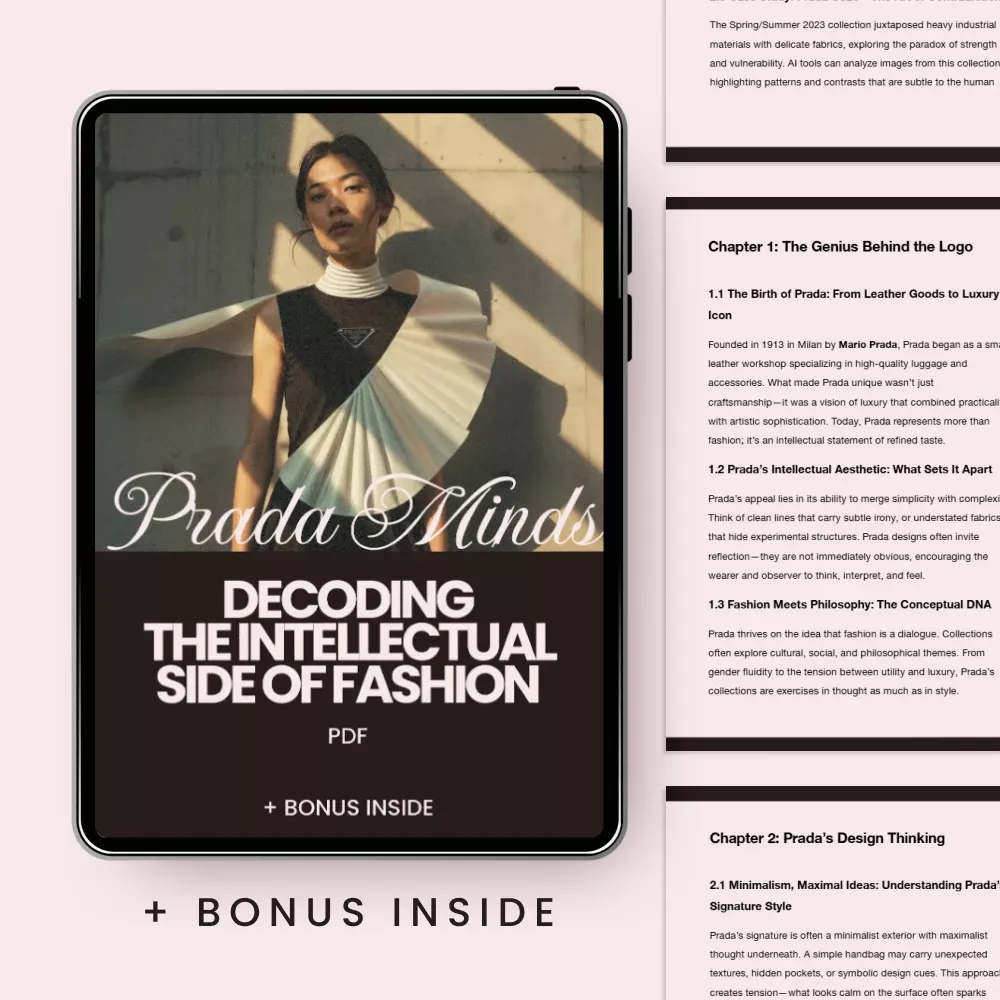



See Prada Beyond the Logo
What if Prada was never just about a triangle logo or a black nylon bag? Prada Minds: Decoding the Intellectual Side of Fashion is a deep yet accessible digital guide designed to help you truly understand the philosophy, research, contradictions, and cultural intelligence behind one of fashion’s most discussed luxury houses. If you’ve ever searched for prada intellectual side explained and felt like the answers were vague or overly academic, this guide translates complex ideas into clear, inspiring insights you can actually use.
What’s Inside This Digital Guide
- Chapter 1: The Genius Behind the Logo – From Prada’s origins in leather goods to its evolution into a luxury icon, plus a breakdown of its intellectual aesthetic and conceptual DNA.
- Chapter 2: Prada’s Design Thinking – A clear explanation of minimalism with maximal ideas, cultural research, and a detailed case study of Prada SS23 and its art of contradiction.
- Chapter 3: Common Misconceptions About Prada – Why it’s more than status, how the intellectual approach is often misread, and how AI insights can reveal subtle design logic.
- Chapter 4: Bringing Prada’s Intellectual Side into Your World – Creative prompt examples, applying AI in fashion analysis, and practical next steps for exploring conceptual fashion.
Why You’ll Love It
- Understand the deeper meaning behind Prada’s collections without academic jargon.
- Learn how philosophy and fashion intersect in real-world design.
- Gain creative prompts you can use for styling, branding, content creation, or design projects.
- Discover how AI tools can help analyze and decode high-concept fashion.
- Build confidence discussing luxury fashion in an informed, intelligent way.
Who This Is For
This guide is perfect for fashion students, stylists, content creators, luxury enthusiasts, brand strategists, and curious minds who want more than surface-level analysis. If you’re drawn to conceptual fashion and want a structured, insightful resource that truly delivers prada intellectual side explained in practical terms, this is for you.
What Makes This Guide Different
Unlike generic fashion summaries, this digital download combines brand history, philosophical context, cultural research, case studies, and AI-driven analysis in one cohesive resource. It bridges theory and application, so you’re not just reading about ideas—you’re learning how to use them.
Download Prada Minds: Decoding the Intellectual Side of Fashion today and start seeing luxury through a sharper, more intelligent lens. Your deeper understanding of fashion begins now.
SHIPPING
We are proud to offer international shipping services that currently operate in over 200 countries and islands world wide. Nothing means more to us than bringing our customers great value and service. We will continue to grow to meet the needs of all our customers, delivering a service beyond all expectation anywhere in the world.
Do you ship worldwide?
Yes. We provide free shipping to over 200 countries around the world. However, there are some locations we are unable to ship to. If you happen to be located in one of those countries we will contact you.
What about customs?
We are not responsible for any custom fees once the items have been shipped. By purchasing our products, you consent that one or more packages may be shipped to you and may get custom fees when they arrive to your country.
How long does shipping take?
Shipping time varies by location. These are our estimates:| Location | *Estimated Shipping Time |
|---|---|
| United States | 5-20 Business days |
| Canada, Europe | 5-20 Business days |
| Australia, New Zealand | 5-20 Business days |
| Central & South America | 5-25 Business days |
| Asia | 5-20 Business days |
| Africa | 5-25 Business days |
Do you provide tracking information?
Yes, you will receive an email once your order ships that contains your tracking information. If you haven’t received tracking info within 5 days, please contact us.
My tracking says “no information available at the moment”.
For some shipping companies, it takes 2-5 business days for the tracking information to update on the system. If your order was placed more than 5 business days ago and there is still no information on your tracking number, please contact us.
Will my items be sent in one package?
For logistical reasons, items in the same purchase will sometimes be sent in separate packages, even if you've specified combined shipping.
If you have any other questions, please contact us and we will do our best to help you out.
RETURNS
Order cancellation
All orders can be cancelled until they are shipped. If your order has been paid and you need to make a change or cancel an order, you must contact us within 12 hours. Once the packaging and shipping process has started, it can no longer be cancelled.
Refunds
Your satisfaction is our #1 priority. Therefore, you can request a refund or reshipment for ordered products if:
- If you did not receive the product within the guaranteed time (45 days not including 1-3 day processing) you can request a refund or a reshipment.
- If you received the wrong item you can request a refund or a reshipment.
- If you do not want the product you’ve received you may request a refund but you must return the item at your expense and the item must be unused.
We do not issue the refund if:
- Your order did not arrive due to factors within your control (i.e. providing the wrong shipping address)
- Your order did not arrive due to exceptional circumstances outside the control of cyclonica.com (i.e. not cleared by customs, delayed by a natural disaster).
- Other exceptional circumstances outside the control of cyclonica.com.
*You can submit refund requests within 15 days after the guaranteed period for delivery (45 days) has expired. You can do it by sending a message on Contact Us page
If you are approved for a refund, then your refund will be processed, and a credit will automatically be applied to your credit card or original method of payment, within 14 days.
Exchanges
If for any reason you would like to exchange your product, perhaps for a different size in clothing, you must contact us first and we will guide you through the steps.
Please do not send your purchase back to us unless we authorise you to do so.
Order cancellation
All orders can be cancelled until they are shipped. If your order has been paid and you need to make a change or cancel an order, you must contact us within 12 hours. Once the packaging and shipping process has started, it can no longer be cancelled.
Refunds
Your satisfaction is our #1 priority. Therefore, you can request a refund or reshipment for ordered products if:
- If you did not receive the product within the guaranteed time( 45 days not including 2-5 day processing) you can request a refund or a reshipment.
- If you received the wrong item you can request a refund or a reshipment.
- If you do not want the product you’ve received you may request a refund but you must return the item at your expense and the item must be unused.
We do not issue the refund if:
- Your order did not arrive due to factors within your control (i.e. providing the wrong shipping address)
- Your order did not arrive due to exceptional circumstances outside the control of cyclonica.com (i.e. not cleared by customs, delayed by a natural disaster).
- Other exceptional circumstances outside the control of
*You can submit refund requests within 15 days after the guaranteed period for delivery (45 days) has expired. You can do it by sending a message on Contact Us page
If you are approved for a refund, then your refund will be processed, and a credit will automatically be applied to your credit card or original method of payment, within 14 days.
Exchanges
If for any reason you would like to exchange your product, perhaps for a different size in clothing. You must contact us first and we will guide you through the steps.
Please do not send your purchase back to us unless we authorise you to do so.
Customer Reviews
Write a Review
We Think You’ll Love
Top picks just for you











Framing fashion as a dialogue rather than product changed how I read collections entirely.
The SS23 case study — industrial materials against delicate fabrics, strength against vulnerability — is the clearest illustration of what makes Prada worth studying rather than just wearing ✨ The minimalism-as-canvas argument also landed hard, I used to find quiet looks uninteresting, and now I'm actively looking for what they're hiding. Exactly the shift a guide like this should deliver.
Before this I understood Prada the way most people understand contemporary art — I could recognize it, say I liked it, and move on. What I couldn't do was explain what I was actually responding to or why a particular piece felt so different from surface-level luxury. The section on conceptual DNA was the turning point for me. Reading that collections function as exercises in thought as much as in style gave me a framework I immediately started applying — not just to Prada, but to every brand I engage with professionally. The distinction between minimalism as restraint versus minimalism as deliberate conceptual canvas was particularly sharp. I work in visual communications and that reframing has genuinely influenced how I approach design briefs.
🧠✨💡
The section on research and cultural influence resonated far beyond fashion — the idea that serious creative work begins long before a sketch, rooted in art history and urban culture, is something I'd been trying to articulate about my own process for years 💭 Prada names it cleanly. Concise, but it packs a lot in.
Genuinely useful framing around pattern recognition and color analysis as tools for reading a brand's intellectual continuity — I hadn't thought about applying AI that way before. My reservation is that the guide stays more introductory than I wanted; once it builds momentum it stops short of the deeper analysis I was hoping for. Still worth the read, especially the misconceptions chapter.
Restraint as deliberate canvas is something design school never taught me this clearly 🎓
Turns out quiet pieces aren't boring — they're asking something of you, and now I see it.
The misconceptions section lands because it names something real — I've seen so many people pair statement Prada pieces with maximalist outfits and wonder why the look falls apart 🎯 Understanding that subtlety is the intent, not a limitation, changes what you're actually looking for. The AI application ideas tied it all together.
Sharp analysis that could have gone two chapters deeper — still, a solid starting point.
I study fashion theory and came in skeptical, mostly because content about intellectual fashion tends to be either too academic or too vague to actually use. This guide threads it well. The observation that Prada's designs are not immediately obvious — they invite the wearer and observer to think, interpret, feel — is both accurate and transferable as a lens for reading any design-forward brand. The trend mapping section, where AI tracks which elements evolve versus remain constant across decades, gave me a concrete research methodology I've since applied in coursework 📐 The SS23 case study was the sharpest section; juxtaposing industrial materials with delicate fabrics to explore strength and vulnerability is exactly the kind of textual analysis fashion writing usually gestures at without grounding. This one does the grounding.
Four pages into Chapter 1 and I already had three notes in the margin.
⭐⭐⭐⭐⭐🔥
The conceptual framework is interesting and the SS23 analysis is the standout section, but the guide covers similar ideas in several places without meaningfully building on them. I wanted it to go further into the philosophical dimensions the title promises — the connections between fashion and cultural theory are named but not really explored. A foundation worth having, not the full building.
The observe-analyze-experiment framework at the end is deceptively simple but genuinely actionable ✨
I've worked in brand strategy and creative direction for about eight years, and there's always been a gap in how luxury is discussed professionally. Either it gets treated as pure commerce, stripped of its conceptual ambitions, or it's described in language so elevated it's useless in a meeting room. This guide sits in neither of those places. What got me was the clarity around design thinking as a process. The description of Prada's creative work beginning long before any sketch — grounded in art movements, historical archives, urban culture — is something I've watched happen in design rooms but never seen named this cleanly in accessible writing. I've since used that framing in two client presentations. The misconceptions chapter addressed something I encounter constantly: clients who dismiss a clean, minimal look as safe or low-effort, not recognizing the conceptual work underneath. The argument that restraint is the quiet canvas on which complex ideas are painted is exactly the reframe those conversations need. The AI applications section was the most forward-thinking part. Pattern recognition and color analysis across decades as a way to map a brand's intellectual continuity is genuinely novel as a practical methodology, and I've been exploring how to apply it in a consulting context. The trend forecasting angle — that understanding a brand's intellectual core helps anticipate future directions — is the kind of thinking that separates reactive work from strategic work. The final observe-analyze-experiment framework is humble but solid. It's the difference between reading about something and actually developing a relationship with it.
Knew Prada was conceptual — had no idea how to articulate why until now.
The cultural influence section is where the guide is strongest — explaining how Prada translates art movements and historical archives into wearable ideas is exactly the kind of analysis I was looking for. The AI-as-lens framing in the final chapter is interesting in theory but a little underdeveloped in practice; the applications are named rather than shown. What's here is good, just leaves you wanting more of it.
The guide reframes Prada's minimalism not as an absence of statement but as the most deliberate kind of one — that distinction matters more than it sounds. The prompt examples for creativity in the final chapter are a smart addition, making the ideas immediately usable for anyone working in design or content. Rare that theory and application sit this comfortably alongside each other.