





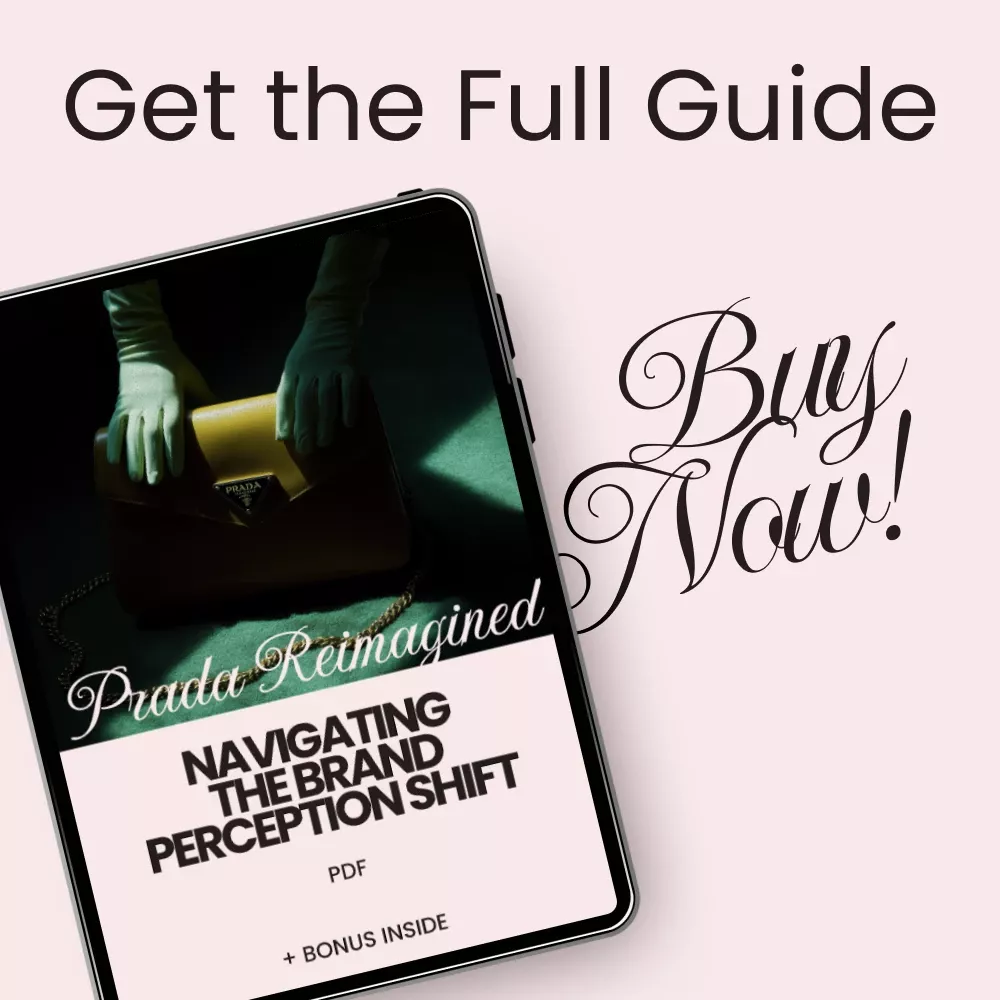
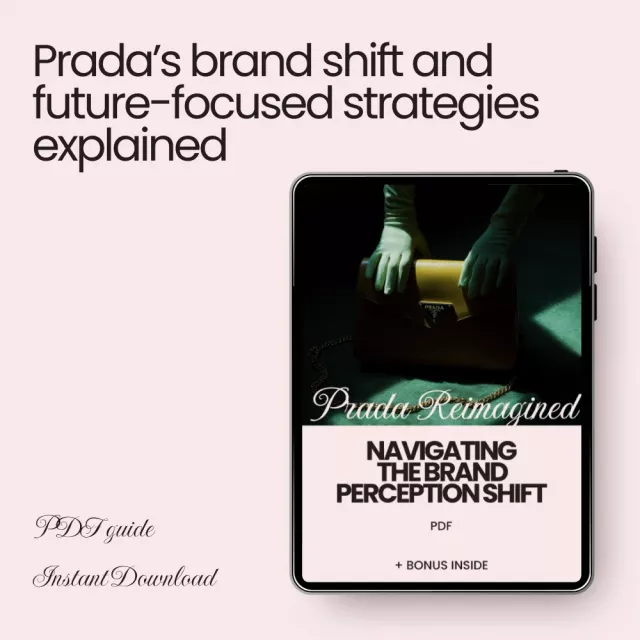
Redefining Luxury in a New Era
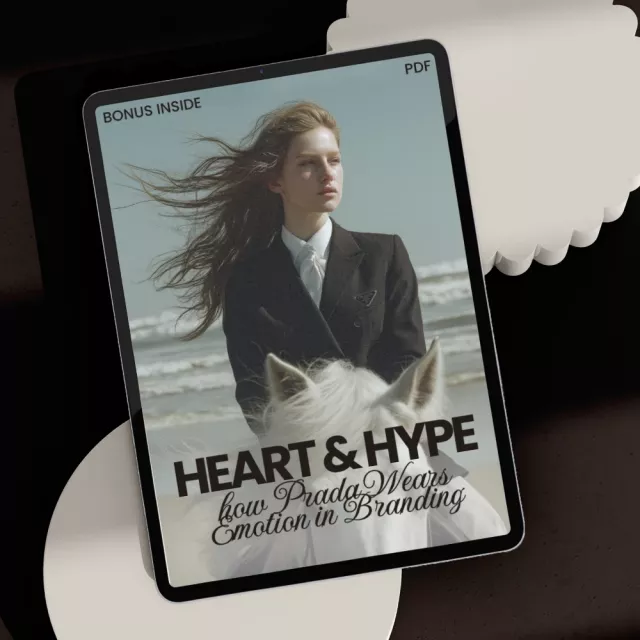
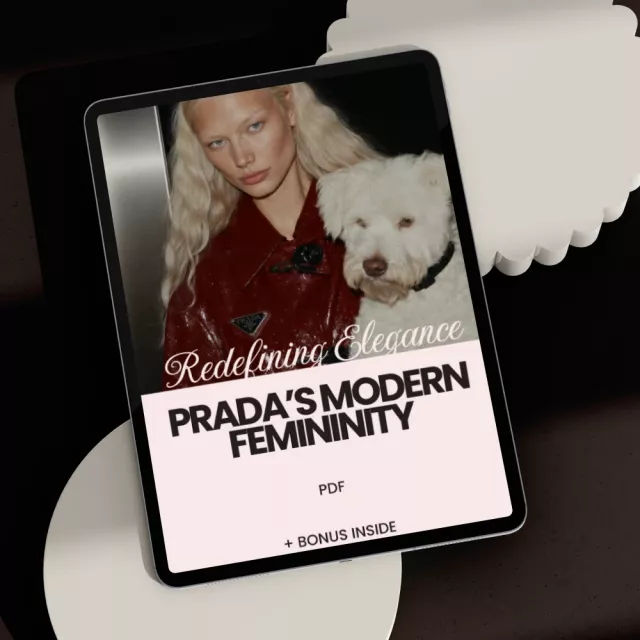
Luxury is no longer just about heritage—it’s about relevance. Prada Reimagined: Navigating the Brand Perception Shift is a powerful, insight-driven ebook that unpacks one of the most fascinating transformations in modern fashion. If you’ve been curious about the prada brand perception shift and how an iconic house adapts to cultural change, digital disruption, and evolving consumer expectations, this guide gives you a clear, strategic roadmap. Designed for fashion professionals, brand builders, marketers, and creators, this digital download delivers practical insights you can apply immediately.
What’s Inside This eBook
- Chapter 1: Prada’s legacy, core brand values, and its current market identity
- Chapter 2: The cultural and consumer forces driving the prada brand perception shift
- Chapter 3: Strategic product innovation, collaborations, and narrative-changing marketing campaigns
- Chapter 4: AI in fashion branding, including predictive analytics, personalization, and virtual engagement
- Chapter 5: Case studies comparing Prada with Gucci, Balenciaga, and Louis Vuitton
- Chapter 6: Common branding pitfalls and how to avoid costly mistakes
- Chapter 7: Step-by-step brand audit guidance, perception shift roadmap, and AI prompt examples
- Chapter 8: The future of luxury fashion, sustainability, and digital influence
Why You’ll Love It
- Gain a deep understanding of the prada brand perception shift and how it reflects broader luxury trends
- Learn actionable branding strategies you can apply to your own fashion or creative business
- Discover how AI tools can transform marketing, customer insights, and trend forecasting
- Avoid common brand positioning mistakes that weaken identity and credibility
- Access structured frameworks instead of scattered online articles
Who This Is For
This ebook is ideal for fashion entrepreneurs, marketing professionals, brand strategists, design students, content creators, and anyone building a premium or luxury brand. Whether you manage an emerging label or study high-fashion business models, this guide translates the prada brand perception shift into clear, usable strategy.
What Makes It Different
Unlike generic fashion business books, Prada Reimagined: Navigating the Brand Perception Shift blends heritage analysis with modern AI strategy. It combines brand history, competitor case studies, digital transformation insights, and practical implementation steps in one cohesive resource. You’re not just learning what happened—you’re learning how to replicate strategic evolution in your own brand.
Download Your Copy Today
If you’re ready to understand how iconic brands evolve—and how you can engineer your own transformation—this ebook is your blueprint. Download Prada Reimagined: Navigating the Brand Perception Shift today and start building a future-proof brand strategy with clarity and confidence.
SHIPPING
We are proud to offer international shipping services that currently operate in over 200 countries and islands world wide. Nothing means more to us than bringing our customers great value and service. We will continue to grow to meet the needs of all our customers, delivering a service beyond all expectation anywhere in the world.
Do you ship worldwide?
Yes. We provide free shipping to over 200 countries around the world. However, there are some locations we are unable to ship to. If you happen to be located in one of those countries we will contact you.
What about customs?
We are not responsible for any custom fees once the items have been shipped. By purchasing our products, you consent that one or more packages may be shipped to you and may get custom fees when they arrive to your country.
How long does shipping take?
Shipping time varies by location. These are our estimates:| Location | *Estimated Shipping Time |
|---|---|
| United States | 5-20 Business days |
| Canada, Europe | 5-20 Business days |
| Australia, New Zealand | 5-20 Business days |
| Central & South America | 5-25 Business days |
| Asia | 5-20 Business days |
| Africa | 5-25 Business days |
Do you provide tracking information?
Yes, you will receive an email once your order ships that contains your tracking information. If you haven’t received tracking info within 5 days, please contact us.
My tracking says “no information available at the moment”.
For some shipping companies, it takes 2-5 business days for the tracking information to update on the system. If your order was placed more than 5 business days ago and there is still no information on your tracking number, please contact us.
Will my items be sent in one package?
For logistical reasons, items in the same purchase will sometimes be sent in separate packages, even if you've specified combined shipping.
If you have any other questions, please contact us and we will do our best to help you out.
RETURNS
Order cancellation
All orders can be cancelled until they are shipped. If your order has been paid and you need to make a change or cancel an order, you must contact us within 12 hours. Once the packaging and shipping process has started, it can no longer be cancelled.
Refunds
Your satisfaction is our #1 priority. Therefore, you can request a refund or reshipment for ordered products if:
- If you did not receive the product within the guaranteed time (45 days not including 1-3 day processing) you can request a refund or a reshipment.
- If you received the wrong item you can request a refund or a reshipment.
- If you do not want the product you’ve received you may request a refund but you must return the item at your expense and the item must be unused.
We do not issue the refund if:
- Your order did not arrive due to factors within your control (i.e. providing the wrong shipping address)
- Your order did not arrive due to exceptional circumstances outside the control of cyclonica.com (i.e. not cleared by customs, delayed by a natural disaster).
- Other exceptional circumstances outside the control of cyclonica.com.
*You can submit refund requests within 15 days after the guaranteed period for delivery (45 days) has expired. You can do it by sending a message on Contact Us page
If you are approved for a refund, then your refund will be processed, and a credit will automatically be applied to your credit card or original method of payment, within 14 days.
Exchanges
If for any reason you would like to exchange your product, perhaps for a different size in clothing, you must contact us first and we will guide you through the steps.
Please do not send your purchase back to us unless we authorise you to do so.
Order cancellation
All orders can be cancelled until they are shipped. If your order has been paid and you need to make a change or cancel an order, you must contact us within 12 hours. Once the packaging and shipping process has started, it can no longer be cancelled.
Refunds
Your satisfaction is our #1 priority. Therefore, you can request a refund or reshipment for ordered products if:
- If you did not receive the product within the guaranteed time( 45 days not including 2-5 day processing) you can request a refund or a reshipment.
- If you received the wrong item you can request a refund or a reshipment.
- If you do not want the product you’ve received you may request a refund but you must return the item at your expense and the item must be unused.
We do not issue the refund if:
- Your order did not arrive due to factors within your control (i.e. providing the wrong shipping address)
- Your order did not arrive due to exceptional circumstances outside the control of cyclonica.com (i.e. not cleared by customs, delayed by a natural disaster).
- Other exceptional circumstances outside the control of
*You can submit refund requests within 15 days after the guaranteed period for delivery (45 days) has expired. You can do it by sending a message on Contact Us page
If you are approved for a refund, then your refund will be processed, and a credit will automatically be applied to your credit card or original method of payment, within 14 days.
Exchanges
If for any reason you would like to exchange your product, perhaps for a different size in clothing. You must contact us first and we will guide you through the steps.
Please do not send your purchase back to us unless we authorise you to do so.
Customer Reviews
Write a Review
We Think You’ll Love
Top picks just for you












Heritage elegance versus digital-native demand — the perception gap is the right frame.
Six years in luxury brand strategy, and this is rare material that actually traces the perception mechanics. Miuccia Prada's 1980s transformation from understated leather goods store to cultural tastemaker gets referenced constantly but is almost never explained through its actual causes. The three-pillar framework of elegance with innovation, cultural relevance, and exclusivity is something I've already used in a client presentation.
A heritage fashion client brought me in last year with a specific problem: their brand was perceived as classic and expensive but not desirable to anyone under 35. The gap described here — between legacy sophistication and the modern demand for immediacy and digital storytelling — was a precise diagnosis of what I'd been observing but couldn't name clearly for them. The brand audit framework gave me the structure: current perception mapped against digital footprint, competitor positioning, and internal alignment. Running three months of social media sentiment analysis alongside the tone and cultural relevance comparison the guide outlines shifted the conversation from 'we need better photography' to 'we have a perception architecture problem.' The Linea Rossa case study was particularly useful — this client had been treating a potential streetwear collaboration as a product decision rather than a brand perception move, and reframing it through the cultural resonance criteria shifted the entire brief. The AI prompt examples for sentiment monitoring and competitor analysis cut weeks off our discovery phase. I've since returned to the roadmap section on three separate engagements, each time finding something I'd underweighted on the previous pass. The sustainability section is the one area I'd expand — it's named as a future essential but doesn't yet match the strategic depth of the earlier material.
Gucci's meme-friendly positioning beside Prada's heritage tension — that competitive comparison makes the difference legible at last.
The Prada x Adidas section makes the collaboration argument more precisely than most brand guides manage: value alignment, not just audience overlap, is what determines whether a partnership shifts perception or dilutes it. The Balenciaga comparison adds useful counterweight — boldness drives visibility but brand alignment is what prevents backlash from replacing buzz. The one gap is the brand audit practical exercise, which names the four evaluation categories well but doesn't address what healthy data looks like versus what's noise.
Mismatched partnerships harming brand credibility — the collaboration section said what most agencies won't.
My leather goods label had been sitting in a perception dead zone for two years — technically positioned as luxury but seen as conservative by buyers under 40 and too niche for wider traction. The case studies in the competitor section shifted how I was thinking about strategic partnerships; I'd been evaluating potential collaborations on product quality alignment alone, which misses the point entirely. The guide reframed it as a cultural narrative question: does this partnership introduce a new story while respecting what we've built? The LV art integration example and the Prada x Adidas case side by side showed the range of how that works in practice. Using the value alignment criteria, I approached a younger ceramics artist whose work shared our craft philosophy but had a completely different visual language, and the limited capsule we launched together generated the strongest engagement our brand had seen in three years.
Every touchpoint from packaging to store design reinforcing perception — most brands ignore this until it starts contradicting their campaign.
The AI prompt examples for trend forecasting and sentiment monitoring are the most immediately usable content here, and the competitor analysis table summarizing Gucci, Balenciaga, and LV will stay in my reference folder. The gap is in the measurement section: naming engagement, sentiment, sales, and brand recognition as the categories to track is a starting point, not a methodology — a guide at this depth should address attribution and how you isolate which touchpoint actually moved the perception needle.
The Prada Reality Lab AR case proves technology can modernize without diluting exclusivity 💫
Brought in to advise a mid-range fashion brand moving upmarket, I found the overextension section an immediate risk map for exactly what this client would do instinctively: launch too many elevated collections in quick succession, partner with aspirational brands without checking value alignment, and over-commercialize limited editions before the prestige foundation was in place. Seeing all three failure modes grouped with an AI simulation solution — testing whether a launch reads as authentic before committing — gave me a concrete pre-launch protocol to propose. The brand audit framework was the first tool I applied, pulling three months of social data and mapping the gap between how the client saw themselves and how the market discussed them. The perception gap analysis from the opening sections gave us language the client could actually use internally — the difference between 'classic' and 'cutting-edge' isn't arbitrary, it's driven by specific signals in design, marketing, and digital behavior. The Gucci meme strategy comparison was the most useful competitive illustration for this client, since their target positioning sat between Gucci's relatability and Prada's sophistication — understanding that as a deliberate spectrum helped define what 'slightly more playful heritage' means in campaign terms. The AI sentiment analysis prompts reduced our trend analysis phase significantly. Where I'd want more: the digital communication pitfall section covers failure modes clearly but is lighter on what excellent digital communication looks like for a brand without Prada's reach or resources. The guide earns its breadth across eight sections but there's more depth available in that one area.
The overextension section names the exact failure pattern most luxury brands don't recognize until it's too late — too many collections, misaligned partners, over-commercialized limited editions, and prestige eroding faster than it was built. Pairing all three failure modes with an AI simulation solution for testing whether a launch reads as authentic or off-brand before committing is the right practical structure. Seeing a mechanism rather than just a warning makes this section actionable rather than cautionary.
✨🔥🖤🎯
Strong on strategy but lighter on execution for brands without Prada's budget or reach.
Sustainability framed as a brand expectation rather than an option is a claim most fashion content softens — this guide states it plainly. The practical tip about foregrounding sustainable practices in campaigns to attract conscientious consumers gives the insight somewhere to land. The AI supply chain optimization angle for reducing waste while maintaining luxury positioning is forward-looking in a way I haven't seen addressed this directly elsewhere 🌿
Building a luxury label out of Lagos meant navigating the same tension this guide describes for Prada, but in reverse: cultural specificity and craft credibility without the international heritage narrative that signals luxury to global buyers. The perception shift roadmap — define target perception, identify touchpoints, plan milestones, assign accountability — gave me the structure to treat this as a deliberate architecture problem rather than a reputation that would build on its own. The digital-first campaigns section, specifically the case for platform-native content rather than print adaptation, changed how I brief my content team entirely. The sustainability framing landed urgently — ethical production and transparency aren't optional for international buyers in my target segment, and 'longevity over fast trends' as both a design and marketing position gave me language I've since used in press materials. The AI micro-segmentation example, a customer engaging with sneaker content receiving personalized limited release invites, made a principle I'd understood abstractly feel executable at my current scale.
Quantitative AI insights plus qualitative human feedback — the most honest measurement framing here.
The Gucci-Balenciaga-LV comparison table is genuinely useful for competitive positioning, and the perception gap framing in the opening sections is accurate and well-constructed. Where this falls short is at the implementation level: the brand audit describes four evaluation dimensions without guidance on what healthy data looks like versus noise, and the AI tools section stays at prompt examples without addressing how these integrate into workflows for teams that aren't already AI-fluent.
Linea Rossa gaining Gen Z traction without compromising luxury — the case is argued cleanly.
A client came to me eighteen months ago with a brand they described as 'classic but invisible' — right stores, right press, no conversation, no desire. The cultural and fashion trends section mapped their situation precisely: legitimate heritage that had failed to connect to memetic culture, digital storytelling, or the values-driven purchasing behavior of their target demographic. Working through the perception shift roadmap together, starting with defining target perception before touching any creative, prevented the instinct to refresh visuals without addressing the brand architecture problem underneath. The sentiment monitoring AI prompt became the first implementation I recommended — three months of baseline data against the competitor tone and cultural relevance framework gave us a gap analysis to actually work from. The digital-first campaigns point about platform-native content, not print adaptation, shifted their production briefing entirely ✨ The one area I'd extend is the overextension risk — the guide names the danger without fully resolving how to read whether a perception shift is succeeding versus starting to dilute the equity you're building toward.
Target, touchpoints, milestones, accountability — the perception shift roadmap every brand needs.
💡🖤✨🔑📊
The LV multi-generational appeal versus Gucci's meme-driven short cycles is the most analytically clean competitive comparison here. The AI avatars and virtual influencer section is forward-looking in a way most brand strategy content ignores entirely. The sustainability section, though, is treated briefly relative to how strongly it drives purchasing decisions among exactly the audiences this guide is targeting — that imbalance stands out.
Proof over aspiration — the Reality Lab AR case made Prada's digital modernization argument concrete.
Running the brand audit framework with my team revealed an immediate gap: we'd been monitoring brand mentions rather than sentiment in adjacent communities where our competitors were generating real cultural conversation. The AI prompt for analyzing positive and negative perceptions across competitive brands, applied to our own data, surfaced something specific — craft story drove engagement while product specification did nothing. The product innovation section's case for streetwear integration as a perception tool without abandoning heritage gave our design team permission to explore a limited sports-influenced capsule they'd been hesitant to propose. The guide's sequencing — from Miuccia Prada's transformation through to future AI tools — builds the analytical frame before asking you to apply it, which is the right order 💡 The three-month social data audit is now a standard part of our planning cycle, traced directly back to the practical exercise in the brand audit section.
AI micro-segmentation enabling personalized limited release invites — exclusivity maintained at scale.
The eight-chapter build from Prada's founding history through to AI-driven future strategy is logically sequenced, and the practical AI prompt examples are immediately usable for any marketing team. The overextension section is the most useful pitfall analysis in the guide. Where I'd want more: the line between successful modernization and brand dilution is narrower in practice than the strategic framing implies, and more guidance on reading those signals before it's too late would complete the picture.
Experience over ownership as luxury's new direction — that shift has immediate strategic implications.
🎨💼⭐
Balenciaga's risk-versus-reward lesson — boldness drives visibility, but misaligned campaigns generate backlash rather than buzz — is the most useful warning in the competitive analysis. Watching a brand with high creative talent damage itself by pushing boundaries without checking alignment is more common than it should be. Naming that mechanism precisely, rather than offering the standard 'know your audience' guidance, makes this the section I'd excerpt for clients tempted by shock-value thinking.
The three pillars of Prada's brand identity and the Miuccia Prada transformation section are handled with precision, and the roadmap from brand audit through AI-driven iteration is logically structured. The gap is in measurement: naming engagement, sentiment, sales, and brand recognition as metrics to track is a starting point, not a methodology — a guide at this depth should resolve how you determine which touchpoint actually drove the perception change when multiple things shifted simultaneously.
The brands that didn't adapt digitally are all the proof this guide needs.
Presenting the competitor monitoring analysis to a strategy team I was advising, the table comparing Gucci's meme model, Balenciaga's shock approach, and LV's artist integration opened one of the most productive strategic discussions we'd had all year. Seeing three approaches mapped side by side with outcomes and key lessons forced the conversation from 'which do we prefer aesthetically' to 'which model aligns with our heritage and what risks does each carry.' The overextension pitfall section became the project's risk register — all three failure modes were live risks for this client, and structuring them with AI simulation as a pre-launch mitigation tool gave us a protocol that hadn't existed before. The AI prompt examples for sentiment analysis and competitor comparison reduced our research setup significantly. The one area I'd reinforce is measurement: the metrics section tracks the right signals but doesn't address how to establish a meaningful perception baseline before the shift begins, which is the prerequisite for knowing whether the shift actually worked 🖤
AI sentiment simulation before a collaboration launch — the step most brands skip.
The Linea Rossa and Prada x Adidas case studies together complete a single argument: cultural relevance requires design risk, but collaboration value depends on equity alignment, not just audience overlap. The digital engagement metrics section gives concrete language for verifying whether that risk paid off. Beginning with heritage analysis and building through strategic transformation to AI-driven future applications, the guide's sequencing earns its conclusions.
The perception gap framing, the three-pillar brand identity analysis, and the Gucci-Balenciaga-LV comparison are all well-structured and accurate. Two things limit the practical usefulness: the AI tools coverage describes what AI can do without addressing how to implement it in actual workflows for teams that aren't yet AI-fluent, and the brand audit exercise doesn't distinguish between high-volume perception data and what's actually meaningful signal. Solid strategic orientation, but stops short as an operational guide.