





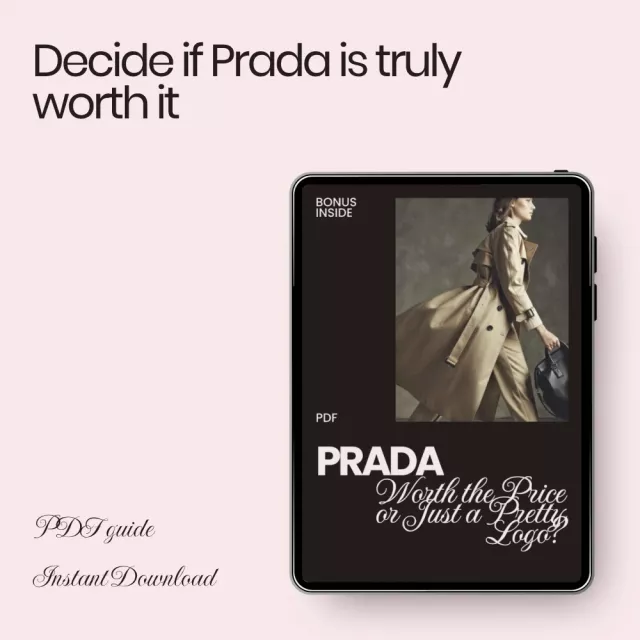
Before You Spend on Luxury, Know What You’re Really Paying For
You’ve admired the sleek lines. You’ve seen the iconic triangle logo. You’ve wondered, are prada items worth it — or is it all just branding? If you’re standing at the crossroads between investment and impulse, this guide was created for you.
Prada: Worth the Price or Just a Pretty Logo? is a practical, honest, and deeply researched digital guide designed to help you confidently decide whether Prada deserves a place in your wardrobe. No hype. No blind luxury worship. Just clear insights that empower smart buying decisions.
What’s Inside This Guide
- Chapter 1: Understanding Prada’s Legacy
- The History of Prada
- What Makes Prada Iconic
- Prada in Today’s Fashion Market
- Chapter 2: Evaluating the Value of Prada Items
- Craftsmanship and Materials: Are They Really Superior?
- The Price Tag Explained: Luxury vs. Marketing
- Case Study: Comparing Prada Bags with Other High-End Brands
- Chapter 3: Common Pitfalls and Smart Shopping Tips
- Mistakes People Make When Buying Prada
- How to Spot Genuine vs. Fake
- AI Tools to Help You Shop Smart
- Chapter 4: Making the Decision: Is Prada Worth It for You?
- Defining Your Personal Style and Budget
- Renting, Reselling, and Investment Pieces
- Next Steps: Building a Thoughtful Luxury Wardrobe
Who This Guide Is For
This digital download is perfect for:
- Luxury-curious shoppers wondering are prada items worth it
- First-time designer buyers who want clarity before committing
- Fashion lovers building a smart, intentional wardrobe
- Resellers and investors evaluating long-term value
- Anyone tired of marketing noise and looking for real answers
What Makes This Guide Different
Unlike generic fashion blogs or influencer reviews, this guide goes beyond opinions. It breaks down craftsmanship, pricing psychology, resale trends, and brand positioning in clear, simple language. You’ll get practical comparison insights, realistic case studies, and actionable tools you can actually use.
Instead of telling you what to think, this guide teaches you how to evaluate luxury purchases for yourself — so you never second-guess another designer investment again.
The Practical Benefits You’ll Gain
- Shop with confidence instead of emotion
- Avoid costly buying mistakes
- Learn how to authenticate and protect your investment
- Understand when luxury is worth the premium — and when it’s not
- Build a wardrobe that reflects your style and financial goals
Make Your Next Luxury Purchase a Smart One
Luxury should feel empowering, not confusing. If you’ve been asking yourself are prada items worth it, this guide will give you the clarity you need.
Download Prada: Worth the Price or Just a Pretty Logo? today and make your next designer purchase with confidence, knowledge, and intention.
SHIPPING
We are proud to offer international shipping services that currently operate in over 200 countries and islands world wide. Nothing means more to us than bringing our customers great value and service. We will continue to grow to meet the needs of all our customers, delivering a service beyond all expectation anywhere in the world.
Do you ship worldwide?
Yes. We provide free shipping to over 200 countries around the world. However, there are some locations we are unable to ship to. If you happen to be located in one of those countries we will contact you.
What about customs?
We are not responsible for any custom fees once the items have been shipped. By purchasing our products, you consent that one or more packages may be shipped to you and may get custom fees when they arrive to your country.
How long does shipping take?
Shipping time varies by location. These are our estimates:| Location | *Estimated Shipping Time |
|---|---|
| United States | 5-20 Business days |
| Canada, Europe | 5-20 Business days |
| Australia, New Zealand | 5-20 Business days |
| Central & South America | 5-25 Business days |
| Asia | 5-20 Business days |
| Africa | 5-25 Business days |
Do you provide tracking information?
Yes, you will receive an email once your order ships that contains your tracking information. If you haven’t received tracking info within 5 days, please contact us.
My tracking says “no information available at the moment”.
For some shipping companies, it takes 2-5 business days for the tracking information to update on the system. If your order was placed more than 5 business days ago and there is still no information on your tracking number, please contact us.
Will my items be sent in one package?
For logistical reasons, items in the same purchase will sometimes be sent in separate packages, even if you've specified combined shipping.
If you have any other questions, please contact us and we will do our best to help you out.
RETURNS
Order cancellation
All orders can be cancelled until they are shipped. If your order has been paid and you need to make a change or cancel an order, you must contact us within 12 hours. Once the packaging and shipping process has started, it can no longer be cancelled.
Refunds
Your satisfaction is our #1 priority. Therefore, you can request a refund or reshipment for ordered products if:
- If you did not receive the product within the guaranteed time (45 days not including 1-3 day processing) you can request a refund or a reshipment.
- If you received the wrong item you can request a refund or a reshipment.
- If you do not want the product you’ve received you may request a refund but you must return the item at your expense and the item must be unused.
We do not issue the refund if:
- Your order did not arrive due to factors within your control (i.e. providing the wrong shipping address)
- Your order did not arrive due to exceptional circumstances outside the control of cyclonica.com (i.e. not cleared by customs, delayed by a natural disaster).
- Other exceptional circumstances outside the control of cyclonica.com.
*You can submit refund requests within 15 days after the guaranteed period for delivery (45 days) has expired. You can do it by sending a message on Contact Us page
If you are approved for a refund, then your refund will be processed, and a credit will automatically be applied to your credit card or original method of payment, within 14 days.
Exchanges
If for any reason you would like to exchange your product, perhaps for a different size in clothing, you must contact us first and we will guide you through the steps.
Please do not send your purchase back to us unless we authorise you to do so.
Order cancellation
All orders can be cancelled until they are shipped. If your order has been paid and you need to make a change or cancel an order, you must contact us within 12 hours. Once the packaging and shipping process has started, it can no longer be cancelled.
Refunds
Your satisfaction is our #1 priority. Therefore, you can request a refund or reshipment for ordered products if:
- If you did not receive the product within the guaranteed time( 45 days not including 2-5 day processing) you can request a refund or a reshipment.
- If you received the wrong item you can request a refund or a reshipment.
- If you do not want the product you’ve received you may request a refund but you must return the item at your expense and the item must be unused.
We do not issue the refund if:
- Your order did not arrive due to factors within your control (i.e. providing the wrong shipping address)
- Your order did not arrive due to exceptional circumstances outside the control of cyclonica.com (i.e. not cleared by customs, delayed by a natural disaster).
- Other exceptional circumstances outside the control of
*You can submit refund requests within 15 days after the guaranteed period for delivery (45 days) has expired. You can do it by sending a message on Contact Us page
If you are approved for a refund, then your refund will be processed, and a credit will automatically be applied to your credit card or original method of payment, within 14 days.
Exchanges
If for any reason you would like to exchange your product, perhaps for a different size in clothing. You must contact us first and we will guide you through the steps.
Please do not send your purchase back to us unless we authorise you to do so.
Customer Reviews
Write a Review
We Think You’ll Love
Top picks just for you













The price-to-use ratio question stopped me from making a $2,300 impulse buy.
I'd been on the fence about the Galleria Tote for over a year, telling myself it was an investment without actually knowing if that was true. The Galleria vs. GG Marmont comparison — same price bracket, but Prada leather consistently smoother and more structured with slightly stronger resale — gave me the specific evidence I'd been missing. I bought it two weeks after finishing this guide and haven't second-guessed it 🖤
💼✨🖤⭐
The Prada Cahier Bag case study — bought in 2019, resold in 2025 for nearly double using AI price-tracking tools — is this guide's most persuasive argument. It reframes a luxury handbag as something closer to a financial instrument, and for that specific class of buyer, this guide delivers.
Asking 'does this reflect my style, or am I buying for status?' sounds simple — it's the question most people spend years avoiding.
Strong on the fundamentals — craftsmanship, materials, resale logic — with a case study that does real analytical work. The AI tools section would benefit from more honest caveats about what these platforms can reliably deliver versus what they promise. The broader framework for building a thoughtful luxury wardrobe is genuinely useful and different in tone from typical luxury content.
I bought a Prada Nylon Backpack online that looked legitimate in photos. The listing price was below market — not suspiciously low, just slightly under. The zipper felt wrong in person and the logo spacing was off in ways I could see once I knew to look. Both are flagged specifically in this guide — the AI verification case example describes almost exactly what happened to me, right down to the nylon backpack and the zipper. I found this after the fact, which made the authentication section genuinely painful to read. I've shared it with three friends who are active resale buyers and recommended they treat it as required reading before any online purchase.
Misaligned lettering on hardware is a red flag I'd never thought to check — now I check it every time.
🔍💎👜🔥
The renting option is undervalued in most luxury content and this guide treats it seriously. Not every buyer has the budget or lifestyle to justify full ownership, and being told to consider rental platforms for special occasions rather than defaulting to outright purchase is honest advice that most luxury guides don't have the incentive to give.
Four solid chapters, but the mix-high-and-low wardrobe advice in the last section feels tacked on relative to the analytical depth of what comes before it.
Luxury pricing isn't just materials — it's marketing, prestige, and scarcity — stated plainly for once.
I work in finance and had been approaching luxury purchases the way I approach any spending: price comparison, basic research, gut feeling. I hadn't treated them as investment decisions with traceable value histories. The framing shift here is significant: using AI resale-value estimators before buying, tracking price trends by specific model rather than brand, differentiating limited editions from seasonal pieces on likely appreciation. I ran that analysis on the Galleria Tote before my most recent purchase and the data supported what the guide describes — timeless design, well-maintained leather, consistent resale demand. The Cahier Bag case study is the most concrete illustration of what patient, data-informed luxury buying actually looks like in practice. I've since applied the same framework to two more purchases and both are performing on the resale market as expected.
Thorough and well-organized overall. My hesitation is with the AI authenticity verification section — the guidance to upload product photos and have AI flag inconsistencies against verified Prada databases is sound in principle, but the specific tools that do this reliably are not named, which limits the practical value. The case example about the nylon backpack is convincing; pointing readers toward actual tools would have made it actionable rather than aspirational.
Limited editions, classic silhouettes, well-maintained leather resell best — three variables I now run through on every purchase 📊
The question of whether a bag suits your daily life — size, compartments, weight — before considering the brand is advice I'd given friends dozens of times and never applied to myself. I bought a Prada piece last year that was objectively beautiful and practically useless for how I actually live. This guide's practicality checklist is the part I should have read first.
The idea that Prada began as a leather goods shop in 1913 Milan and built to this over a century is context that shifts how you evaluate the price. Heritage has compounding value — this guide connects that history to why the price is what it is, which most luxury content treats as self-evident and skips.
Good framing overall, though the final wardrobe strategy chapter covers a lot of ground quickly. The 12-month Prada wardrobe AI prompt is interesting but left me wanting the guide to model what a thoughtful answer to that prompt would actually look like rather than suggesting I go find out.
I'd never thought to distinguish Prada's sharp silhouettes and experimental fabrics from its logo — the design philosophy section reframed what I'd been evaluating.
Bought a Prada piece for the wrong reasons three times before I understood what that meant. Each time, the item ended up barely worn — not because the quality was poor but because it didn't reflect how I actually dress or what I actually reach for. The section on buying for status versus personal style is the most important part of this guide and possibly the hardest to act on honestly. Reading it after those three purchases felt like a fair and overdue corrective. I now run through those three questions — does this reflect my style, can I fit it into my real wardrobe, am I comfortable with the price-to-use ratio — before any significant luxury consideration. Two purchases since then, both of which I wear constantly.
Prada isn't just a logo — it's an experience. This guide earns that conclusion rather than just asserting it.
The Galleria Tote versus Gucci GG Marmont comparison with actual price points — $2,300 versus $2,100 — and a concrete resale edge for Prada due to timeless design is exactly the kind of specific comparative analysis that most luxury guides avoid because it forces a real conclusion. This one doesn't flinch from it 💡
Honest about where the premium price goes — materials, yes, but also runway shows, global advertising, and brand collaborations inflating beyond production costs. That transparency is rarer than it should be in luxury content.
The sustainability and AI-driven design predictions in the contemporary market section were interesting additions I didn't expect — shows Prada isn't coasting on century-old heritage alone. I'd have liked more depth there, but as a signal that the guide is tracking the brand's current positioning rather than just its history, it lands.