





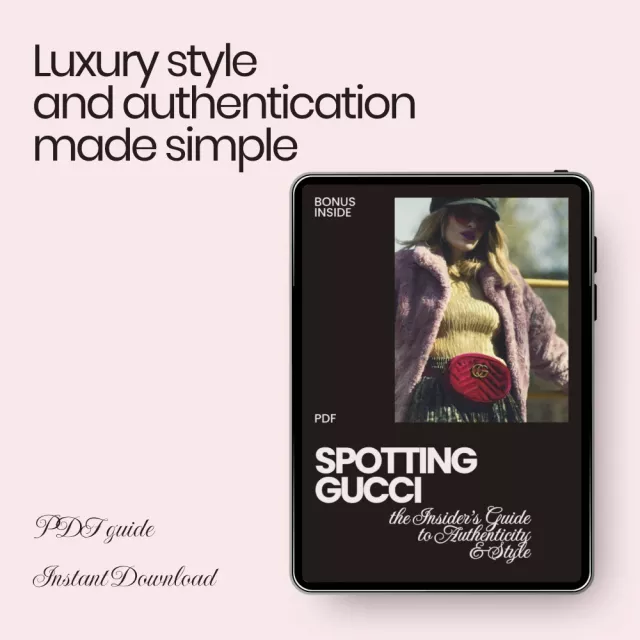
Master the Art of Identifying Authentic Gucci
If you love luxury fashion, knowing how to separate authentic pieces from counterfeits is essential. Spotting Gucci: The Insider’s Guide to Authenticity & Style is a practical and easy-to-follow ebook designed to help shoppers confidently perform a reliable gucci brand check. Whether you’re browsing online marketplaces, shopping vintage, or expanding a designer collection, this guide gives you the insider knowledge needed to verify Gucci items with confidence.
Written in clear, beginner-friendly language, this digital guide breaks down the key elements of Gucci authentication—from logos and materials to serial numbers and modern AI tools. Instead of relying on guesswork, you’ll learn proven techniques used by experienced collectors and resellers. The result is a smarter, safer approach to buying Gucci.
What’s Inside This Digital Guide
- Comprehensive introduction to Gucci history, iconic styles, and signature design elements
- Step-by-step guidance for performing a proper gucci brand check
- Detailed explanations of Gucci labels, tags, and serial numbers
- Common authentication mistakes and how to avoid them
- Real case studies comparing authentic and counterfeit bags, shoes, and accessories
- Practical insights into product materials and quality indicators
- AI-assisted authentication tools for analyzing logos, fonts, and patterns
- Tips for spotting fake listings on online marketplaces
- Advice on trustworthy sellers and negotiating for authentic pieces
- Guidance for collectors who want to protect and maintain their Gucci collection
Why This Guide Is Worth Downloading
- Helps you confidently perform a reliable gucci brand check before purchasing
- Saves money by helping you avoid counterfeit designer items
- Perfect for fashion lovers, resellers, collectors, and vintage shoppers
- Combines traditional authentication methods with modern AI tools
- Easy-to-read format designed for quick reference while shopping
- Useful for both beginners and experienced luxury buyers
Who This eBook Is For
This guide is ideal for luxury fashion enthusiasts, designer bag collectors, online marketplace shoppers, vintage store buyers, and resellers who want to perform a reliable gucci brand check. If you’ve ever wondered whether a Gucci item is genuine or simply want to shop smarter, this ebook gives you the knowledge to make confident decisions.
Download Your Guide and Shop Gucci With Confidence
Stop guessing and start identifying authentic designer pieces like a pro. Download Spotting Gucci: The Insider’s Guide to Authenticity & Style today and learn how to perform a smart, reliable gucci brand check every time you shop. Get instant access and start protecting your luxury purchases today.
SHIPPING
We are proud to offer international shipping services that currently operate in over 200 countries and islands world wide. Nothing means more to us than bringing our customers great value and service. We will continue to grow to meet the needs of all our customers, delivering a service beyond all expectation anywhere in the world.
Do you ship worldwide?
Yes. We provide free shipping to over 200 countries around the world. However, there are some locations we are unable to ship to. If you happen to be located in one of those countries we will contact you.
What about customs?
We are not responsible for any custom fees once the items have been shipped. By purchasing our products, you consent that one or more packages may be shipped to you and may get custom fees when they arrive to your country.
How long does shipping take?
Shipping time varies by location. These are our estimates:| Location | *Estimated Shipping Time |
|---|---|
| United States | 5-20 Business days |
| Canada, Europe | 5-20 Business days |
| Australia, New Zealand | 5-20 Business days |
| Central & South America | 5-25 Business days |
| Asia | 5-20 Business days |
| Africa | 5-25 Business days |
Do you provide tracking information?
Yes, you will receive an email once your order ships that contains your tracking information. If you haven’t received tracking info within 5 days, please contact us.
My tracking says “no information available at the moment”.
For some shipping companies, it takes 2-5 business days for the tracking information to update on the system. If your order was placed more than 5 business days ago and there is still no information on your tracking number, please contact us.
Will my items be sent in one package?
For logistical reasons, items in the same purchase will sometimes be sent in separate packages, even if you've specified combined shipping.
If you have any other questions, please contact us and we will do our best to help you out.
RETURNS
Order cancellation
All orders can be cancelled until they are shipped. If your order has been paid and you need to make a change or cancel an order, you must contact us within 12 hours. Once the packaging and shipping process has started, it can no longer be cancelled.
Refunds
Your satisfaction is our #1 priority. Therefore, you can request a refund or reshipment for ordered products if:
- If you did not receive the product within the guaranteed time (45 days not including 1-3 day processing) you can request a refund or a reshipment.
- If you received the wrong item you can request a refund or a reshipment.
- If you do not want the product you’ve received you may request a refund but you must return the item at your expense and the item must be unused.
We do not issue the refund if:
- Your order did not arrive due to factors within your control (i.e. providing the wrong shipping address)
- Your order did not arrive due to exceptional circumstances outside the control of cyclonica.com (i.e. not cleared by customs, delayed by a natural disaster).
- Other exceptional circumstances outside the control of cyclonica.com.
*You can submit refund requests within 15 days after the guaranteed period for delivery (45 days) has expired. You can do it by sending a message on Contact Us page
If you are approved for a refund, then your refund will be processed, and a credit will automatically be applied to your credit card or original method of payment, within 14 days.
Exchanges
If for any reason you would like to exchange your product, perhaps for a different size in clothing, you must contact us first and we will guide you through the steps.
Please do not send your purchase back to us unless we authorise you to do so.
Order cancellation
All orders can be cancelled until they are shipped. If your order has been paid and you need to make a change or cancel an order, you must contact us within 12 hours. Once the packaging and shipping process has started, it can no longer be cancelled.
Refunds
Your satisfaction is our #1 priority. Therefore, you can request a refund or reshipment for ordered products if:
- If you did not receive the product within the guaranteed time( 45 days not including 2-5 day processing) you can request a refund or a reshipment.
- If you received the wrong item you can request a refund or a reshipment.
- If you do not want the product you’ve received you may request a refund but you must return the item at your expense and the item must be unused.
We do not issue the refund if:
- Your order did not arrive due to factors within your control (i.e. providing the wrong shipping address)
- Your order did not arrive due to exceptional circumstances outside the control of cyclonica.com (i.e. not cleared by customs, delayed by a natural disaster).
- Other exceptional circumstances outside the control of
*You can submit refund requests within 15 days after the guaranteed period for delivery (45 days) has expired. You can do it by sending a message on Contact Us page
If you are approved for a refund, then your refund will be processed, and a credit will automatically be applied to your credit card or original method of payment, within 14 days.
Exchanges
If for any reason you would like to exchange your product, perhaps for a different size in clothing. You must contact us first and we will guide you through the steps.
Please do not send your purchase back to us unless we authorise you to do so.
Customer Reviews
Write a Review
We Think You’ll Love
Top picks just for you




















The Marmont comparison table in Chapter 4 is the single most useful authentication resource I've found. I'd been buying secondhand Gucci for two years and thought I had a decent eye, but I was checking the wrong things — logo placement and overall shape, mostly. This guide taught me to focus on hardware weight, stitching consistency at corners and flap edges, and the specific feel of the leather. The serial number decoding in Chapter 2 was also new to me — I didn't know the first row was the style code and the second was the batch code. That alone helped me verify a Dionysus I'd been hesitant about for weeks.
The hardware weight tip alone justified reading the whole guide 🔍
Chapter 2's serial number formatting caught a fake I was about to buy. The listing looked clean, but the number was only eight digits — the guide specifies ten to thirteen — and the font spacing was uneven. Would never have noticed either detail without this.
I resell on Vestiaire and The RealReal, and the reference kit concept from Chapter 3 changed my sourcing workflow. I built a photo folder on my phone — authentic leather grain, canvas weave, hardware engravings, serial number fonts — exactly as recommended. My rejection rate on suspicious items nearly tripled, which means I was unknowingly passing through questionable pieces before. The reverse image search tip from the AI chapter also caught a seller reusing photos across three different platform listings.
Strong manual inspection content but the AI chapter oversells what current tools can do. It describes instant scan-and-verify apps without naming any or testing accuracy. The hands-on techniques in Chapters 1 through 4 are excellent, which makes the vagueness of Chapter 5 stand out.
The Ace sneaker section saved me $400 on fakes I almost bought.
Most authentication guides give you a checklist. This one gives you a system — visual checks, serial number decoding, common mistakes, real case studies, then AI layered on top. That distinction matters when you're standing in a consignment shop making a real-time decision 💯
Wish it covered vintage Gucci authentication. The examples focus on current products — Marmont, Ace, GG belts — but 70s and 80s pieces have different serial formats, hardware finishes, and label styles. The general principles hold up, but vintage collectors will need supplementary resources.
I teach luxury brand management and incorporated the Chapter 4 case studies into my authentication module. The comparison tables break down authentic versus fake features in a way that's structured enough for classroom discussion but practical enough for real application. My students particularly responded to the hardware weight detail — a tangible sensory checkpoint they'd never considered. Assigned the full guide as prep reading before our counterfeiting seminar.
The online marketplace red flags in Chapter 3 should be required reading before anyone buys luxury from a third-party seller.
⭐🔍👜💯
The negotiation tips are surprisingly nuanced. The advice to avoid sellers offering bulk discounts on multiple Gucci items is obvious in retrospect but not something I'd articulated as a rule. Using a seller's willingness to share detailed photos as its own authenticity signal is clever and has helped me filter suspicious listings faster than any visual check.
Good content but repetitive — the AI tips across Chapters 2, 3, 4, 5, and 6 often restate the same point without adding specificity. Consolidating all AI advice into one thorough chapter would tighten things up. The actual authentication knowledge is solid though.
The belt buckle check — examining all edges, not just the front face — caught a counterfeit already in my collection 😤
Chapter 1's material quality section earns this guide its credibility. Four specific physical tests: leather texture and smell, canvas weave density, hardware weight and engraving, stitching evenness. Each one is a concrete sensory check you can perform in a store with an item in hand.
Thorough for leather goods but barely touches Gucci clothing authentication. Fabric care tags, button stamps, interior lining quality — all significant counterfeit vectors that get a single sentence. Given how much fake Gucci apparel circulates online, this feels like a real gap.
The collector community recommendations in Chapter 7 were the unexpected highlight. Within two weeks of joining the Reddit groups, someone flagged a Web Stripe color inconsistency on a bag I was considering that I would have missed entirely. The authentication techniques are strong alone, but the community layer adds human verification no AI can replicate yet.
Appreciate that Chapter 5 admits AI's limitations directly — most guides treat it like a magic solution.
The Dionysus AI scan case study — where the tool caught misaligned GG patterns invisible to the naked eye — reframed how I think about image analysis entirely. AI processes pixel-level symmetry differences that humans miss because we perceive overall shape. I now photograph items specifically for AI comparison rather than just my own assessment 📸
Doesn't address Gucci's transition from serial numbers to QR-based digital authentication on newer products. Someone following only the Chapter 2 guidance might flag a legitimate recent-era item as suspicious. A section on how authentication markers have evolved would make this more durable as a reference.
I bought a Marmont from consignment last year and was never fully confident about it. After reading this guide, I systematically checked every feature in the Chapter 4 table: logo symmetry, quilting alignment at seams, hardware weight, leather softness and smell. Every checkpoint passed. First time I felt genuinely certain rather than just hopeful. The guide turned vague anxiety into a structured process, and that shift is worth more than any single tip inside it 🤍
Strongest when most specific — the Marmont table, the Ace heel tab check, the belt buckle edge inspection. Weakest when it generalizes. If a second edition expanded case studies to wallets, scarves, sunglasses, and loafers with the same detail level, it would be the definitive Gucci authentication reference.
I run a small authentication side business and this aligns with about ninety percent of the methodology I've built through experience. I've started sending it to new clients as prep reading before their first consultation — saves us both time and means they arrive with the right vocabulary to discuss what they're seeing.