





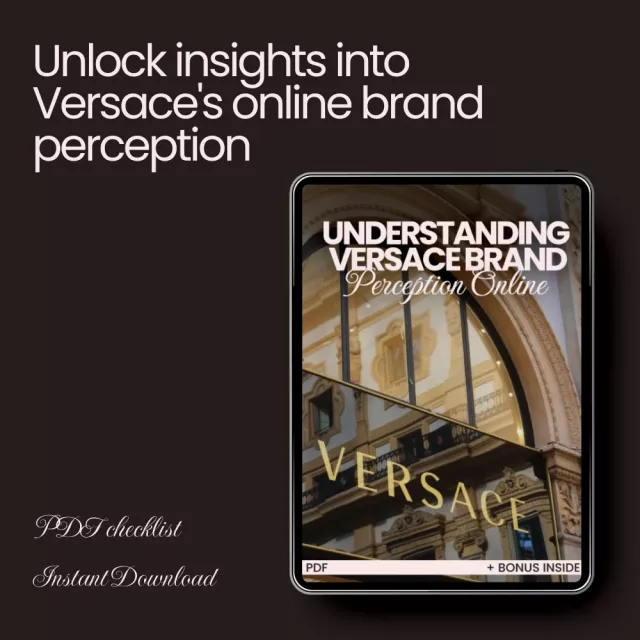
Unlock the Power of Brand Perception with Our Detailed Checklist on Versace
Get an insider’s look at how Versace is perceived online with our comprehensive digital checklist. Whether you’re a marketing professional, brand strategist, or fashion enthusiast, this guide will provide you with all the tools you need to analyze Versace’s presence across digital platforms. Understanding Versace Brand Perception Online is your step-by-step roadmap to exploring what people are really saying about this iconic luxury brand. Use it to assess Versace’s status, uncover emerging trends, and pinpoint opportunities to elevate or shift its brand image.
Key Features of the Checklist
- Audit the Digital Footprint – Search “Versace” across Google, social media, fashion blogs, and forums to assess tone and perception.
- Check Social Media Sentiment – Analyze user engagement on Instagram, TikTok, and Twitter/X, tracking which campaigns spark excitement or skepticism.
- Spot Influencer Collaborations – Examine partnerships with influencers and celebrities, assessing their alignment with Versace’s audience.
- Evaluate Visual Consistency – Compare the brand’s use of logos, color schemes, and imagery across platforms to ensure a strong luxury identity.
- Examine Customer Reviews – Dive into feedback on e-commerce sites and fashion marketplaces to identify what customers love or dislike about the brand.
- Monitor PR and Media Coverage – Review fashion magazines, press releases, and editorials to understand how media coverage shapes Versace’s reputation.
- Track Campaign Engagement – Investigate likes, shares, and comments to gauge how well recent ad campaigns are resonating.
- Compare Competitor Buzz – Analyze sentiment, volume, and engagement with Versace’s competitors to understand its market positioning.
- Identify Emerging Trends – Discover viral memes, TikTok challenges, and fashion communities discussing Versace’s presence.
- Summarize Insights – Conclude your research with a clear snapshot of Versace’s online perception, whether it’s edgy, aspirational, or outdated.
Who is This Guide For?
This digital checklist is perfect for anyone looking to better understand Versace’s online presence and its impact on the fashion industry. Whether you’re a digital marketer, a luxury brand consultant, or simply someone interested in the latest trends in high fashion, this guide is designed to give you the tools to make informed decisions about brand perception.
What Makes This Checklist Different?
Unlike other generic brand perception tools, Understanding Versace Brand Perception Online focuses specifically on one of the most iconic luxury fashion brands in the world. Its in-depth structure allows you to dive deeper into the cultural relevance and online sentiment of Versace in a way that’s actionable and tailored for fashion professionals. This checklist will not only help you track the current state of Versace’s image, but also highlight areas where the brand can strengthen or reinvent its presence.
Key Benefits of Downloading This Checklist
- Gain Insights – Understand how Versace is seen online, and use this data to craft targeted marketing strategies.
- Spot Trends Early – Identify emerging trends and online conversations that could shape the brand’s future.
- Improve Brand Strategy – Use actionable insights to align campaigns with what consumers really want from Versace.
- Competitive Advantage – Measure Versace’s online presence against competitors and discover ways to stand out in the luxury market.
Ready to Dive Into Brand Perception?
Don’t miss out on this powerful tool for analyzing Versace’s online footprint. Download your checklist now and start discovering what people really think about the brand today. Whether you’re managing Versace’s online reputation or working with luxury brands, this guide is a must-have resource for understanding brand perception in the digital age.
SHIPPING
We are proud to offer international shipping services that currently operate in over 200 countries and islands world wide. Nothing means more to us than bringing our customers great value and service. We will continue to grow to meet the needs of all our customers, delivering a service beyond all expectation anywhere in the world.
Do you ship worldwide?
Yes. We provide free shipping to over 200 countries around the world. However, there are some locations we are unable to ship to. If you happen to be located in one of those countries we will contact you.
What about customs?
We are not responsible for any custom fees once the items have been shipped. By purchasing our products, you consent that one or more packages may be shipped to you and may get custom fees when they arrive to your country.
How long does shipping take?
Shipping time varies by location. These are our estimates:| Location | *Estimated Shipping Time |
|---|---|
| United States | 5-20 Business days |
| Canada, Europe | 5-20 Business days |
| Australia, New Zealand | 5-20 Business days |
| Central & South America | 5-25 Business days |
| Asia | 5-20 Business days |
| Africa | 5-25 Business days |
Do you provide tracking information?
Yes, you will receive an email once your order ships that contains your tracking information. If you haven’t received tracking info within 5 days, please contact us.
My tracking says “no information available at the moment”.
For some shipping companies, it takes 2-5 business days for the tracking information to update on the system. If your order was placed more than 5 business days ago and there is still no information on your tracking number, please contact us.
Will my items be sent in one package?
For logistical reasons, items in the same purchase will sometimes be sent in separate packages, even if you've specified combined shipping.
If you have any other questions, please contact us and we will do our best to help you out.
RETURNS
Order cancellation
All orders can be cancelled until they are shipped. If your order has been paid and you need to make a change or cancel an order, you must contact us within 12 hours. Once the packaging and shipping process has started, it can no longer be cancelled.
Refunds
Your satisfaction is our #1 priority. Therefore, you can request a refund or reshipment for ordered products if:
- If you did not receive the product within the guaranteed time (45 days not including 1-3 day processing) you can request a refund or a reshipment.
- If you received the wrong item you can request a refund or a reshipment.
- If you do not want the product you’ve received you may request a refund but you must return the item at your expense and the item must be unused.
We do not issue the refund if:
- Your order did not arrive due to factors within your control (i.e. providing the wrong shipping address)
- Your order did not arrive due to exceptional circumstances outside the control of cyclonica.com (i.e. not cleared by customs, delayed by a natural disaster).
- Other exceptional circumstances outside the control of cyclonica.com.
*You can submit refund requests within 15 days after the guaranteed period for delivery (45 days) has expired. You can do it by sending a message on Contact Us page
If you are approved for a refund, then your refund will be processed, and a credit will automatically be applied to your credit card or original method of payment, within 14 days.
Exchanges
If for any reason you would like to exchange your product, perhaps for a different size in clothing, you must contact us first and we will guide you through the steps.
Please do not send your purchase back to us unless we authorise you to do so.
Order cancellation
All orders can be cancelled until they are shipped. If your order has been paid and you need to make a change or cancel an order, you must contact us within 12 hours. Once the packaging and shipping process has started, it can no longer be cancelled.
Refunds
Your satisfaction is our #1 priority. Therefore, you can request a refund or reshipment for ordered products if:
- If you did not receive the product within the guaranteed time( 45 days not including 2-5 day processing) you can request a refund or a reshipment.
- If you received the wrong item you can request a refund or a reshipment.
- If you do not want the product you’ve received you may request a refund but you must return the item at your expense and the item must be unused.
We do not issue the refund if:
- Your order did not arrive due to factors within your control (i.e. providing the wrong shipping address)
- Your order did not arrive due to exceptional circumstances outside the control of cyclonica.com (i.e. not cleared by customs, delayed by a natural disaster).
- Other exceptional circumstances outside the control of
*You can submit refund requests within 15 days after the guaranteed period for delivery (45 days) has expired. You can do it by sending a message on Contact Us page
If you are approved for a refund, then your refund will be processed, and a credit will automatically be applied to your credit card or original method of payment, within 14 days.
Exchanges
If for any reason you would like to exchange your product, perhaps for a different size in clothing. You must contact us first and we will guide you through the steps.
Please do not send your purchase back to us unless we authorise you to do so.
Customer Reviews
Write a Review
We Think You’ll Love
Top picks just for you















The competitor buzz comparison step was the one I'd been missing in my own audits. Started benchmarking Versace against Balenciaga and Gucci immediately after reading and the gaps in engagement were eye-opening.
Tight, actionable, zero fluff — exactly how a checklist should be.
The visual consistency step caught me off guard. I'd never thought to compare logo usage and color schemes across platforms for a single brand. Did it for Versace and then applied the same exercise to the brand I manage — found three platforms where our imagery was completely off-brand.
Printed this and pinned it above my desk. Use it weekly now 🔥
Good framework but feels like it was designed specifically for someone already familiar with brand auditing tools. If you've never done sentiment analysis before, the checklist tells you to do it but not how.
The TikTok trend identification step is so relevant right now.
I manage social media for a mid-tier fashion label and adapted every single step of this checklist to our brand within an afternoon. The sentiment tracking step alone revealed that our last campaign was getting way more skepticism than we realized — comments we'd been ignoring were actually shaping perception. Before this I was just counting likes. Now I read the room.
Simple enough to actually use, which is the whole point.
Three stars because the content is sound but extremely surface-level. Each step is one sentence of instruction for something that could easily be its own chapter. Telling me to 'analyze comments and hashtags' without any methodology doesn't move the needle.
The step about flagging PR stories that shape perception — innovation, scandal, cultural relevance — gave me a clear filter I didn't have before. I used to save every article. Now I sort by impact.
💎🔍✨👌
Solid checklist but would benefit from example outputs. What does a good brand perception snapshot actually look like when you're done? A sample summary at the end would've made this twice as useful.
The influencer alignment step is where most brands get lazy and this calls it out perfectly.
I teach a digital marketing course and the emerging trends step is the one my students struggle with most. Memes and TikTok challenges move faster than traditional brand monitoring, and most frameworks ignore them completely. This checklist doesn't. I walked my class through the full ten steps using Versace as the case study and it was the most engaged they've been all semester. The only reason I'm not giving five stars is that the checklist doesn't mention any specific tools — even just naming one or two social listening platforms would help beginners know where to start.
Used this to audit my own brand and found three blind spots in one sitting.
The summarize insights step at the end is deceptively important. Without it the rest is just data collection — turning it into a perception snapshot is where the actual value lives.
Useful but short. I finished the entire guide in under five minutes and wanted more depth on each step, especially the campaign engagement analysis. Feels like a teaser for a longer resource that doesn't exist.
The customer review step made me go read actual Versace reviews on Nordstrom and I found patterns I'd never noticed — consistent praise for hardware quality but complaints about sizing. That kind of insight is gold for anyone in fashion.
Quick read that punches above its weight.
The digital footprint audit step is where I always start now. Searching the brand across Google, social, blogs, and forums in one session gives you a surprisingly complete picture in under an hour 🎯
Four stars because the framework is excellent but it's clearly written with Versace in mind and some steps don't translate as cleanly to smaller brands. A more universal version of this would be incredible.
Straightforward and practical — no theory, just steps.
I've been doing brand perception work for five years and this is the first checklist that includes competitor benchmarking as a standard step rather than an afterthought. Most guides treat it as optional but it's the only way to know if your sentiment is good relative to the market or just good in a vacuum.
Wish this existed when I started my marketing career.
Three stars — the checklist is fine but each item is essentially a one-liner. If you already know how to do sentiment analysis and competitor mapping, this is a handy reminder. If you don't, it's a to-do list with no instructions.
The step about tracking which campaigns spark excitement versus skepticism completely changed how I review our post-campaign analytics. We used to only measure reach — now we categorize the actual emotional tone of responses.
⭐🔍👏🔥💡
Applied this checklist to three luxury brands in one afternoon and the differences in online perception were stark. Versace reads as bold and culturally connected. The other two felt stale by comparison. Wouldn't have seen the contrast without the side-by-side structure this guide encourages.
Good starting point but the PR monitoring step needs more nuance. Not all media coverage shapes perception equally — a Vogue feature and a Reddit thread have very different weight.
Perfect for someone building a brand audit habit from scratch.
I run a boutique consulting firm and handed this to two junior analysts as their onboarding exercise. They completed a full Versace perception audit in one day using nothing but this checklist and free tools. The quality of their output surprised me — the structure kept them focused and prevented the usual rabbit holes. I've since adapted it into our standard brand audit template for all new clients. Only knock is the lack of a scoring rubric to make results comparable across time periods.
The influencer step needs more — just listing collaborators isn't enough without evaluating engagement rates and audience overlap.
This gave my weekly brand monitoring actual structure instead of random scrolling.
I've seen similar checklists sold as $50 templates. This covers the same ground for free.
Four stars because the content is spot on but the format feels rushed. Some steps could use sub-steps or examples to make them less ambiguous. What exactly counts as 'visual consistency' for someone who's never audited a brand before?
The emerging trends step is what separates this from every other brand audit framework I've used. TikTok moves perception faster than any campaign and most checklists completely ignore it.
Clean, direct, and immediately usable. Rare combination.
Helpful but three stars because the guide doesn't mention frequency. Should I do this audit monthly? Quarterly? After every campaign? The checklist implies a one-time exercise but brand perception shifts constantly.
I adapted the sentiment tracking step to monitor my own personal brand on LinkedIn and the patterns were humbling 😅
The step about turning data into a perception snapshot — edgy, aspirational, outdated, or culturally relevant — is the kind of forcing function that makes the rest of the exercise worthwhile. Without that synthesis step you're just collecting data with no conclusion.
My team ran through every step for a client pitch and it made us look way more prepared than we were. The competitor comparison was the slide that closed the deal. Before this checklist we would've just shown social metrics without context.
Solid but wish it included a blank template or worksheet to fill in as you go. The steps are clear enough to follow but having a structured format to capture findings would make it easier to share results with a team.
🔥📊👜✨
The e-commerce review step revealed something I'd been ignoring: customers consistently praise Versace's design but complain about online shopping experience. That gap between product love and service friction is exactly the kind of insight this checklist is built to surface. I now do this step for every brand I consult for.
Ten steps, ten minutes, genuinely useful output at the end.
I appreciate that it includes both quantitative steps like tracking engagement metrics and qualitative ones like noting tone and sentiment. Most checklists lean too far one way. This balances both and that's what makes the final snapshot feel complete rather than one-dimensional.