





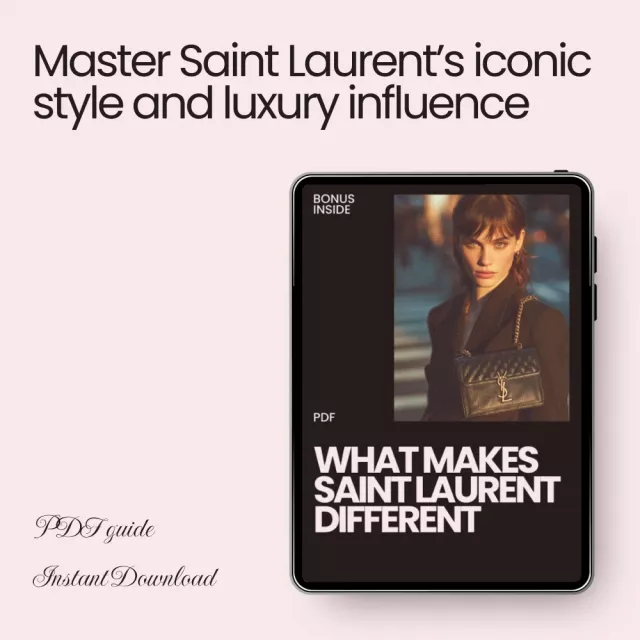
Product Description
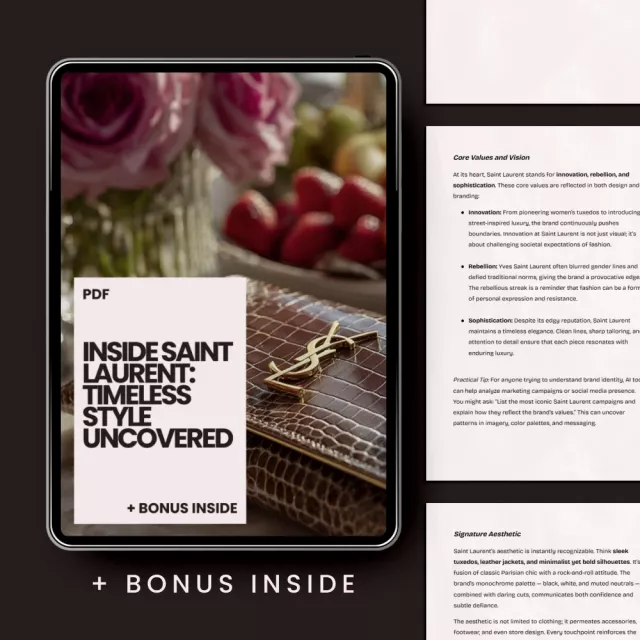
If you’ve ever wondered what sets Saint Laurent apart from other luxury fashion houses, this eBook is for you. Dive deep into the world of Yves Saint Laurent and discover how this iconic brand redefined fashion with an unparalleled blend of rebelliousness, power, and effortless elegance. Whether you’re a fashion lover, a style enthusiast, or simply curious about the inner workings of one of the most influential designers of all time, this guide uncovers the hidden elements that make Saint Laurent different.
In “What Makes Saint Laurent Different,” we take you on a journey through the origins, aesthetics, and creative revolutions that have shaped the brand over decades. From Yves Saint Laurent’s bold breakaway from tradition to Hedi Slimane’s groundbreaking influence, the guide offers insights that go beyond surface-level trends. You’ll also learn how Saint Laurent’s minimalist branding and cultural power continue to set it apart from others in the fashion world.
Key Features:
- Chapter 1: The Vision of Yves Saint Laurent and how he revolutionized fashion.
- Chapter 2: The Saint Laurent Aesthetic Code—explore the principles that define the brand’s look.
- Chapter 3: Creative reinventions through the decades, from Hedi Slimane to Anthony Vaccarello.
- Chapter 4: How Saint Laurent differs from other luxury houses, like Chanel and Italian brands.
- Chapter 5: Case study of the iconic Tuxedo and its cultural impact on women’s fashion.
- Chapter 6: Saint Laurent’s branding and marketing secrets, from minimal logos to celebrity influence.
- Chapter 7: How AI interprets the Saint Laurent look—can technology replicate Parisian cool?
- Chapter 8: Common misconceptions and tips for avoiding costly buying mistakes.
- Chapter 9: How to recognize authentic Saint Laurent style, from silhouette to styling.
- Chapter 10: Tips for incorporating Saint Laurent’s edge into your wardrobe.
Practical Benefits:
- Gain a deeper understanding of what makes Saint Laurent different from other luxury brands.
- Learn how to identify the key elements of the brand’s aesthetic that make it stand out.
- Discover the secrets to recognizing authentic pieces and avoiding common buying mistakes.
- Get actionable advice on how to incorporate Saint Laurent’s iconic style into your own wardrobe.
- Stay ahead of trends by learning how Saint Laurent has adapted and thrived over the decades.
Who is this for?
This eBook is perfect for fashion enthusiasts, style seekers, and anyone interested in the behind-the-scenes history of luxury fashion. Whether you’re new to the world of Saint Laurent or a long-time admirer, this guide will give you a new perspective on how the brand has shaped fashion history.
Why This eBook is Different
Unlike other generic fashion guides, “What Makes Saint Laurent Different” takes an in-depth, analytical approach, giving you a unique perspective on the brand’s journey. With its comprehensive chapters, including exclusive insights into the brand’s aesthetic, creative reinventions, and marketing strategies, this guide sets itself apart from similar digital resources. It’s a must-have for anyone who wants to understand the Saint Laurent difference and how it continues to captivate the fashion world.
Download Today!
Don’t miss out on the chance to uncover the secrets of Yves Saint Laurent’s legacy. Download your copy of “What Makes Saint Laurent Different” today and start exploring how this iconic brand continues to shape the fashion industry. Get ready to elevate your style knowledge and become a true Saint Laurent aficionado!
SHIPPING
We are proud to offer international shipping services that currently operate in over 200 countries and islands world wide. Nothing means more to us than bringing our customers great value and service. We will continue to grow to meet the needs of all our customers, delivering a service beyond all expectation anywhere in the world.
Do you ship worldwide?
Yes. We provide free shipping to over 200 countries around the world. However, there are some locations we are unable to ship to. If you happen to be located in one of those countries we will contact you.
What about customs?
We are not responsible for any custom fees once the items have been shipped. By purchasing our products, you consent that one or more packages may be shipped to you and may get custom fees when they arrive to your country.
How long does shipping take?
Shipping time varies by location. These are our estimates:| Location | *Estimated Shipping Time |
|---|---|
| United States | 5-20 Business days |
| Canada, Europe | 5-20 Business days |
| Australia, New Zealand | 5-20 Business days |
| Central & South America | 5-25 Business days |
| Asia | 5-20 Business days |
| Africa | 5-25 Business days |
Do you provide tracking information?
Yes, you will receive an email once your order ships that contains your tracking information. If you haven’t received tracking info within 5 days, please contact us.
My tracking says “no information available at the moment”.
For some shipping companies, it takes 2-5 business days for the tracking information to update on the system. If your order was placed more than 5 business days ago and there is still no information on your tracking number, please contact us.
Will my items be sent in one package?
For logistical reasons, items in the same purchase will sometimes be sent in separate packages, even if you've specified combined shipping.
If you have any other questions, please contact us and we will do our best to help you out.
RETURNS
Order cancellation
All orders can be cancelled until they are shipped. If your order has been paid and you need to make a change or cancel an order, you must contact us within 12 hours. Once the packaging and shipping process has started, it can no longer be cancelled.
Refunds
Your satisfaction is our #1 priority. Therefore, you can request a refund or reshipment for ordered products if:
- If you did not receive the product within the guaranteed time (45 days not including 1-3 day processing) you can request a refund or a reshipment.
- If you received the wrong item you can request a refund or a reshipment.
- If you do not want the product you’ve received you may request a refund but you must return the item at your expense and the item must be unused.
We do not issue the refund if:
- Your order did not arrive due to factors within your control (i.e. providing the wrong shipping address)
- Your order did not arrive due to exceptional circumstances outside the control of cyclonica.com (i.e. not cleared by customs, delayed by a natural disaster).
- Other exceptional circumstances outside the control of cyclonica.com.
*You can submit refund requests within 15 days after the guaranteed period for delivery (45 days) has expired. You can do it by sending a message on Contact Us page
If you are approved for a refund, then your refund will be processed, and a credit will automatically be applied to your credit card or original method of payment, within 14 days.
Exchanges
If for any reason you would like to exchange your product, perhaps for a different size in clothing, you must contact us first and we will guide you through the steps.
Please do not send your purchase back to us unless we authorise you to do so.
Order cancellation
All orders can be cancelled until they are shipped. If your order has been paid and you need to make a change or cancel an order, you must contact us within 12 hours. Once the packaging and shipping process has started, it can no longer be cancelled.
Refunds
Your satisfaction is our #1 priority. Therefore, you can request a refund or reshipment for ordered products if:
- If you did not receive the product within the guaranteed time( 45 days not including 2-5 day processing) you can request a refund or a reshipment.
- If you received the wrong item you can request a refund or a reshipment.
- If you do not want the product you’ve received you may request a refund but you must return the item at your expense and the item must be unused.
We do not issue the refund if:
- Your order did not arrive due to factors within your control (i.e. providing the wrong shipping address)
- Your order did not arrive due to exceptional circumstances outside the control of cyclonica.com (i.e. not cleared by customs, delayed by a natural disaster).
- Other exceptional circumstances outside the control of
*You can submit refund requests within 15 days after the guaranteed period for delivery (45 days) has expired. You can do it by sending a message on Contact Us page
If you are approved for a refund, then your refund will be processed, and a credit will automatically be applied to your credit card or original method of payment, within 14 days.
Exchanges
If for any reason you would like to exchange your product, perhaps for a different size in clothing. You must contact us first and we will guide you through the steps.
Please do not send your purchase back to us unless we authorise you to do so.
Customer Reviews
Write a Review
We Think You’ll Love
Top picks just for you












The Le Smoking case study alone justifies the entire read
I've been wearing SL for years but never understood why it felt different from other luxury houses until I read the chapter comparing it to Chanel and Italian brands. The distinction between quiet luxury and what the author calls "controlled intensity" finally gave me language for something I've always felt but couldn't articulate. The section on silhouette clues is practical and smart. Sent it to three friends who keep asking why I dress the way I do.
The Hedi Slimane chapter reads like a cultural history lesson wrapped in fashion writing 🖤
This reframed how I think about my entire wardrobe. The idea that Saint Laurent operates as visual psychology rather than decoration is the kind of insight I didn't know I needed.
🖤🔥⭐✨
Read it cover to cover in one sitting on a flight to Paris. The breakdown of why black dominates the brand DNA — rebellion without chaos, timelessness without nostalgia — completely changed how I approach getting dressed. I used to think wearing all black was lazy. Now I understand it as a deliberate design decision that forces attention onto cut and proportion instead of color. The practical check in Chapter 9, about standing in front of a mirror and reading your outline, has become my daily ritual before walking out the door.
Chapter 4 comparing luxury philosophies should be required reading for anyone spending serious money on fashion
The "Executive Effect" case study hit close to home. I switched from soft florals to sharp tailoring at work last year and noticed the exact same shift in how colleagues treated me. This PDF validated every instinct I had.
Surprisingly thoughtful for a fashion guide
Finally someone explains the difference between looking plain and looking Saint Laurent. The section on material and construction signals — fabric weight, seam placement, proportions — made me realize why my cheaper alternatives never quite worked. Two black blazers can look identical on a hanger and worlds apart on a body. This PDF taught me to feel the difference before I see it.
The rock-and-roll minimalism chapter is brilliant. Proportion over decoration as a design philosophy applies way beyond fashion.
Worth it for the Chanel comparison table alone
I bought this expecting surface-level brand worship and got a genuine cultural analysis spanning six decades of creative reinvention. The thread connecting Yves Saint Laurent's original vision of clothing as liberation through Slimane's indie-culture reboot to Vaccarello's sculptural sensuality is beautifully drawn. What surprised me most was Chapter 7 on AI style recognition — using emotional descriptors like controlled power and nighttime elegance in prompts actually produces better results than generic fashion terms. I've already tested it and the outputs are noticeably sharper.
The misconceptions chapter saved me from an expensive mistake 🙏
My friend who works in luxury retail said this is more insightful than most internal brand training materials she's seen. Coming from her that's serious praise.
Loved the framing of Saint Laurent as intellectual rebellion made wearable
Chapter 10 alone is a masterclass in building a personal style without needing a luxury budget. The hierarchy concept — one dominant piece setting the tone while everything else stays quiet — clicked immediately.
Clean, intelligent writing throughout
The "Logo Trap" case study in Chapter 8 describes my exact first luxury purchase and the regret that followed. Wish I had this years ago.
Concise and packed with real insight — no fluff
I've read probably a dozen fashion brand analyses and this one stands apart because it treats the reader as genuinely intelligent. The discussion of Le Smoking as a cultural intervention rather than just a design choice is exactly the level of depth I was looking for. The only thing I'd add is more on the fragrance and accessories side of the house, since the focus skews heavily toward ready-to-wear. But for what it covers, the quality of thinking is exceptional.
That line about a traditional suit saying "I belong to the establishment" while a Slimane suit says "I built my own" — that's going to stick with me
👏🖤🔥👌⭐
The AI chapter was an unexpected bonus. Actually useful prompts for style analysis that I've started using.
Chapter 1 on the origins of the house gave me chills. Head designer at Dior at 21 years old, then walking away to build something riskier and more culturally engaged — the audacity of that decision shaped everything the brand became. The author traces the through line from that original break to every creative director since, and it never feels forced. Even the discussion of Kering's role in enabling creative autonomy within a corporate structure was fascinating. Fashion writing rarely goes this deep into business dynamics.
Every chapter builds on the last — rare for this kind of guide
The Vaccarello section nails it. Sculptural sensuality with monumental runway settings — that's exactly the vibe of current SL.
Solid and well-researched throughout. The comparison with Italian luxury houses — structure vs drama — is particularly well done. I knocked off a star only because the AI chapter, while interesting, feels slightly disconnected from the rest of the narrative.
The idea that Saint Laurent clothing changes perception before the wearer even speaks is the most compelling argument for investing in tailoring I've ever encountered 🔥
Not just a fashion guide — it's a philosophy of self-presentation
I was skeptical going in because I assumed this would be another brand-worship piece with no substance. Instead I got a thoughtful exploration of how one house used androgyny, precision, and restraint to fundamentally redefine what power dressing means. The section on why replicas fail was eye-opening — they mimic the look but not the physics of the garment. That single sentence changed how I evaluate quality when I shop.
Chapter 5 on Le Smoking should be taught in design schools
The practical check about observing your outline rather than details in the mirror is deceptively simple but it works.
Sent this to my stylist and she said it articulates what she's been trying to tell me for two years
The writing is sharp and the structure makes it easy to revisit specific chapters. I keep going back to the aesthetic code section whenever I'm planning outfits for events.
Controlled nonchalance as a concept — yes, exactly that
My background is in architecture, not fashion, and I was struck by how much the design philosophy here mirrors architectural thinking. The emphasis on line over decoration, structure over spectacle, and the idea that restraint creates a paradox where simplicity becomes impossible to replicate — those are principles I apply to buildings every day. This PDF convinced me to rethink my wardrobe using the same spatial logic I use professionally. Three months later, every compliment I get is about how intentional I look.
Best breakdown of "Parisian cool" I've ever read — it's not effortless, it's controlled
Devoured this in one evening and immediately reorganized my closet
The dangerous luxury framing in 4.3 is the sharpest take I've seen on where SL sits in the market
Appreciate how the author doesn't just say Saint Laurent is better than other brands — the point is that they serve different psychological roles. That nuance elevates the entire piece.
Chapter 3 covering every creative era is written with such clarity that you can feel the shifts from bohemian to nocturnal to sculptural without ever seeing a runway image. That takes real skill.
The starter pieces section in Chapter 10 is where theory meets real life 👌
I've bought luxury items from five different houses and only now understand why my Saint Laurent pieces feel fundamentally different on my body. The explanation of how fabric weight and seam engineering support the silhouette without adding bulk was the missing piece for me. Replicas and fast fashion copies always felt off but I couldn't explain why. Now I can. This PDF pays for itself the first time it stops you from making a bad purchase.
Read it twice, learned something new both times
Clean, precise, no wasted words — fitting for the subject matter
The boardroom shift case study in the Le Smoking chapter resonated deeply. Clothing that alters social dynamics, not just aesthetics — that's the entire thesis in one sentence.
More substance than books twice its length
I came for the shopping advice and stayed for the cultural history. The section on how Yves Saint Laurent bridged couture and ready-to-wear by making high design accessible without losing prestige was fascinating — it explains why the brand still feels relevant when so many of its contemporaries don't.
The prompt examples in Chapter 7 actually work — tested them and got genuinely useful outfit suggestions
I underlined so many passages my PDF reader ran out of colors
Finally someone explains why fit matters more at Saint Laurent than almost anywhere else. The sizing section alone prevented a costly mistake 🙌
Intellectual, practical, and beautifully paced
As someone who works in branding, the chapter on minimal logos and maximum identity is a case study in how design language can replace traditional signage. Saint Laurent proves you don't need a giant monogram if your visual vocabulary is strong enough. I've started referencing this in client presentations.
The hierarchy concept in Chapter 10 — one dominant piece, everything else quiet — simplified my morning routine completely
Chapter 2 on the aesthetic code is the heart of this guide and it delivers
🖤✨👏🔥
I gifted this to my partner who was starting to explore luxury fashion and within a week she was pointing out silhouette differences between brands at the mall. The education is that effective.
The line about one wrong proportion turning cool into plain is burned into my brain now
Genuinely surprised by the depth of the competitive analysis chapter. Placing Saint Laurent alongside Chanel and Italian houses on a spectrum of philosophies instead of just ranking them was the right call and made everything click 🖤
I've been a Chanel loyalist for a decade. This didn't convert me, but it made me deeply respect what Saint Laurent does differently. The warm sophistication versus cool authority comparison is honest and fair to both houses. I actually bought a structured black blazer after reading Chapter 10 and now I rotate between both aesthetics depending on what I need to communicate that day. That versatility in thinking is worth more than any single purchase.
Tight writing, zero filler, every chapter earns its place
This is fashion writing for grown-ups
The fact that AI systems can identify Saint Laurent through structural features rather than logos says everything about the brand's design consistency. Chapter 7 is quietly the most forward-thinking section.
The "it's just black clothes" myth-busting section in Chapter 8 is the kind of straightforward education that saves beginners thousands. Cut precision, fabric weight, seam placement — those invisible details are where the money actually goes.
Reread Chapter 9 before my last shopping trip and caught construction details I would have missed completely
Ten chapters and not a single one felt like padding — that's rare
The thread from Dior prodigy to independent icon to rock-and-roll minimalism to modern seduction is told with a pace that respects your intelligence without losing accessibility. Every creative transition feels both inevitable and surprising.
Bought it on impulse, ended up taking notes like it was a university course